
TMJ Headache Relief in Houston: Understanding the Jaw-Head Pain Connection (2026)
Have you ever wondered why your “migraines” return every morning like clockwork, despite every medication you try? For many people, the true culprit isn’t a neurological glitch but a misaligned jaw joint causing a persistent tmj headache. It’s incredibly draining to wake up with temple pain or a stiff jaw, especially when you feel like you’ve exhausted every standard medical option. You aren’t alone in this frustration; it’s completely natural to feel a bit of anxiety about seeking help when past treatments haven’t delivered the results you deserve.
This article will help you discover how your jaw joint triggers chronic head pain and provide a clear path to lasting relief through professional TMD therapy. We’ll explore how to identify if your symptoms are jaw-related, look at gentle non-surgical treatment options, and show you how a supportive expert in Houston can help you reclaim your comfort. Our goal is to ensure you feel enlightened and empowered as you move toward a life free from constant tension.
Key Takeaways
- Understand how a tmj headache originates in the jaw joint and travels through the trigeminal nerve to create persistent temple pain.
- Identify if your chronic discomfort is jaw-related by checking for specific morning symptoms like stiffness or a “tight band” sensation around your head.
- Learn the clear differences between migraines and jaw-induced pain to ensure you’re pursuing the right path for your specific needs.
- Explore non-invasive, modern treatment options like custom-fitted oral appliances that help recalibrate your jaw muscles without surgery.
- Discover the benefits of a gentle, patient-centered evaluation in a calm environment to help you move from persistent pain to lasting clarity.
What Is a TMJ Headache and Why Does Your Jaw Trigger It?
A tmj headache is often a misunderstood experience. It isn’t just a random ache in your temples; it’s a direct signal from your body that your jaw isn’t moving quite as it should. This type of pain originates from Temporomandibular joint dysfunction, which is a collective term for issues affecting the complex connection between your jaw and your skull. When this joint is out of alignment, the surrounding muscles must work twice as hard to compensate, leading to a cycle of tension that eventually radiates upward into the head and neck.
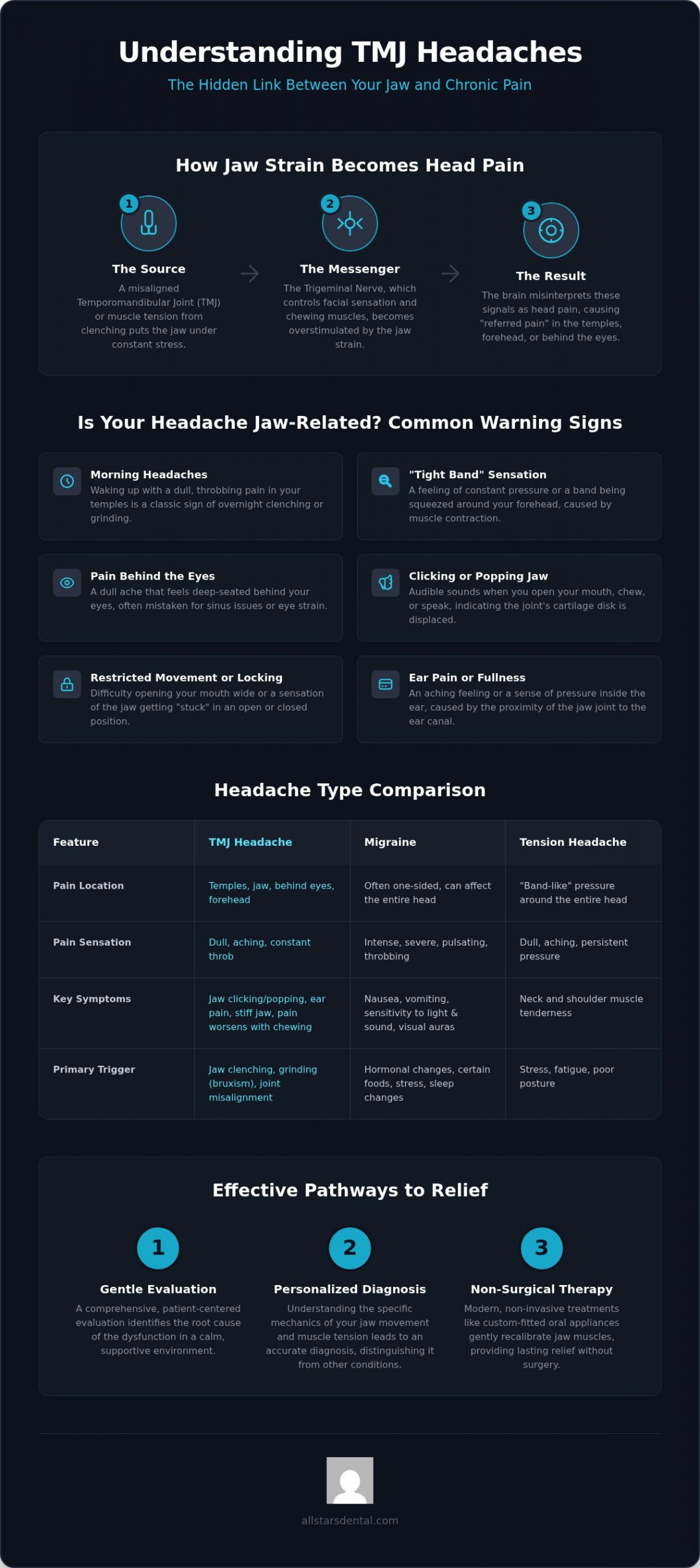
The primary messenger in this process is the trigeminal nerve. This is the largest and most complex nerve in your head, responsible for providing sensation to your face and controlling the muscles you use for chewing. When your jaw joints are stressed or misaligned, the trigeminal nerve becomes overstimulated. Because this nerve also services much of your scalp and facial area, your brain often misinterprets the source of the distress. You might feel a throbbing sensation in your forehead or a dull ache behind your eyes, even though the actual mechanical problem is resting just below your ears.
The Anatomy of the Temporomandibular Joint
Your jaw joint is one of the most hardworking parts of your body. It uses a sophisticated combination of hinge and sliding motions to help you speak, eat, and express emotions. The lower jaw bone, or mandible, fits into the temporal bone of your skull, cushioned by a small cartilage disk that acts as a vital shock absorber. This disk ensures that your movements are smooth and silent. However, if the disk slips or the muscles that control these movements become chronically tight from clenching, the joint loses its harmony. This tension often spreads to the large muscle groups in your temples, creating a sense of constant, exhausting pressure.
How Jaw Strain Becomes Head Pain
The transition from a jaw click to a full-blown tmj headache often involves what experts call “referred pain.” This happens when inflammation in the joint capsule triggers a chain reaction through the nervous system. When the joint is inflamed, it sends a constant stream of distress signals to the brain. Over time, this creates a state of hypersensitivity where even minor jaw movements can trigger a painful episode. It’s also helpful to remember that dental health is deeply interconnected. Sometimes, deep-seated discomfort from a failing root canal or a localized infection can mimic the symptoms of jaw pain, which is why a thorough, gentle evaluation is so essential for finding clarity and peace of mind.
Recognizing the Warning Signs: Is Your Headache Actually TMD?
If you find yourself waking up most mornings with a dull, throbbing pain in your temples, you might be experiencing a classic tmj headache. This “morning headache” phenomenon occurs because the jaw joint and its supporting muscles have been under immense strain throughout the night. Unlike a standard tension headache that might build up during a long workday, this pain is often present the moment you open your eyes. It frequently feels like a tight band is being squeezed around your forehead, a sensation that stems from the constant contraction of the muscles used for chewing. According to the National Institute of Dental and Craniofacial Research, TMD (Temporomandibular Disorders) can manifest in various ways, making it easy to mistake for a typical migraine if you aren’t looking for the right clues.
Beyond the pain itself, your jaw often provides audible warnings. You might notice a clicking or popping sound when you eat or even just when you speak. While these sounds are common, they indicate that the cartilage disk is not moving in perfect sync with the bone. In more severe cases, you might experience restricted movement or “locking,” where the jaw feels stuck in an open or closed position. This can be a frightening experience, but understanding these signs is the first step toward finding a gentle, effective solution. If you’ve noticed these changes, scheduling a comprehensive dental evaluation can help bring you the peace of mind you’ve been seeking.
Physical Symptoms Beyond the Headache
The reach of jaw dysfunction often extends beyond the joint itself. Many people report a persistent sense of “fullness” or an ache in their ears, leading them to suspect an infection when the ears are actually healthy. This happens because the jaw joint sits directly in front of the ear canal. Additionally, because the body tries to balance the weight of the head when the jaw is misaligned, you may feel chronic tension in your shoulders and neck. Facial swelling or tenderness near the joint is another sign that the area is struggling with inflammation and needs a gentle touch to heal.
The Role of Bruxism (Teeth Grinding)
Nighttime teeth grinding, or bruxism, is one of the most frequent drivers of jaw-related pain. Bruxism is a condition characterized by involuntary teeth grinding or clenching that acts as a primary driver of TMD headaches. This habit puts immense pressure on your teeth, often leading to worn-down enamel or flattened chewing surfaces that a skilled dentist can identify during a routine visit. Over time, this constant force exhausts the muscles and compresses the joint, making the resulting tmj headache feel like an inescapable part of your morning routine.
Comparing TMJ Headaches, Migraines, and Tension Headaches
Distinguishing between different types of head pain is often the most challenging part of a patient’s journey toward relief. While many people assume any severe, throbbing pain is a migraine, a true tmj headache has very specific characteristics that set it apart. Identifying these differences is essential because the treatment that works for a neurological migraine will rarely provide lasting comfort for a mechanical jaw issue. By understanding where your pain lives and what triggers it, you can move away from guesswork and toward a solution that actually addresses the source.
The primary way to differentiate these conditions is by looking at their location and triggers. We can break these down into a few clear categories:
- Location: A migraine is typically one-sided and characterized by a pulsing or throbbing sensation. In contrast, jaw-related pain is usually felt in the temples, behind the eyes, or directly in front of the ears. It often feels like a deep, dull ache rather than a sharp pulse.
- Triggers: Migraines are frequently set off by environmental factors like bright lights, strong smells, or specific foods. A tmj headache is almost always linked to physical jaw use. If your pain flares up after a long meal, a dental appointment, or a stressful day of clenching, the joint is likely the culprit.
- Medication Response: This is a major clue. If you’ve tried standard migraine medications or over-the-counter pain relievers with little to no success, it’s often because those drugs don’t address the underlying muscle fatigue and joint inflammation in the jaw.
Why Misdiagnosis Is Common
The frustration of visiting multiple specialists only to leave without answers is a common experience for those with TMD. Because the pain from the jaw often feels like a “tight band” around the head, it’s frequently misdiagnosed as a simple tension headache. A general physician may look at your symptoms through a neurological lens, while an ear specialist might find your ears are perfectly healthy. This is why a comprehensive dental exam is such a vital part of the diagnostic process. A dentist who understands the relationship between your bite and your muscles can see the physical evidence of strain that other providers might overlook.
The “Migraine Trigger” Theory
It’s also important to understand that these conditions don’t always exist in isolation. Modern research suggests a concept called central sensitization, where chronic pain in one area lowers the overall threshold for pain elsewhere. Constant distress signals from a misaligned jaw can “prime” your nervous system, making you much more susceptible to a secondary migraine attack. By treating the jaw and calming the trigeminal nerve, we can often reduce the frequency and intensity of these neurological episodes, leading to a much more relaxed and enlightened quality of life.
Effective Pathways to Relief: From Self-Care to TMD Therapy
Modern dentistry in 2026 has transitioned toward a philosophy of conservative, non-surgical management that prioritizes your comfort and long-term health. We’ve moved away from aggressive interventions in favor of therapies that help your body heal naturally. If you’re currently managing a tmj headache, you don’t have to wait for your appointment to find a small measure of comfort. There are several gentle steps you can take at home right now to soothe your jaw and lower your pain levels:
- Apply moist heat to the jaw area for 15 minutes twice a day to relax tight muscle fibers.
- Switch to a soft food diet for several days to give the joint a much-needed rest.
- Practice slow, controlled jaw opening and closing exercises to maintain mobility.
- Avoid habits that cause unnecessary strain, such as chewing gum or biting your nails.
- Focus on deep, diaphragmatic breathing to lower systemic stress and muscle tension.
For patients who feel anxious about dental procedures, we utilize advanced tools like air abrasion Houston to ensure your experience is as calm and drill-free as possible. This technology is part of our commitment to a gentle, person-centered approach that removes the traditional stresses of restorative care.
Custom Oral Appliance Therapy
While you might see “boil and bite” guards at a local pharmacy, these store-bought options can often worsen a tmj headache by being too bulky or ill-fitting. A professional splint is a precision-crafted tool designed specifically for your unique bite. It gently repositions your jaw into its most natural, relaxed state, allowing the muscles to recover while you sleep. This therapy doesn’t just provide relief; it also acts as a protective shield that prevents nighttime grinding from destroying your tooth enamel.
Lifestyle Adjustments and Posture
Small changes in your daily routine can yield significant improvements in how you feel. We often teach the “tongue-up, teeth-apart” technique, where you rest the tip of your tongue against the roof of your mouth to prevent clenching during the day. Ergonomic adjustments at your workstation can also prevent you from leaning forward, which reduces the weight your jaw has to support. Your neck posture and jaw health are deeply interconnected, as a forward-leaning head position can put significant extra strain on the temporomandibular joint.
Advanced Restorative Solutions
In cases where a “bad bite” or missing teeth are the primary cause of dysfunction, we may look toward permanent restorative options. Correcting your occlusion, or how your teeth fit together, can provide the stable foundation your jaw needs to function without pain. For some, this might involve dental crowns to restore vertical jaw height that was lost to years of grinding. If your needs are more complex, understanding a full mouth reconstruction cost Houston can help you plan for a comprehensive solution that restores both your smile and your peace of mind. If you’re ready to move past the cycle of pain, we invite you to schedule your specialized TMD consultation today.
Personalized TMD Treatment at All Stars Dental in Houston
At All Stars Dental, we believe that real healing begins with understanding. Dr. Tran has spent over 15 years cultivating a “Gentle Expert” philosophy that prioritizes the person behind the pain. When you’re struggling with a chronic tmj headache, you don’t just need a clinical procedure; you need a partner who listens to your story and respects the toll this discomfort has taken on your daily life. Our clinic on Waugh Drive is specifically designed to be a sanctuary from the typical clinical atmosphere, offering a warm and welcoming environment where your emotional well-being is valued just as much as your physical recovery.
We see ourselves as patient educators first. Our goal is to transform what might be a stressful experience into one of calm and security. By taking a holistic view of your needs, we ensure that you aren’t just another number in a system. Instead, you’re a student of your own health, guided by a mentor who is highly skilled but remains humble and focused on your growth. This unhurried pace prevents you from feeling pressured, allowing trust to build incrementally from the moment you first walk through our doors.
A Person-Centered Diagnostic Experience
We start every journey by listening. Many of our Houston patients have spent years visiting different specialists only to feel like their concerns weren’t fully heard. During your comprehensive evaluation, we take the time to explore your history of pain and how it impacts your daily routine. Our diagnostic process goes beyond a simple visual check; we utilize advanced imaging and precise bite analysis to visualize exactly how your jaw joint is behaving in real-time. This thoroughness allows us to educate you on the specific triggers of your tmj headache, ensuring you feel enlightened before any therapy begins. For a deeper look at what to expect during this process, we invite you to explore our TMJ specialist Houston guide, which offers additional insights into our specialized approach.
Starting Your Journey to a Pain-Free Life
Your first steps toward a pain-free life are designed to be steady and deliberate. We focus on conservative TMD treatment that works in harmony with your body’s natural mechanics rather than against them. Whether we’re designing a custom oral appliance to relax your muscles or adjusting your bite to provide permanent relief, every step is explained with total transparency. We want you to feel empowered by the knowledge that a clear path to comfort exists. If you’ve been searching for a supportive expert who leads with kindness, we’re here to help you move from a state of concern to one of resolution and clarity. You can Schedule your TMD consultation in Houston today to begin this unhurried journey toward lasting peace of mind.
Reclaim Your Comfort and Clarity
Understanding the connection between your jaw and your head is the first step toward a life defined by comfort rather than tension. We’ve explored how a misaligned joint can trigger a persistent tmj headache and why typical migraine treatments often fail to address the root mechanical cause. By focusing on gentle, non-invasive therapies like custom-fitted oral appliances, you can finally move away from the cycle of morning pain and toward a state of lasting resolution. Dr. Tran brings over 15 years of patient-trusted experience to every evaluation, ensuring you feel enlightened and supported throughout the entire process.
Our stress-free environment on Waugh Drive is designed specifically to calm your anxieties and provide the personalized care you deserve. You don’t have to navigate this journey alone; we’re here to act as your steady, calming partners in health. If you’re ready to experience the difference that a gentle, expert approach can make, we invite you to Schedule Your Gentle TMJ Consultation at All Stars Dental. A brighter, more relaxed future is well within your reach, and we look forward to welcoming you into our care soon.
Frequently Asked Questions
How do I know if my headache is from TMJ?
You can often identify a tmj headache by its relationship to your jaw movement and timing. If you wake up with temple pain, notice clicking sounds when you eat, or feel your jaw muscles tire easily, these are strong indicators. Unlike standard headaches, this pain often worsens after long periods of talking or chewing. A gentle evaluation of your bite can confirm if the joint is the primary source of your distress.
Can a dentist really fix my chronic headaches?
Yes, a dentist can help because many chronic headaches are actually mechanical issues caused by a misaligned bite. When your teeth don’t fit together correctly, your jaw muscles must work overtime to compensate, leading to constant tension. By using specialized TMD therapy to stabilize your jaw position, a dentist addresses the physical trigger of the pain. This approach focuses on long-term resolution rather than just masking symptoms with medication.
Will insurance cover TMD treatment in Houston?
Insurance coverage for jaw-related care can be complex, but Texas law requires many group health plans to provide comparable coverage for the temporomandibular joint. This often applies when the treatment is medically necessary due to trauma or pathology. Because these treatments sometimes fall between medical and dental insurance, we recommend a thorough review of your specific plan. Our team is here to help you feel informed and supported as you navigate these benefits.
Is TMJ surgery the only way to stop the pain?
Surgery is actually considered a last resort, as the vast majority of patients find relief through conservative, non-surgical methods. Modern protocols in 2026 prioritize reversible treatments like custom oral appliances and physical therapy. These gentle paths aim to rest the joint and allow the surrounding tissues to heal naturally. We focus on these minimally invasive options to ensure your journey toward a pain-free life is as stress-free as possible.
How long does it take for a night guard to stop headaches?
Many patients begin to notice a decrease in their tmj headache frequency within the first two to four weeks of consistent use. While some feel a sense of relief almost immediately as their muscles stop clenching, others may need a few months for joint inflammation to fully subside. Every individual’s healing process is unique, and we’ll move at a pace that allows your body to recalibrate comfortably and effectively.
Can stress cause TMJ headaches even if I don’t grind my teeth?
Stress can trigger these headaches because it often leads to subconscious muscle “bracing” throughout the day. Even if you don’t grind your teeth at night, you might be holding your jaw in a tight, fixed position while you work or drive. This persistent contraction exhausts the muscles and overstimulates the nerves in your face. Learning to recognize these tension patterns is a vital part of the education we provide to help you find relief.
What happens if I leave my TMJ disorder untreated?
Leaving the condition untreated can lead to more significant issues like permanent joint wear or the displacement of the protective cartilage disk. Over time, you might experience more frequent jaw locking or a noticeable change in how your teeth fit together. The chronic tension can also make your nervous system more sensitive to pain in general. Early, gentle intervention is the best way to protect your long-term health and prevent these complications.
Are TMJ headaches the same as tension headaches?
While they feel very similar, they have different underlying causes. A tension headache is a general response to stress, but a jaw-related headache is a specific mechanical symptom of joint dysfunction. Because both types of pain often settle in the temples, they are frequently misdiagnosed. A professional dental exam is the most reliable way to determine if your pain is coming from your bite or if it requires a different therapeutic approach.