
Teeth Whitening Trays: Types, Safety, and Real Results
You're standing in the oral care aisle, holding a cheap whitening kit in one hand and a dentist's quote in the other, and both boxes seem to promise the same thing. A brighter smile. That's where the confusion starts, because teeth whitening trays can look interchangeable until you notice the differences in fit, gel strength, wear time, and whether anyone is checking your teeth before you use them.
The right tray changes more than convenience. It affects how evenly the gel touches your teeth, how much it leaks onto your gums, and whether the result fits the rest of your mouth, especially if you already have crowns, veneers, or fillings. For people trying to get ready for a wedding, a new job, or just a photo they don't want to cringe at, the smartest question isn't “Which box looks simplest?” It's “Which tray makes sense for my smile as a whole?”
teeth whitening benefits and what patients usually expect helps set that expectation, but the bigger picture matters even more. Whitening is rarely just about making one tooth lighter. It's about timing, material, and whether the shade plan works with everything else already in your mouth.
Table of Contents
- Why the Tray You Pick Changes Your Whitening Results
- How Whitening Gels Lift Stain From Enamel
- Custom Trays vs OTC Trays vs Prefilled Disposables
- What a Typical Take-Home Treatment Actually Looks Like
- The Restoration Problem Most Whitening Guides Skip
- Safety Risks and Dentist Supervision
- When In-Office Whitening Is the Smarter Choice
- Choosing the Right Whitening Tray for Your Smile
Why the Tray You Pick Changes Your Whitening Results
A patient in Houston can walk down a store aisle and see one whitening tray kit for a low price, then hear a dentist recommend a custom take-home tray and wonder why the process needs to be complicated. The answer is that trays may look similar from the outside, but they don't behave the same way once they're in the mouth. Fit, seal, gel delivery, and supervision all change the final result.
The tray is part of the treatment, not just the container
A tray that hugs the teeth closely keeps gel where it belongs and helps reduce soft-tissue contact. That matters because a sloppy fit can let gel pool against the gums or miss parts of the tooth surface, which is how people end up with patchy whitening or avoidable irritation. A literature review on bleaching tray design emphasized strong peripheral seal, straight trimming just beyond the gingival margin, and comfort that supports compliance as the key design features, rather than overly complex contouring bleaching tray design and efficacy review.
That difference is easy to miss if you're comparing boxes in a hurry. A disposable tray can be convenient, but a custom tray is designed around the shape of your teeth, which changes how the gel sits, how long you can wear it, and how much irritation you're likely to feel.
Practical rule: if the tray doesn't fit well, the gel can't do its job well.
What you should ask before buying
Before you choose anything, ask a few plain-language questions.
- Does the tray seal tightly around my teeth? A better seal usually means more even contact and less mess.
- Is the gel strength matched to the wear time? Stronger gels often need shorter wear periods.
- Will my dentist check for fillings, crowns, or gum issues first? That changes whether whitening is even the right first step.
- Am I trying to brighten the whole smile or just make natural teeth lighter? That distinction matters more than most ads admit.
That's why the tray choice isn't just a product decision. It's a planning decision, especially if you're trying to fit whitening around other dental work or a deadline.
How Whitening Gels Lift Stain From Enamel
The easiest way to understand whitening is to start with what the gel is doing, not with the tray itself. Peroxide in teeth whitening trays does not scrub enamel the way toothpaste does. It diffuses into the tooth surface and breaks apart the molecules that make stains look darker. As those stain molecules become smaller and less pigmented, the tooth reflects light more evenly and appears lighter.
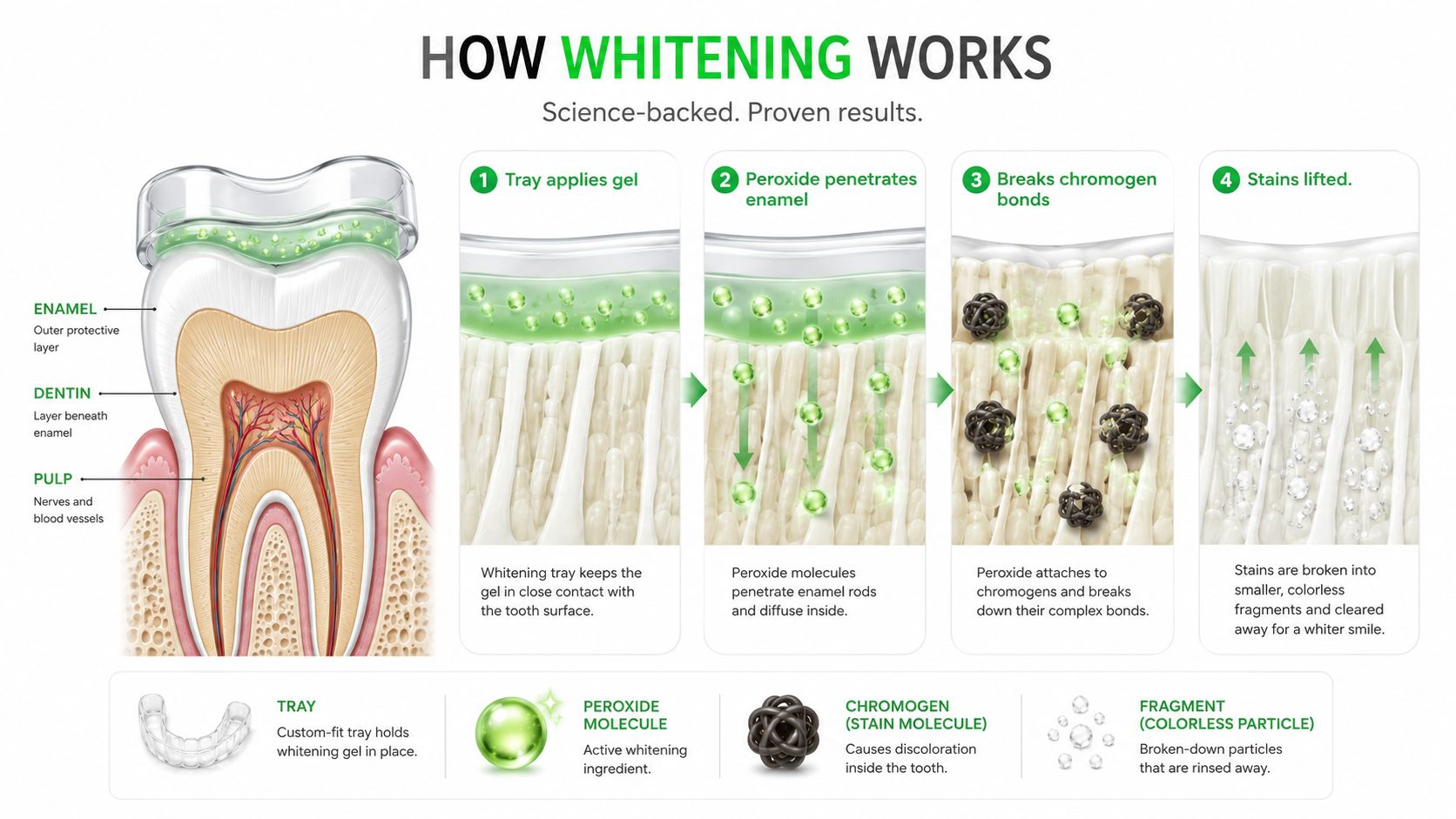
The tray matters because it acts like a mold that keeps the gel where it needs to stay. If the gel spreads onto the gums, it can irritate soft tissue. If it sits too thinly or shifts around, the whitening effect becomes uneven. The goal is controlled contact with enamel, not a flood of peroxide.
Why concentration matters, but isn't the whole story
Peroxide strength affects how fast whitening begins, but concentration alone does not decide the result. The gel also needs enough time against the tooth surface to do its work, and the tray has to hold it there without washing it away with saliva or pushing it onto the gums.
That is why fit and wear protocol matter just as much as the formula itself. A tray that hugs the teeth closely keeps the gel in a stable layer, while a loose tray lets the material move around and lose efficiency. The chemistry only works on the areas it touches.
Clinical research supports that time-on-tooth approach. A study of take-home tray whitening reported measurable improvement after 3 days, with color continuing to improve over a 14-day treatment period clinical whitening research. Another clinical trial found that both tray-based bleaching and whitening strips produced significant shade improvement after 2 weeks, and the tray group remained significantly lighter than baseline at an 18-month recall, even though some relapse occurred compared with the immediate post-treatment result.
The three levers that matter most
- Fit: keeps the gel on the teeth instead of the gums.
- Gel volume: too much can leak, too little can miss areas.
- Wear time: gives peroxide enough contact to lift stain.
Whitening works best when the gel stays in a thin, even layer. A tray is not just a container. It controls where the peroxide goes, how long it stays there, and how uniformly it reaches the enamel.
That control becomes even more important in a smile that already includes crowns, veneers, or fillings. Natural teeth can lighten, but restorations do not respond the same way, so the tray plan has to be chosen with the whole smile in mind, not only the teeth that can whiten.
Custom Trays vs OTC Trays vs Prefilled Disposables
如果你在比較美白選項,其實是在比較你想對整個過程掌握多少。客製牙托讓牙醫有最多控制,OTC 牙托讓消費者有最多自主性,預填式拋棄牙托則介於兩者之間。它們都朝同一個目標前進,但路徑不同,結果的穩定度也會跟著改變。
Tray Format Comparison
| Format | Fit and Seal | Gel Strength | Supervision | Typical Cost | Best For |
|---|---|---|---|---|---|
| Custom dentist-made trays | Custom-fitted to the teeth, better seal | Commonly uses 10% to 20% carbamide peroxide in dentist-directed home protocols market data | High | Varies by office and treatment plan | Patients who want fit, comfort, and planning around other dental work |
| OTC boil-and-bite trays | More variable, depends on molding at home | Usually lower and less precisely matched | Low | Lower upfront cost | People who want convenience and are comfortable with a less exact fit |
| Prefilled disposable trays | Fixed shape, convenience-focused | Manufacturer-specific | Limited | Product-specific | Short-term use and minimal setup |
Why fit often decides the winner
研究牙托設計時,反覆被提到的是同一件事,密合度會影響表現。一個沿著牙齒輪廓貼合得更好的牙托,比較能減少凝膠外漏,也通常比較舒服。這也是為什麼牙醫製作的牙托,仍常用在居家美白療程中,雖然市售產品更容易取得。
市場資料也顯示,這一類產品已經成為牙科美學的一部分,對牙托市場的估計不一,來源數字也不相同,但都指向持續的需求 market data。有些分析把全球牙托市場估計為約 USD 203.43 million in 2025,並預測到 2033 前有 3.2% CAGR。另一些分析則把規模放在 USD 1,280.45 million in 2024,並預測到 2032 可達 USD 3,450.78 million,年增率為 11.2% CAGR。這些數字不能直接互換,因為它們很可能來自不同的市場定義,但方向一致,都說明需求仍在。
What each option really buys you
零售牙托提供的是速度和較低的入門門檻。客製牙托提供的是更可預測的覆蓋範圍,也比較有機會避免牙齦刺激。預填式拋棄牙托提供的是簡單,但幾乎沒有微調空間。
如果你的笑容未來還要搭配其他美學治療,客製路線通常更合理。因為要先把整體計畫想清楚,不只是看哪些牙齒能變白,還要一起看假牙、貼片和補牙之間的色調是否會協調。自然牙可以變淺,修復體卻不會用同樣方式改變,所以牙托方案要和整個笑容一起規劃,而不是只看單顆牙齒。
What a Typical Take-Home Treatment Actually Looks Like
People often picture whitening trays as a single appointment, then they find out the process looks more like a short home routine with a dental-made tool. The dentist takes impressions or scans, makes the tray, and sends you home with clear instructions on how long to wear it and how much gel to use. The day-to-day part is simple, but precision still matters.
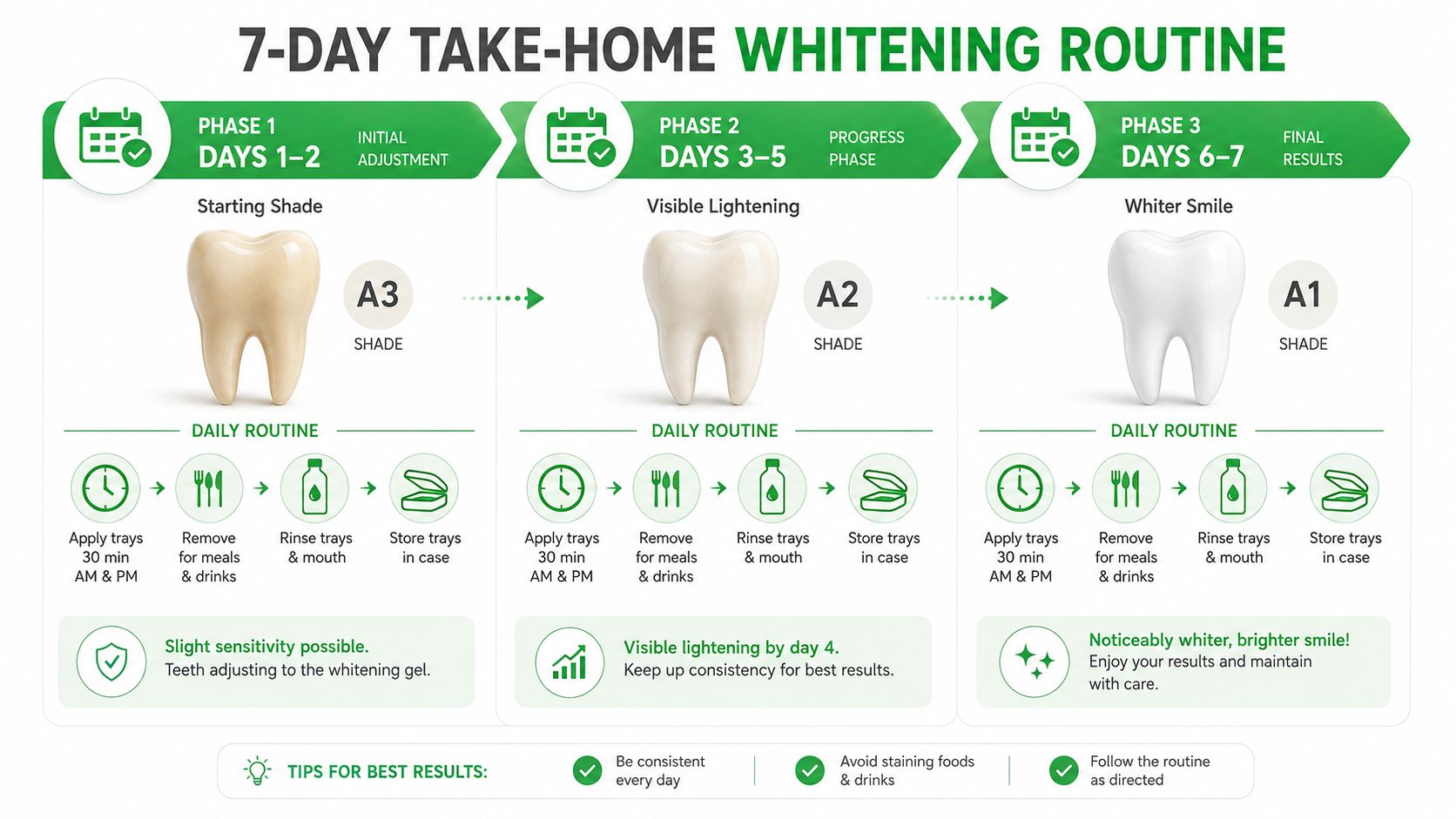
The wear schedule depends on the gel
One manufacturer specifies 10% hydrogen peroxide for 30 to 60 minutes daily for 5 to 10 days, and 15% hydrogen peroxide for 15 to 20 minutes daily for 5 to 10 days wear-time guidance. Stronger gel usually means shorter wear time, because the peroxide is doing the same job in less time.
That tradeoff is easier to understand with an everyday example. A person who prefers a longer evening routine may do better with the lower-strength option, while someone with a busy schedule may prefer fewer minutes each day even if the gel is stronger. The key is matching the protocol to the product, not guessing at the schedule.
Practical rule: follow the wear time exactly, and do not “make up” for missed sessions by leaving the tray in longer.
What the first week usually feels like
The first couple of days are mostly about getting used to the rhythm. You place a small amount of gel in the tray, seat it, wipe away any excess, then go on with the rest of your evening. Mild sensitivity can show up as the teeth start responding, and it often surprises people because the teeth may look fine while still feeling a little zingy with cold air.
That reaction does not mean the treatment has failed. It usually means the enamel is reacting to the peroxide and the schedule may need a small adjustment. If the sensitivity becomes sharp, lasts a long time, or seems tied to one specific tooth, that is the point to call the dental office instead of trying to push through it.
custom-fit whitening trays at home and how people use them safely gives readers a practical starting point, but consistency is what carries the treatment. Wear the trays as directed, rinse them after use, and store them somewhere clean and dry.
The Restoration Problem Most Whitening Guides Skip
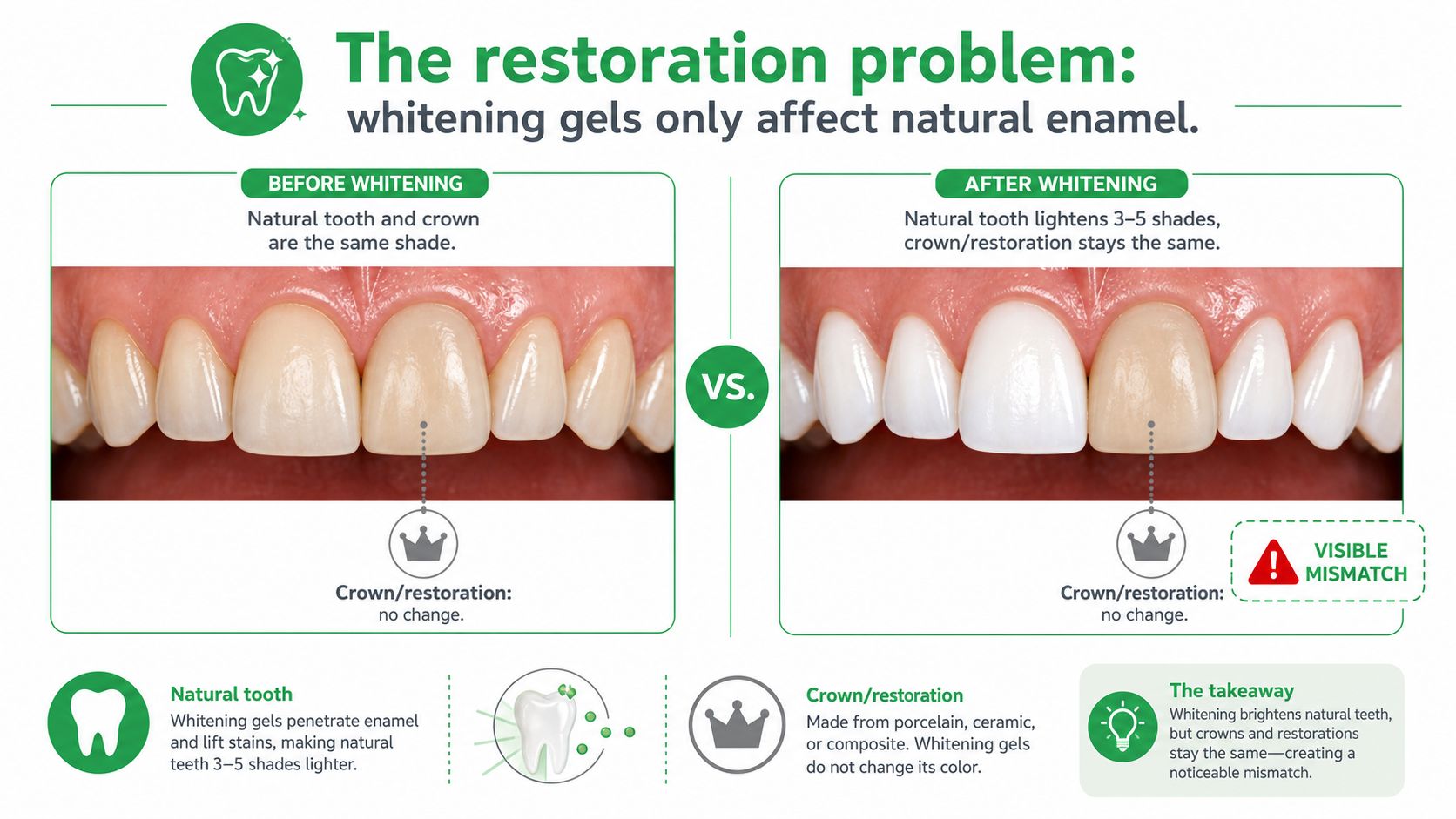
Whitening gets oversimplified online because a lot of guides assume every tooth in the smile is natural enamel. That's not how most adult mouths look. Plenty of patients have crowns, veneers, composite fillings, or other visible restorations, and those materials do not whiten the same way natural teeth do.
Why mismatch happens
The ADA states that whitening works on natural teeth, not tooth-colored restorations ADA whitening guidance. So if a front tooth has a crown and the neighboring teeth lighten, the crown stays where it was. The same issue can happen with fillings in the smile zone, especially if they're visible when you talk or smile.
That's why some people finish a whitening course and feel disappointed even though the gel worked. The natural teeth are lighter, but the visible restorations now stand out more. The smile can look less uniform than before.
Why trays should be part of a plan
A better sequence is usually to whiten the natural teeth first, let the shade settle, then match or replace visible restorations afterward. That way, the dental work can be chosen to fit the lighter tooth shade rather than locking in the old one. For patients who already know they may need cosmetic bonding, a new veneer, or a crown replacement, this planning step matters more than the whitening product itself.
This is also where a dentist's judgment matters. A good plan can save you from whitening twice, or from ending up with a noticeably mismatched front tooth after the rest of the smile changes.
If restorations are in the smile zone, whitening is often a coordination step, not the final cosmetic step.
For anyone with mixed dental work, that timing is the difference between “brighter” and “brighter, but uneven.”
Safety Risks and Dentist Supervision
Most whitening side effects are temporary, but that does not make them trivial. The common complaints are tooth sensitivity, mild gum irritation from gel contact, and results that look uneven because the tray fit was not good. Those problems usually get worse when people use a product without guidance or stretch the wear time beyond what was recommended.
What supervision adds before the first session
A dentist can check for decay, gum inflammation, cracked restorations, or other issues that might make whitening uncomfortable or unwise right now. That exam matters because peroxide can aggravate an area that already has inflammation or exposed dentin. Supervision also gives you a tray that is made to fit your mouth instead of forcing the gel to work around a generic shape.
Supervision improves comfort and gives the dentist direct control over the process. A dentist can adjust wear time, gel choice, and the amount of material in the tray if you are sensitive.
Why overuse backfires
People often assume that leaving the tray in longer will speed things up. In reality, that can increase irritation without guaranteeing a better result. It can also make the teeth feel dehydrated for a while, which can make the color look temporarily different before it settles.
Practical rule: more exposure is not the same as better whitening.
If you have ever felt a sharp cold sensitivity after trying an OTC kit, that is usually a sign that the protocol, not your commitment, is the issue. The product may have been fine, but the fit or wear pattern was not.
For a plain-language overview of the risk side, this Houston dentist's explanation of whitening safety is useful because it frames the question around your actual mouth, not just the box on the shelf.
When In-Office Whitening Is the Smarter Choice
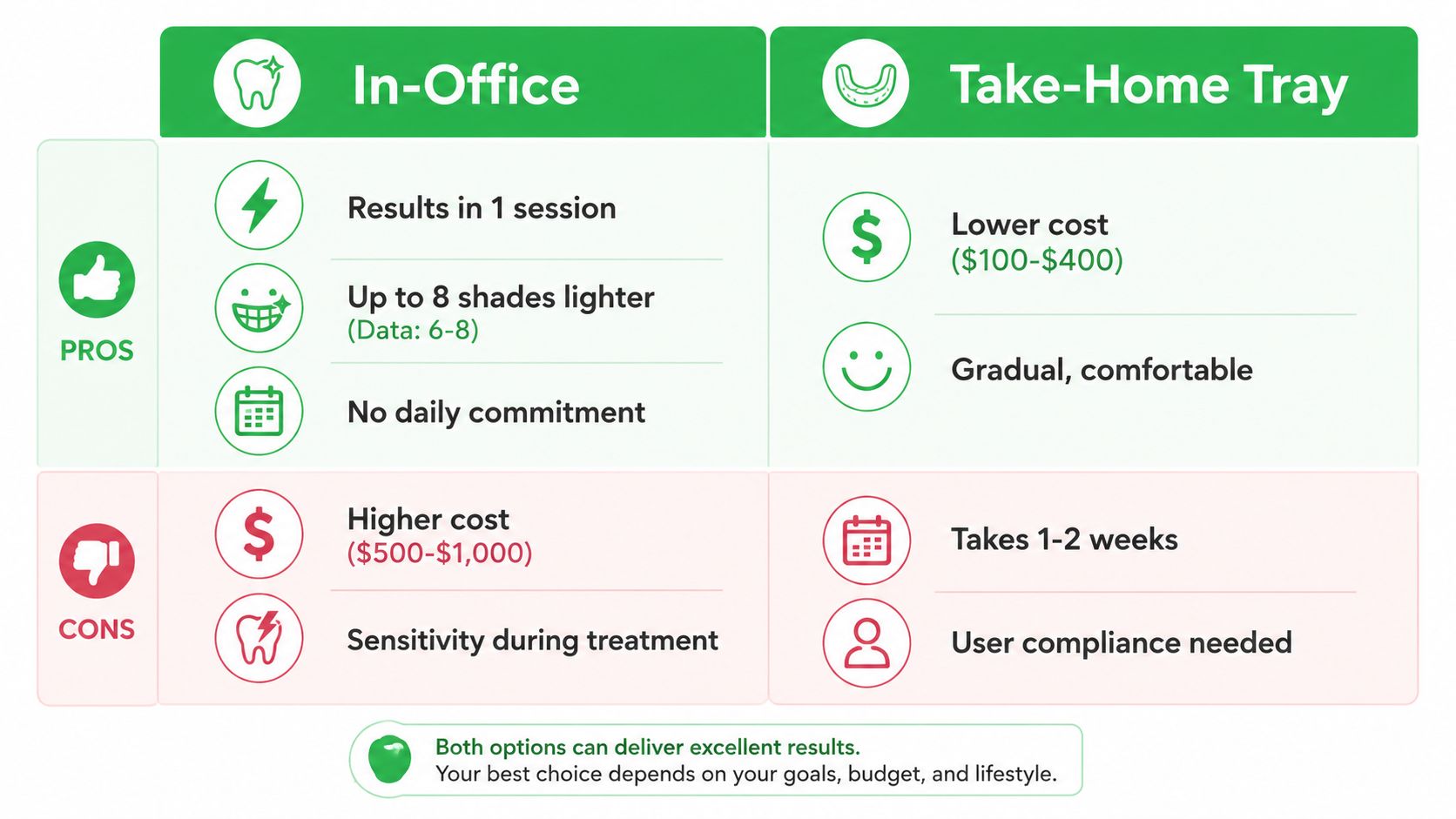
A patient who needs a brighter smile for a wedding, interview, or other deadline usually has a different problem than someone who can whiten slowly at home. Take-home trays suit gradual change and more control over the pace. In-office whitening fits better when the schedule is tight and the result needs to happen in one visit.
The fastest route isn't always the best route
Clinical whitening research shows tray-based systems can produce measurable change quickly and maintain lighter shade over time clinical whitening research. In-office treatment still makes more sense for people who want visible change right away, who do not want to manage a daily routine, or who know they are unlikely to keep up with a home schedule. It also helps when a patient wants a single appointment to do the work instead of spreading the process across many evenings.
Where trays still win
Trays are often the better fit when you want the color to build gradually and look less abrupt. They also make it easier to pause, shorten, or stretch the schedule if your teeth start to feel sensitive. For patients planning veneer, crown, or filling work later, that slower pace can be useful because it gives the dentist time to settle on the shade before the final restorations are made.
That planning step matters in a mixed-restoration mouth. A crown, veneer, or filling will not whiten the same way natural enamel does, so the question is not only how bright the teeth can get. It is whether the whitening method leaves the whole smile looking balanced once the rest of the treatment is finished.
All Stars Dental offers both in-office and take-home whitening, so a dentist can match the method to the current condition of the teeth instead of treating whitening as a one-size-fits-all add-on.
Choosing the Right Whitening Tray for Your Smile
The simplest way to choose is to look at fit, gel strength, and supervision together, not one at a time. If you want better control and you already have visible dental work, a dentist-made tray usually makes more sense. If you want low commitment and you understand the fit will be less exact, a retail option may still be enough.
A quick checklist helps narrow it down. Is your mouth free of untreated decay or gum issues? Do you have crowns, veneers, or fillings in the front teeth? Have you dealt with sensitivity before? Do you need results for a specific date, or can you whiten gradually?
If those questions keep pointing in different directions, that's a sign to get a shade plan before you buy anything. A consultation can cover the exam, impressions or scans, and timing for any follow-up cosmetic work in one visit.
The best tray isn't the one with the flashiest box. It's the one designed around the rest of your smile.
If you're ready to figure out whether take-home trays, in-office whitening, or a combined plan fits your teeth, schedule a visit with All Stars Dental. The team can evaluate your current restorations, talk through sensitivity concerns, and build a whitening plan that matches the rest of your smile instead of working against it.