
Gum Disease Treatment: A Complete Guide for 2026
You've noticed bleeding when you floss, or your gums look puffy no matter how carefully you brush. That's the point where a lot of people hope it's just temporary irritation, but gum disease usually doesn't calm down on its own, and the earlier it's checked, the simpler treatment tends to be.
Gum disease treatment works best when it matches what's happening under the gumline. Sometimes that means a deep cleaning and close follow-up. Sometimes it means surgery, regeneration, or a maintenance plan that keeps the disease from coming back.
Table of Contents
- Recognizing the Early Signs of Gum Disease
- Understanding the Stages of Periodontal Disease
- How Dentists Decide on the Right Treatment Approach
- Comparing Adjunctive Therapies and Advanced Techniques
- Building a Long-Term Maintenance Plan
- Common Misconceptions About Gum Disease Treatment
- Taking the Next Step Toward Healthier Gums
Recognizing the Early Signs of Gum Disease
A patient will often come in saying, “My gums only bleed when I floss.” That sounds small, but bleeding is one of the first signs that the gum tissue is irritated enough to deserve attention, not a reason to brush it off. If the bleeding happens again and again, especially with swelling, tenderness, or bad breath, it's no longer just a one-time irritation.
This guide on bleeding gums when brushing is useful because it addresses the same moment many people hesitate to act. The hesitation is understandable. Bleeding doesn't always hurt, and painless problems are easy to delay.
What early gum disease often looks like
Early gum disease can look mild from the outside. The gums may be red instead of coral pink, feel a little swollen, or bleed during brushing and flossing. What matters most is persistence, because recurring inflammation is a sign that plaque and bacteria are irritating the tissue day after day.
If your gums bleed repeatedly, the safest next step is an exam, not a guess.
People often wonder whether they should “just brush harder.” That usually isn't the answer. A firmer brush or aggressive flossing can irritate already inflamed gums, while a professional exam can tell the difference between simple irritation and a disease process that needs treatment.
Why timing changes the outcome
Early evaluation matters because gum disease is easier to control before the supporting structures around the teeth are involved. Once deeper tissues are affected, treatment becomes more involved and follow-up becomes more important. That's why dentists prefer to see a problem early, when home care, professional cleaning, and a targeted plan can still keep things manageable.
A clear sign that you shouldn't wait is when bleeding becomes routine, not accidental. If your gums bleed in the same spots, your breath stays unpleasant despite brushing, or your teeth feel a little different when you bite, it's time to ask for an evaluation. The appointment itself is often the most important step because it gives you a baseline and prevents guesswork from shaping the next few months of care.
Understanding the Stages of Periodontal Disease
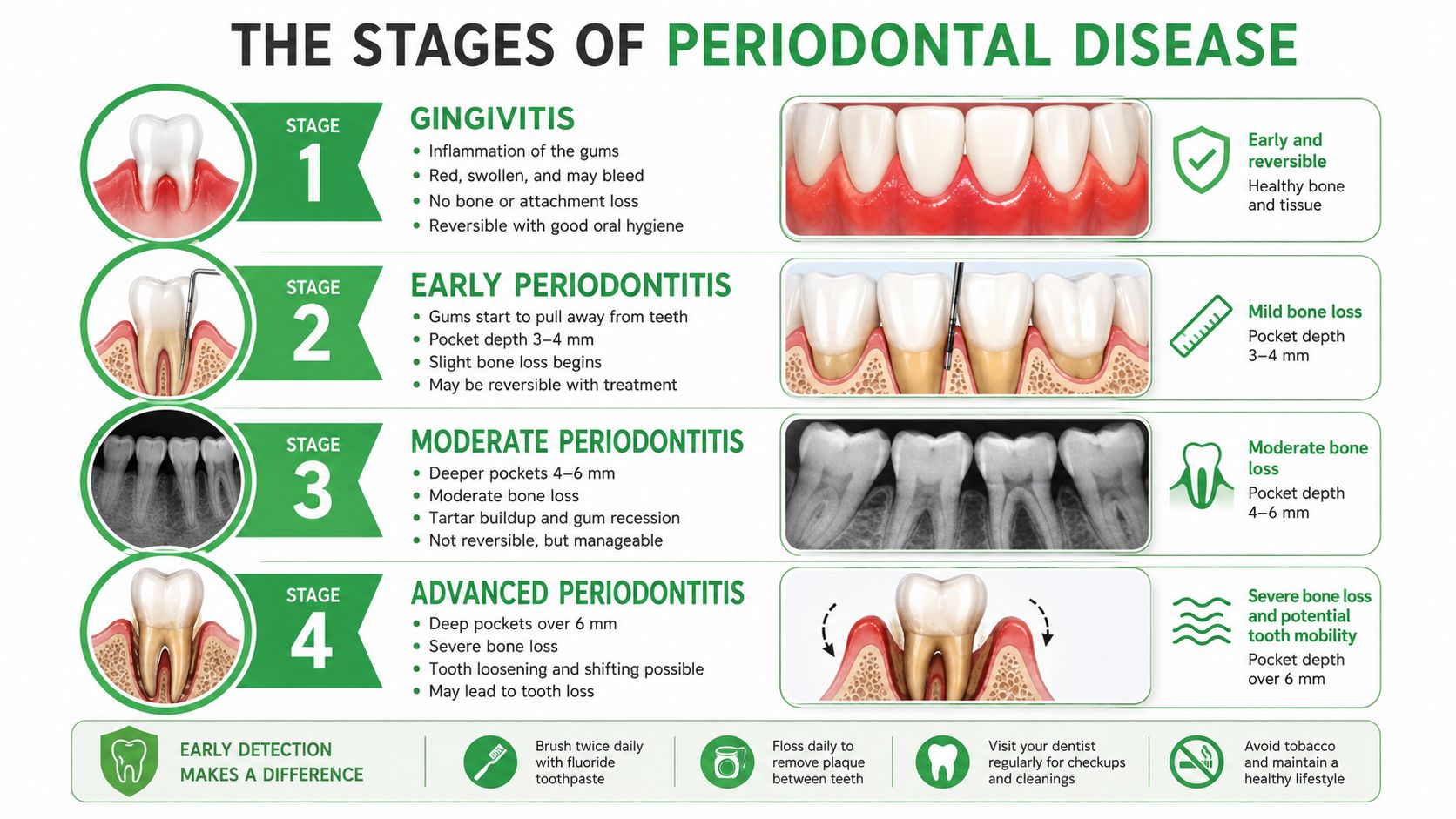
Think of gum disease like a leak around a foundation. At first, the problem is surface-level inflammation. If the leak keeps going, the deeper structure starts to change, and the repair becomes more complex.
From gingivitis to periodontitis
Gingivitis is inflammation of the gum tissue itself. The gums are irritated, but the deeper support around the tooth hasn't been permanently damaged yet. This is the stage where the mouth often gives warning signs, like bleeding or puffiness, before the disease moves further.
Periodontitis means the infection and inflammation have moved beyond the gums into the support system holding the teeth in place. At that point, dentists look for pocket depth, attachment loss, and bone levels to understand how far the disease has progressed. Those measurements matter because they show whether the issue is still mainly soft tissue inflammation or whether the support around the tooth is being compromised.
The European Federation of Periodontology recommends a stepwise approach for stage I to III periodontitis, starting with oral hygiene instruction and risk-factor control, then mechanical plaque removal and subgingival debridement, with surgery reserved for cases that don't respond well. The EFP guidance also ties treatment to long-term supportive care because gum disease can relapse if the biofilm keeps rebuilding.
Why stage changes the plan
The same mouth can contain different stages in different areas. One tooth may respond to cleaning alone, while another has deeper pockets and needs a more aggressive plan. That's why one-size-fits-all advice doesn't work well here.
For readers who manage another chronic condition in the family, empowering care for chronic conditions is a helpful framing, because periodontal care also depends on routines, follow-up, and consistency. Gum disease behaves more like a long-term condition than a one-time fix.
Practical rule: the more the supporting bone and attachment are involved, the more treatment shifts from simple cleaning to targeted periodontal therapy.
The clinical takeaway is straightforward. Gingivitis calls for prompt care and improved hygiene. Periodontitis requires a measured plan based on what the dentist finds in the pockets, on the x-rays, and during re-evaluation.
How Dentists Decide on the Right Treatment Approach
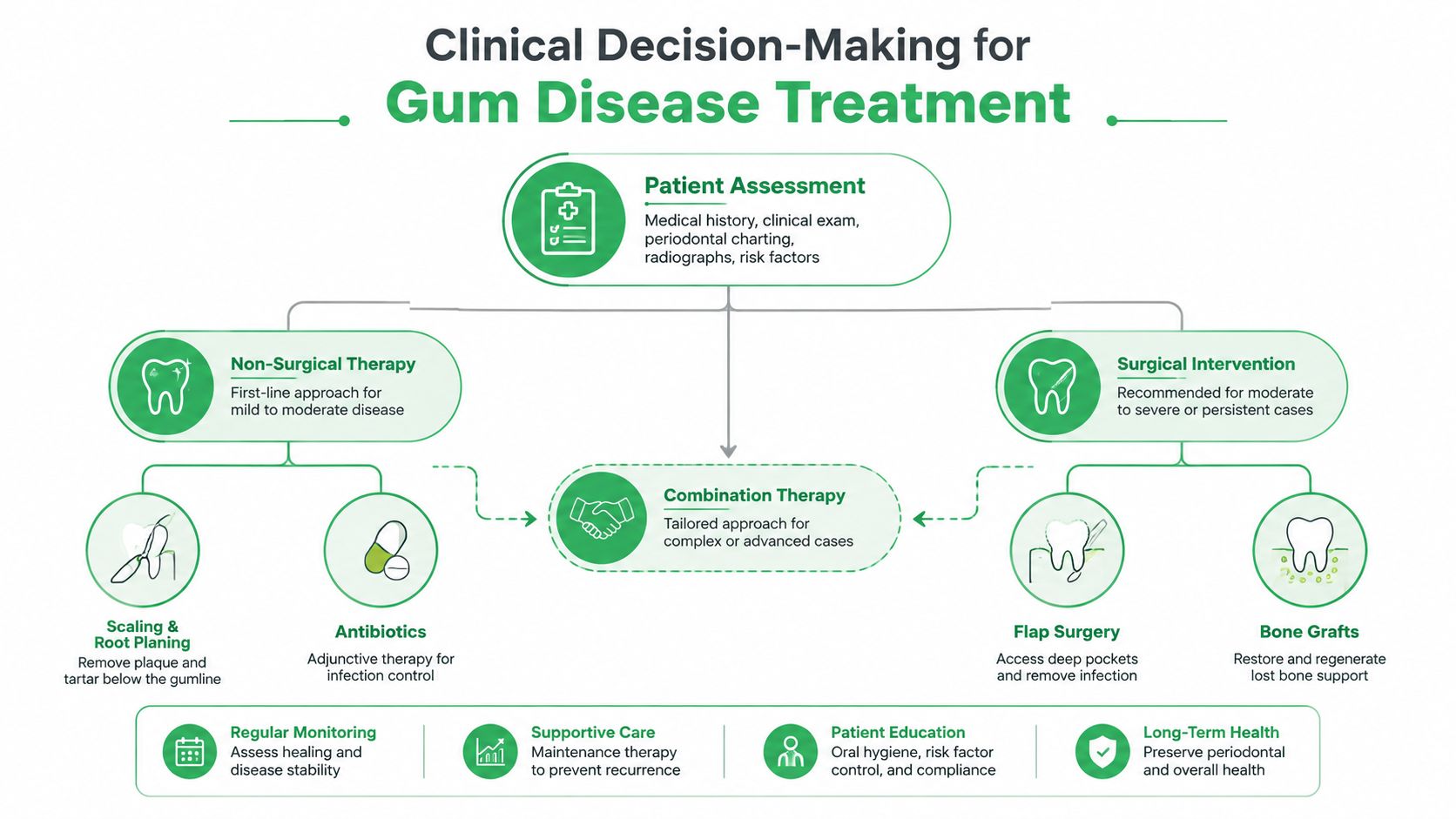
Treatment decisions start with a simple question, what changed after the first round of therapy? A dentist doesn't jump straight from diagnosis to surgery. The usual sequence is assessment, initial therapy, then re-evaluation to see whether the gums responded.
What happens after deep cleaning
Scaling and root planing is often the first active treatment for gum disease. It removes plaque and calculus below the gumline and smooths the root surface so bacteria have a harder time reattaching. In mild to moderate cases, non-surgical periodontal therapy is reported as successful in 85% of cases, while professional dental cleanings are associated with a 35% reduction in gum disease incidence, according to the data provided in the brief (source).
Re-evaluation matters because the first cleaning is not the finish line. The dentist checks whether bleeding has improved, whether the pockets have tightened, and whether the tissues look calmer. If the inflammation is dropping and the pockets are shallower, continued non-surgical care may be enough.
This scaling and root planing guide fits neatly here because it describes the same deep-cleaning step patients usually hear about first. In a real treatment plan, though, the decision doesn't stop at “deep cleaning or not.”
When surgery becomes part of the plan
A useful threshold from periodontal surgery guidance is that sites with probing depths of 6 mm or more after re-evaluation are more likely to benefit from surgery, while shallower sites are generally managed nonoperatively (EFP guidance). That doesn't mean every deep site goes straight to surgery. It means the dentist is more likely to recommend it when the pocket is still too deep to clean predictably by non-surgical means.
Risk factors also shape the decision. Smoking, older age, medical complexity, and poor access to maintenance all make recurrence more likely. National data in the brief show how common periodontitis is in older adults and current smokers in the U.S., which helps explain why dentists lean heavily on follow-up and prevention in those groups (source).
Good question to ask at re-evaluation: “Are we seeing improvement in the pocket depths, or do we still have areas that are too deep to clean reliably?”
For clinics that document chronic care patterns, resources such as billing and documentation for CCM codes can be useful context for structured follow-up, even though periodontal care has its own clinical rules. The key point is that the plan should match the disease burden, not just the first procedure.
A practical mind-set helps here. If the pockets are responding, stay the course. If they aren't, the next step may be surgery, targeted adjunctive therapy, or both.
Comparing Adjunctive Therapies and Advanced Techniques
Not every add-on treatment belongs in every gum disease plan. The right adjunct depends on the defect, the severity, and whether the goal is infection control or regeneration. That distinction matters, because some treatments help only in specific situations.
Where antibiotics fit and where they don't
The review evidence in the brief is clear that systemic antibiotics added to mechanical infection control do not improve pocket depth or attachment level compared with scaling and root planing alone (NCBI Bookshelf review). That supports antibiotic stewardship. If the main problem is biofilm sitting on and below the tooth surface, the first job is mechanical removal, not routine antibiotics.
Local adjunctive antimicrobials are a different conversation. They can reduce pocket depth and improve attachment in selected cases when used with scaling and root planing, but the benefit is context-specific rather than universal (NCBI Bookshelf review). In plain language, the dentist is matching the drug delivery method to the pocket that needs help.
When regeneration becomes worthwhile
For specific angular bone defects, adding guided tissue regeneration, or GTR, or enamel matrix derivative, or EMD, to flap surgery can improve attachment and bone levels. The brief notes that greater than 4 mm attachment gain occurs about twice as often with these regenerative add-ons as with flap surgery alone (NCBI Bookshelf review). That's not a reason to use them everywhere, it's a reason to use them when the defect shape makes regeneration realistic.
A patient usually hears a recommendation for surgery when the site can't be cleaned well enough non-surgically, or when the bone loss pattern suggests a regenerative opportunity. That's why two people with “gum disease” can leave with very different plans.
How to hear a recommendation without feeling pressured
When a dentist mentions an adjunctive therapy, ask what problem it solves.
- If the issue is bacterial load: mechanical cleaning comes first, and antibiotics are considered only in select situations.
- If the issue is a deep pocket with a favorable defect: regeneration may be discussed.
- If the issue is inflammation that improved after deep cleaning: continued maintenance may be the smartest choice.
All Stars Dental offers gum disease treatment, including periodontal care and scaling and root planing, which makes it one example of how a general dental office can address both early and more established periodontal concerns. The important part for patients is not the label on the service, but whether the recommended treatment fits the clinical picture.
Advanced periodontal care works best when it's targeted. The goal is to correct the site you actually have, not the one-size-fits-all version you saw online.
Building a Long-Term Maintenance Plan
Gum disease treatment doesn't end when the gums stop bleeding. It ends when the mouth stays stable over time, and that takes a maintenance plan that fits the patient's risk profile and daily reality.
How follow-up is usually scheduled
Supportive periodontal care is risk-stratified. The brief notes 3-month maintenance for high-risk patients and 6 to 12 months for lower-risk groups (EFP guidance). That schedule exists because plaque rebuilds, pockets can reopen, and old inflammation can return if the mouth goes too long without professional care.
The CDC data in the brief also show how common periodontitis is in older adults and smokers, which is why follow-up tends to be tighter for those groups (source). A dentist isn't being overly cautious by recommending frequent maintenance. The schedule is often based on how quickly the disease can recur.
What maintenance looks like in real life
Daily brushing and flossing still matter, but supportive care is more than home hygiene. It includes monitoring for bleeding, checking whether the gums feel tender again, and keeping appointments even when the mouth seems fine.
For people with limited access, disability, or caregiving needs, the plan has to be realistic. The brief flags that underserved patients often have irregular hygiene routines, infrequent check-ups, and barriers that make standard advice hard to follow (NIH equity research). In those situations, caregiver-supported home care and simple follow-up instructions are not extras, they're part of the treatment.
A maintenance plan that can't be followed won't protect the teeth.
That's why dentists often simplify the routine rather than complicate it. They may focus on one or two home-care tools that the patient can use, then build the recall schedule around what's realistic. If a patient can't attend frequent visits, the plan should be discussed openly so the office can reduce the chance of drop-off.
Signs the plan needs adjustment
If bleeding returns, if plaque control slips, or if the same pockets stay inflamed, the maintenance interval may need to be shorter. That doesn't mean the treatment failed. It means the disease needs a tighter monitoring cycle.
The most useful mindset is consistency. A good maintenance plan protects the work already done, especially after surgery or deep cleaning, and it gives the dentist a chance to catch relapse before it turns into more bone loss.
Common Misconceptions About Gum Disease Treatment
One of the biggest myths is that deep cleaning is always the final answer. It helps many people, but it isn't the end of decision-making when pockets stay deep, inflammation returns, or the bone defect pattern suggests a better result with surgery or regeneration.
Another common misconception is that antibiotics can replace mechanical treatment. They can't. The evidence in the brief supports a more careful approach, because systemic antibiotics added to scaling and root planing do not reliably improve pocket depth or attachment compared with mechanical therapy alone (NCBI Bookshelf review). That's a strong reason to avoid treating gum disease as if every case needs medication.
People also underestimate gum disease because it's not always painful. Untreated gingivitis can progress to irreversible periodontitis, and by the time pain shows up, the supporting structures may already be affected. That's why treatment success depends on both the office visit and what happens at home afterward.
Gum disease treatment isn't just a procedure. It's a plan that has to hold up between visits.
The final misconception is that once a dentist fixes the gums, the problem is gone forever. Recurrence is common without maintenance. Home hygiene, tobacco avoidance, and structured follow-up aren't optional extras, they're part of the result.
Taking the Next Step Toward Healthier Gums
The right gum disease treatment is the one that matches the stage, the pocket depth, and the way your mouth responds after initial care. Deep cleaning often comes first, but deeper pockets, persistent inflammation, or higher relapse risk can justify surgery, regeneration, or a tighter maintenance schedule.
If your gums bleed, swell, or seem unchanged even after better brushing, don't wait for the problem to declare itself more clearly. Ask for a periodontal evaluation, ask what your pocket depths are, and ask what would make your dentist choose non-surgical care versus escalation. Those questions help you take part in the decision instead of just hearing a recommendation.
If you're dealing with bleeding gums, deep pockets, or a treatment plan that feels unclear, All Stars Dental can evaluate your gums, explain your options, and build a periodontal plan that fits your needs. Visit All Stars Dental to request an appointment and get a clear, step-by-step conversation about gum disease treatment.