
Laser Root Canal: Pain Relief & Success Rate Facts
You're probably here because a tooth has started acting up, and you've already seen the phrase laser root canal in a search result or an ad. The promise sounds appealing, less discomfort, cleaner treatment, maybe a faster recovery, but it's hard to know what's real and what's just marketing.
A laser can be a useful tool in endodontic care, but it doesn't replace the basic root canal process. The most honest way to think about it is as an adjunct, something that can help with disinfection and, in some cases, short-term pain control, while the evidence for better long-term outcomes is still limited and mixed.
Table of Contents
- Understanding Laser Root Canal Treatment
- How Laser Technology Enhances Root Canal Procedures
- What the Research Says About Benefits and Limitations
- Laser Versus Traditional Root Canal Treatment
- Who Is a Good Candidate for Laser Root Canal Treatment
- Finding Qualified Providers and Understanding Costs
- Making Your Decision and Preparing for Treatment
Understanding Laser Root Canal Treatment
A patient might first hear about a laser root canal while scrolling late at night and wondering whether a sore tooth can be saved without a hard recovery. The phrase can sound like an entirely different procedure, but it usually refers to standard root canal care with laser support during specific cleaning and disinfection steps. For a plain-English overview of the conventional procedure itself, this root canal guide from All Stars Dental helps put the basics in context.
A traditional root canal removes infected pulp, cleans the canals, disinfects them, and seals the space. A laser-assisted version keeps those same core steps, then adds focused light energy during parts of the cleanup and disinfection process, like using a small precision light to reach corners that hand instruments and rinses may not fully address.
What the laser is actually doing
The laser does not “zip through” the tooth and solve every problem on its own. It helps reduce bacteria, reaches areas that shaped files and irrigating solutions may miss, and may support comfort after treatment. The most accurate description is laser-assisted endodontic therapy, because the laser supports standard root canal care rather than replacing it.
Practical rule: if a clinic makes it sound like the laser replaces all the usual root canal steps, that is a red flag. The standard cleaning and sealing process still does the main work.
Patients also worry about whether a practice answers questions clearly enough to explain treatment in a calm way. For offices trying to improve that first contact, dentistry call answering tips can be useful, because a good front desk conversation often decides whether a worried patient gets timely help or keeps putting care off.
What to expect from the visit
The appointment usually still feels familiar. Your dentist numbs the tooth, isolates it, opens access, cleans the canals, and seals them. The laser enters that workflow as a precision aid, especially when the tooth has narrow spaces, lingering bacteria, or a more complicated shape.
A laser root canal can sound reassuring because it feels high-tech, but the core question is simpler. Does the laser add something useful for your tooth, or is it mostly a marketing label? That is the question to keep in mind as you review the evidence.
How Laser Technology Enhances Root Canal Procedures
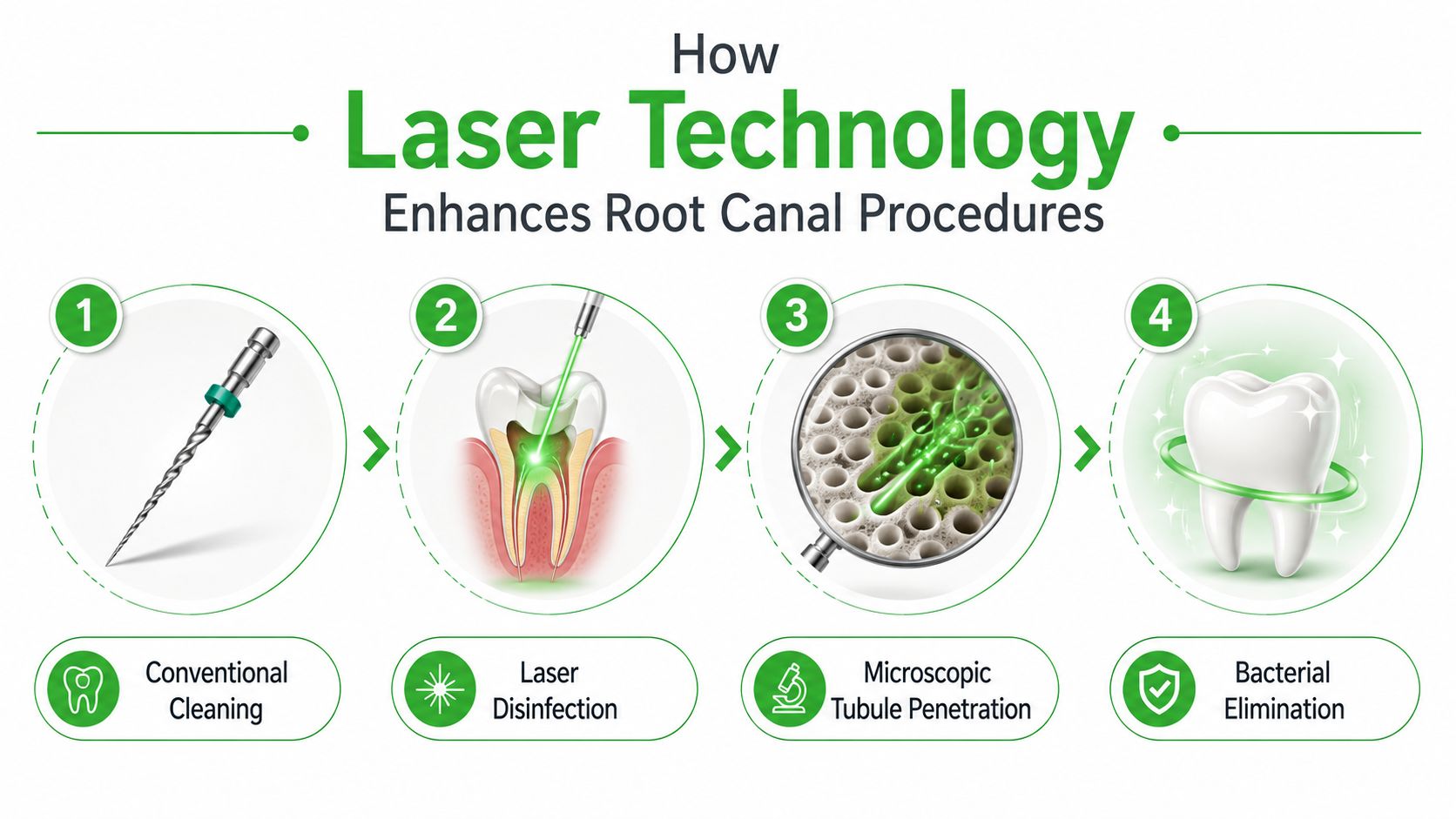
A root canal is more like cleaning a tree with a wide trunk and many hidden offshoots than clearing a single open tube. The main path can be shaped and rinsed, but small fins, side branches, and microscopic tubules still give bacteria places to stay. Laser technology is used to help reach those hidden areas, especially when the canal anatomy is tight, curved, or difficult to fully disinfect with conventional methods alone.
Where the laser fits in the sequence
The usual workflow still starts with mechanical cleaning. Files remove the bulk of infected tissue and shape the canal so it can be disinfected and sealed properly. After that, a laser can support disinfection by reaching into microscopic spaces and helping reduce the microbial load on canal walls.
That matters because root canals have fins, branches, and tiny tubules that behave like grooves in rough wood. Irrigation can wash the main surfaces, but some bacteria stay in sheltered spots. A laser sends energy in a controlled way, so the operator has another tool for treating areas that are harder to flush out completely.
Why erbium and diode lasers get discussed so often
Different laser types serve different purposes. In the endodontic literature, erbium-based lasers have shown the most consistent adjunctive benefits, while diode lasers have drawn interest for short-term postoperative comfort. A 2023 systematic review of 17 studies found that laser-assisted endodontic therapy produced a statistically significant improvement in 14 studies, and 14 of the 17 studies reported positive therapeutic results, with beneficial outcomes seen across conventional laser endodontics, antimicrobial photodynamic therapy, and photobiomodulation (systematic review).
That does not mean every laser does the same job. Some are used mainly for disinfection, some are aimed at comfort or inflammation, and some protocols are better established than others. The laser is one targeted tool within a broader treatment approach.
The most useful question is not “Is laser technology better?” It is “What step of the procedure is the laser being used for, and why?”
What still belongs to conventional care
Standard irrigation, shaping, and sealing remain the core of root canal therapy. The laser may help with microscopic spaces, but it still depends on sound endodontic technique to finish the job well. That is why patients should hear a clear explanation of what the laser is doing, not just that it is being used.
For patients comparing treatment options, this overview of single-visit root canal treatment can help frame the discussion, especially when a clinic is also talking about laser care.
What the Research Says About Benefits and Limitations
A patient can leave the chair feeling two very different things after root canal treatment. They may feel less soreness right away, while still wondering whether the laser changed the tooth's long-term outlook. The research helps separate those two questions. The clearest support is for disinfection support and short-term pain reduction. Claims about stronger long-term success remain limited and mixed, so it helps to hear what lasers do well before accepting marketing that promises more than the evidence shows.
What the laser does
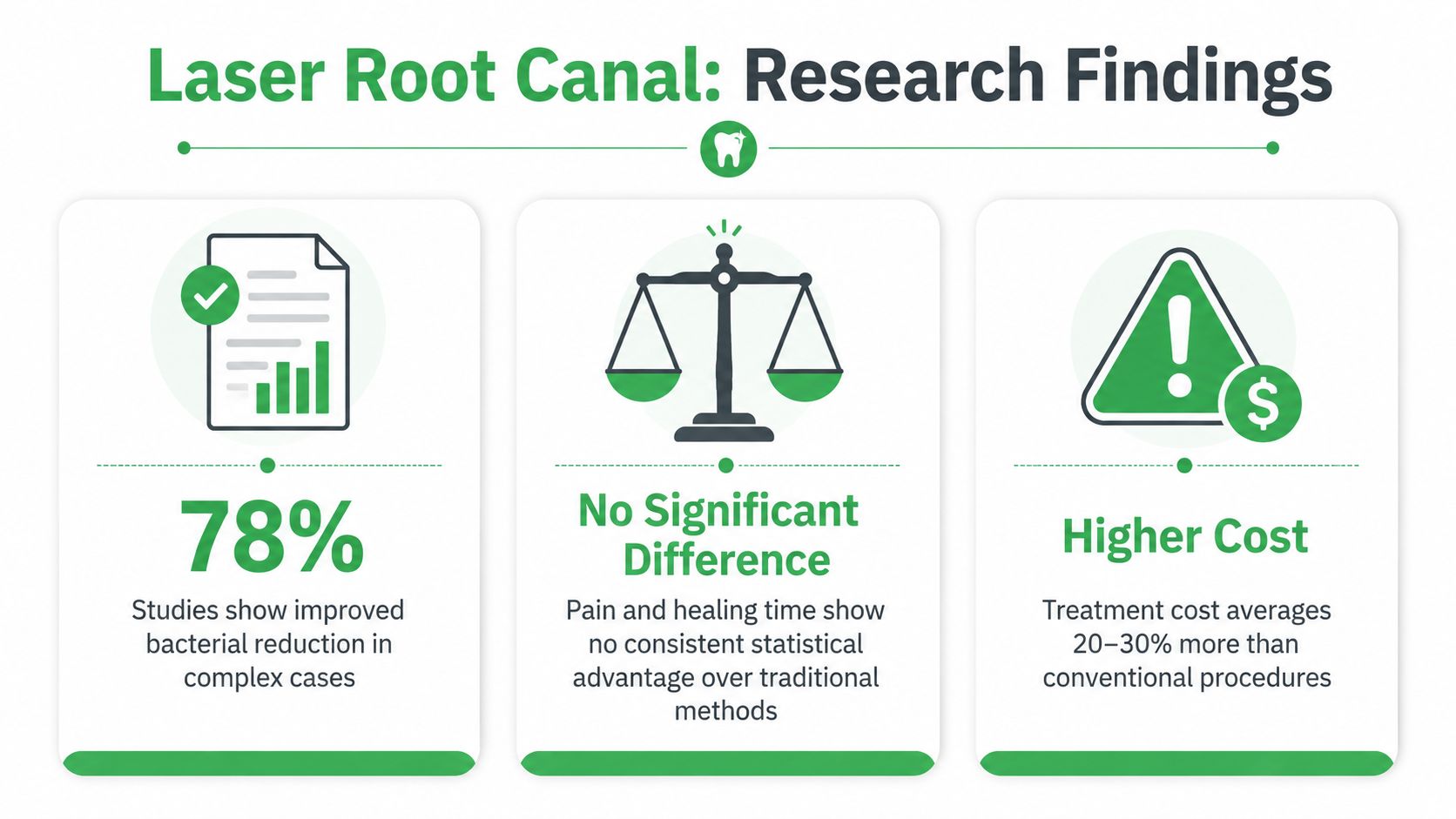
A 2024 meta-analysis of randomized clinical trials found that lasers can reduce postoperative pain after root canal treatment, especially in the early hours after treatment. Compared with placebo, laser use was associated with a 32.4% higher rate of “no/mild pain” and compared with combined controls it produced a 28.9% increase in “no/mild pain”. The same analysis also reported significant pain reduction at 24, 48, and 72 hours in retreatment cases, with mean differences of 0.65, 0.46, and 0.40 respectively.
A 2023 systematic review of 17 studies found a statistically significant improvement in 14 studies, or 82.3%, and 12 of 17 articles, or 70.5%, were rated at low risk of bias. Those numbers show that laser-assisted root canal therapy has a real evidence base, not just a marketing story.
What the evidence still hasn't settled
The main limitation is just as important. Reviews still point to too few randomized trials and study designs that differ too much from one another, which makes it hard to prove that a laser root canal produces better healing or higher tooth survival for every patient. The evidence for better long-term outcomes remains limited and mixed.
Bottom line: lasers can help with certain parts of treatment, especially pain and disinfection support, but they have not been proven to outperform conventional root canal care in every long-term outcome that patients care about.
For a patient, the practical takeaway is straightforward. A laser may help the tooth feel calmer soon after treatment, but it should not be presented as a guarantee of better long-term success. If a clinician says otherwise, that claim goes beyond what the research can support.
For patients comparing appointment styles, single-visit root canal treatment safety details are also worth reading, because treatment timing and technology are often discussed together even though they are separate decisions.
Laser Versus Traditional Root Canal Treatment
A patient sitting in the chair often wants one clear answer: will the laser make this tooth better? The more useful question is whether the laser adds enough value for your tooth to justify the extra complexity, cost, or time spent discussing options. In many cases, conventional root canal therapy still does the job very well, especially when the tooth anatomy is straightforward and the infection is manageable.
| Factor | Traditional Root Canal | Laser-Assisted Root Canal |
|---|---|---|
| Cleaning method | Files and irrigation remove infected tissue and shape the canals | Same base treatment, with laser support for selected disinfection steps |
| Pain after treatment | Many patients do well, but discomfort can still happen | Research suggests early pain relief can be better in some cases, not all |
| Long-term success | Established standard with widely used protocols | Evidence for superior long-term success is still not conclusive |
| Anatomy fit | Works well for many routine cases | May be more useful in complex canals or retreatment cases |
| Availability | More widely available | Less common, depends on training and equipment |
| Cost | Usually more familiar and predictable | Often more expensive because of equipment and expertise requirements |
How to think about the trade-offs
Traditional care is the baseline because it is reliable, familiar, and supported by long-running clinical practice. The laser does not replace that foundation. It adds a different kind of support, mainly in disinfection and, in some cases, early comfort after treatment.
That is why the details of the tooth matter so much. A simple tooth that can be cleaned and shaped in a routine way may not gain much from the added technology. A retreatment case, or a canal system that is harder to fully access, may give the laser more room to help. The right choice is about matching the tool to the job, not about choosing the newest device by default.
What patients often ask
Patients usually want to know whether the laser will hurt less, take less time, or last longer. The research is strongest for the first point, more mixed for the second, and still not definitive for the third. That makes a balanced comparison more useful than a sales pitch.
If the treatment plan sounds identical for every tooth and every patient, the conversation is too simplistic.
That practical question is also the one to ask in the dental office. All Stars Dental offers root canal therapy in Houston, so patients can ask directly whether a standard or laser-assisted approach makes sense for their case rather than relying on an ad.
Who Is a Good Candidate for Laser Root Canal Treatment
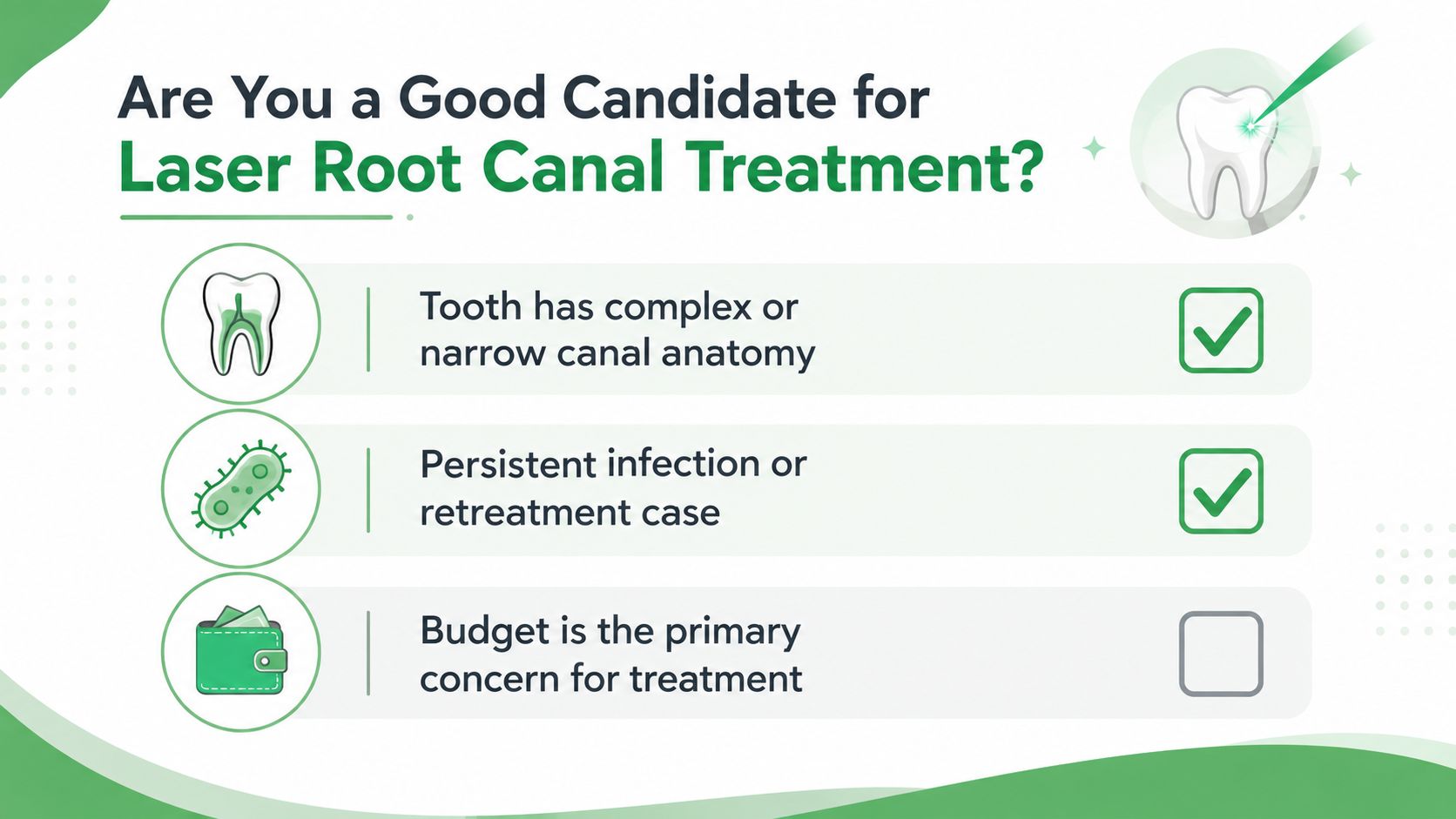
A laser root canal isn't the right fit for every mouth, and that's a good thing to know upfront. The strongest case for it usually shows up when the anatomy is more challenging, the infection is persistent, or the tooth has already been treated once and still needs help. In those situations, the extra disinfection support can be more relevant than it would be for a simple first-time case.
Signs that laser support may be worth discussing
A tooth with complex or narrow canal anatomy is one of the clearest reasons to ask about laser assistance. So is a retreatment case, where the tooth has already been through one root canal and still needs deeper disinfection. In those scenarios, the laser may help address areas that are harder to clean with conventional instruments alone.
Some patients also care most about how they'll feel in the first day or two after treatment. That's reasonable, because the research on pain relief is one of the more consistent positives linked to laser use. If early comfort matters to you, it's worth asking whether the practice uses a protocol that's aimed at that goal.
When it may not be the best value
If the tooth is simple, access is good, and the infection is straightforward, the added technology may not change much. Cost-sensitive patients should also ask whether the extra fee matches a benefit they care about, because paying more for a tool that won't change the outcome can be frustrating.
Ask this directly: “What does the laser do for my tooth that standard irrigation and cleaning won't already do?”
That question cuts through a lot of confusion. It also helps you hear whether the recommendation is based on your anatomy and symptoms, or just on a practice's general preference for technology.
Risks and judgment calls
The literature also notes concerns about thermal damage and dentinal microcrack formation if some lasers are used improperly. That's why operator skill matters so much. A laser is only as good as the protocol behind it, and the field is still working toward more standardized approaches.
For another practical way to compare providers, browse dental patient testimonials and look for comments about clear explanations, comfort, and follow-through, not just star ratings. Those details often tell you more about the experience than a generic “great office” comment does.
Finding Qualified Providers and Understanding Costs
A laser helps only when the team knows how to use it well. Training matters as much as the device itself, because laser-assisted endodontics depends on the right settings, the right wavelength, and careful judgment during the procedure. A polished machine does not tell you whether the clinician using it can protect the tooth and surrounding tissue.
What to ask before you book
Start with the basics. Ask whether the dentist or endodontist has specific training in laser-assisted root canal care, what type of laser is used, and how they decide which cases are likely to benefit. If the answers stay vague, keep asking until you get a clear explanation.
Ask how the laser fits into the overall treatment plan. A good provider should be able to explain whether the laser is being used for disinfection, for comfort, or for another defined purpose. If that purpose is hard to explain, the technology may be getting more attention than the diagnosis itself.
For guidance on evaluating providers, see our article on how to choose a root canal dentist in Houston.
Cost and access questions that matter
Laser equipment adds overhead, which often means higher fees than conventional treatment. The exact amount depends on the practice, the tooth, and the details of the procedure, so the safest move is to ask for a written estimate before treatment begins. Clear pricing matters because you should not be surprised after the tooth is already numb.
Insurance coverage can be uneven, so patients should verify how much of the treatment is coded as standard endodontics and how much, if any, is treated as an added service. Financing can also help when the best clinical option is more than a one-time out-of-pocket payment.
A practical checklist for consultations
- Training: Ask who uses the laser and what endodontic training they have had.
- Protocol: Find out whether the laser is part of routine care or reserved for specific cases.
- Equipment: Ask how often the device is maintained and whether it is current.
- Price: Request a written estimate before treatment begins.
- Alternatives: Ask what changes if you choose conventional treatment instead.
If you want a local example of a practice that lays out treatment fees before work begins, All Stars Dental in Houston says that all fees are quoted before any work starts, which can make comparison easier for patients who need root canal care and want a clear financial picture.
For another practical way to compare providers, browse dental patient testimonials and look for comments about clear explanations, comfort, and follow-through, not just star ratings. Those details often tell you more about the experience than a generic “great office” comment does.
Making Your Decision and Preparing for Treatment
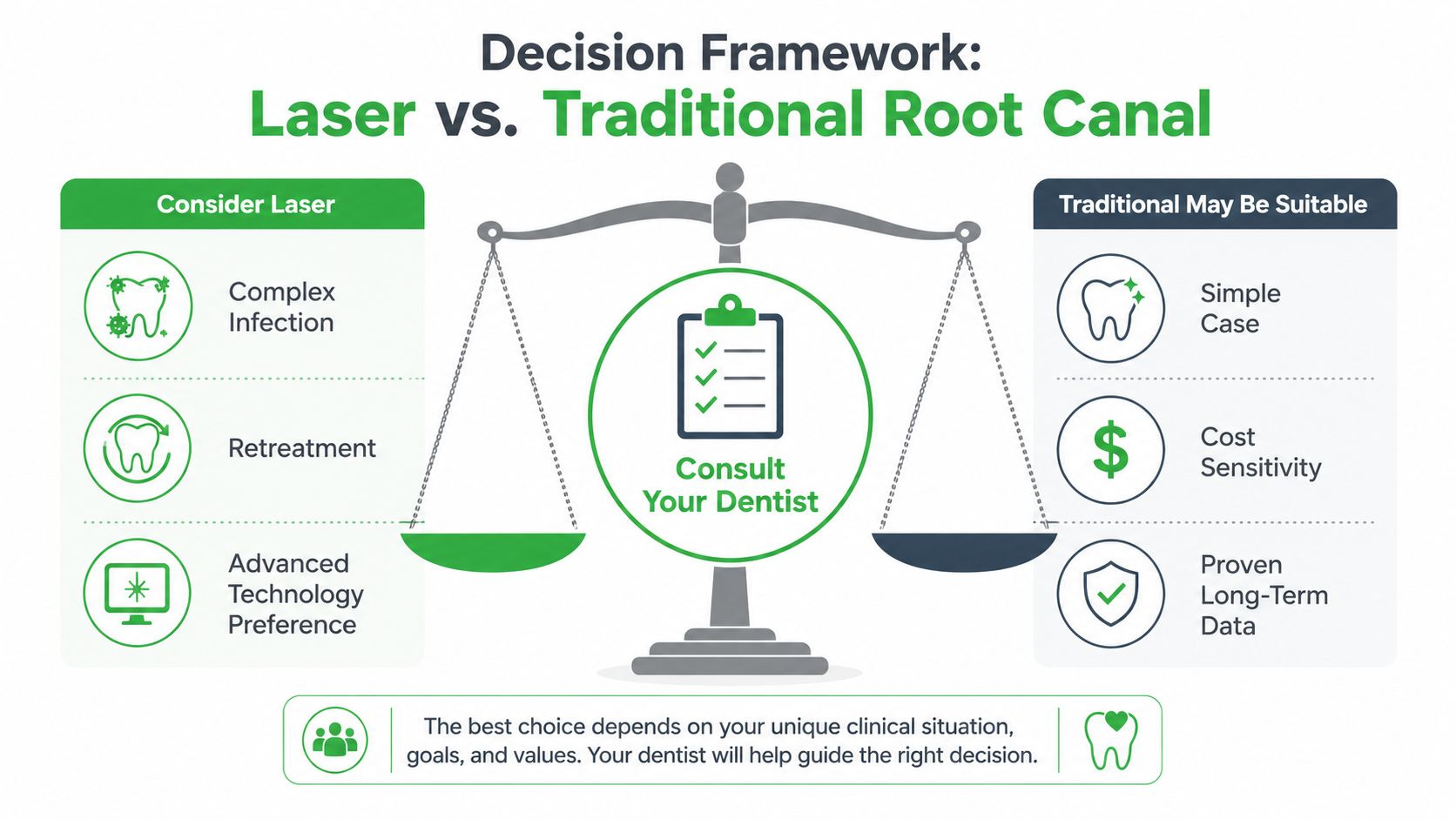
The best decision usually comes from matching the tool to the tooth, not from chasing the newest label. If your case is complex, your dentist expects disinfection to be challenging, or early comfort matters a lot to you, laser-assisted treatment may be worth discussing. If your case is straightforward and budget matters most, conventional care may be the more sensible choice.
A simple way to decide
Consider laser treatment if your tooth has complex infection, if this is a retreatment, or if you want to discuss advanced technology as part of your care plan. Traditional treatment may be suitable if the case is simple, you're cost-sensitive, or you want the most established path with the longest track record.
The strongest decision is the one your dentist can explain in plain language. If you leave the consultation still unsure why the laser is being suggested, ask again before you schedule.
What to do before the appointment
Bring a list of medications, note when the pain started, and mention any swelling, sensitivity, or prior treatment on the tooth. If you've had a root canal before on the same tooth, say so early. That detail can change the entire conversation.
You should also ask what recovery normally looks like after the specific procedure you're getting. Pain control, follow-up timing, and what counts as normal soreness are all easier to handle when you know what to expect.
Trust the explanation that makes sense on a dental chart, not the one that sounds the most dramatic in an ad.
If you're still undecided, a second opinion can be helpful, especially if one office pushes laser treatment without explaining the trade-offs. A careful plan should leave you informed, not pressured.
If you're comparing laser and traditional root canal options in Houston, All Stars Dental can help you understand what fits your tooth, your comfort level, and your budget. Visit All Stars Dental to request an appointment and get a clear, case-specific explanation before treatment begins.