
Root Canal vs Extraction: Houston Patient Guide
About 90.7% of root-canaled teeth were still in place after 5 years in a large registry study of 218,796 root-filled teeth. That makes saving the tooth the stronger choice in many cases, unless the tooth has a clear reason it can't be restored.
| Factor | Root Canal Treatment | Extraction |
|---|---|---|
| Main goal | Save the natural tooth | Remove the tooth |
| Upfront cost | Higher direct cost in the study, $689.1 on average | Lower direct cost in the study, $280.1 on average |
| Replacement needed | Usually a crown or filling afterward | Often needs replacement later if you want full function |
| Long-term outcome | Most teeth stayed in place over 5 years, with restoration quality mattering | Missing teeth can create new costs and maintenance needs |
| Best fit | Tooth is restorable and the root structure can be preserved | Tooth can't be saved, or replacement is part of the plan |
Table of Contents
- Root Canal vs Extraction, What You Need to Know Before Deciding
- Understanding Root Canal Therapy and Tooth Extraction
- True Costs of Root Canal vs Extraction with Replacement
- Recovery, Discomfort, and Functional Outcomes Compared
- Side-by-Side Comparison of Key Decision Factors
- When Root Canal Is the Right Choice and When Extraction Makes Sense
- Making Your Decision with Confidence
Root Canal vs Extraction, What You Need to Know Before Deciding
A painful tooth often leaves one question at the center of the decision, save it or remove it. Root canal vs extraction is not just a choice about today's discomfort. It also shapes how you chew, how the nearby teeth behave, and whether you will need more treatment later.
A tooth that can be saved often keeps the bite more stable and preserves the space where it belongs. Extraction ends the infection source, but it also creates a gap that has to be managed. In a large registry study of 218,796 root-filled teeth, only 9.3% were later extracted within 5 years, which means about 90.7% stayed in place during that period (registry study).
That does not mean every tooth should be saved. It means the decision should depend on whether the tooth can be treated and restored well afterward. A tooth that is cleaned but left with a weak final restoration is much more likely to fail than one that is finished properly, so the filling, crown, or other final restoration is part of the treatment, not an extra step after it.
Two paths, two different goals
Root canal therapy keeps the tooth in the mouth by removing the inflamed or infected pulp, then sealing and rebuilding the tooth so it can keep working. Extraction removes the tooth entirely. That ends the infection source, but it also leaves a missing tooth that often needs replacement.
Practical rule: If a tooth can be restored well after treatment, saving it usually gives you more control over the long-term result.
That is the main idea behind this guide. You will see what each procedure involves, how the cost picture changes once replacement is included, how recovery compares, and when a dentist may reasonably recommend pulling the tooth instead. For a clear overview of how root canal treatment works in practice, this root canal overview from All Stars Dental is a useful place to start.
Understanding Root Canal Therapy and Tooth Extraction
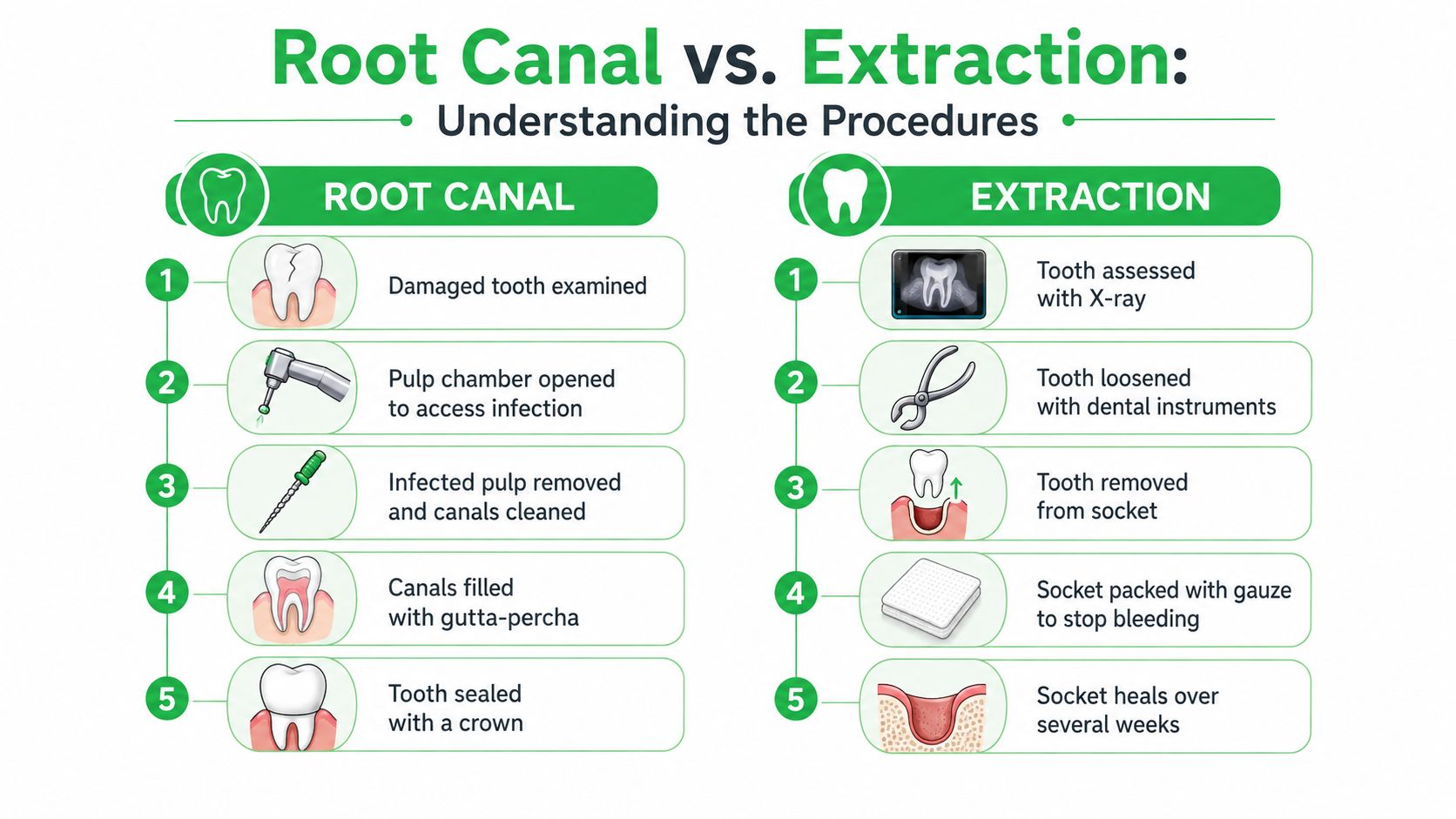
A root canal aims to keep the tooth's outer shell in place while removing the damaged inner tissue. The dentist takes out the nerve and pulp inside the tooth, cleans and shapes the canal space, and seals it. After that, the tooth often needs a crown or another strong restoration so it can handle biting forces and stay protected from fracture or reinfection.
What happens during root canal therapy
The treatment begins with numbing the tooth and the area around it. The dentist opens the tooth, reaches the canal space, removes the infected pulp, and cleans the inside so bacteria and debris are cleared away. The tooth is then filled, sealed, and rebuilt so it can function again.
That final restoration step carries more weight than many patients expect. A tooth that is cleaned but left without the right restoration can fail later, even if the infection itself was treated. In a registry study, teeth with weaker or missing recorded restorations were more likely to end up extracted than teeth restored with stronger indirect work and post-and-core support. For a plain-language overview of the treatment process, this root canal overview from All Stars Dental walks through the steps clearly.
What happens during extraction
Extraction is easier to picture. The dentist or oral surgeon numbs the area, loosens the tooth, and removes it from the socket. Some teeth come out with a straightforward pull, while others need a surgical approach if the root shape, breakage, or position makes removal harder.
The difference shows up after the tooth is gone. The socket heals, but the missing tooth does not replace itself with another working tooth. That leaves a gap that can affect chewing, how nearby teeth shift, and what kind of replacement the mouth may need later.
A missing tooth can feel like a quick fix in the chair and a longer project afterward.
That longer project matters because replacement is often part of the decision. If you want to see how one common replacement path fits into the cost picture, this single tooth implant cost guide explains the basics, and Family Caregiving Kit's Medicaid dental guide can help readers sort out coverage questions.
True Costs of Root Canal vs Extraction with Replacement
Price is usually the first thing people ask about, and it is easy to see why. In the cost-effectiveness study, root canal treatment had a higher mean direct cost of $689.1 than extraction at $280.1 (cost-effectiveness study). At the chair side, that makes extraction look like the cheaper path.
The problem is that the first bill is only part of the story. If the tooth is removed and then replaced, extraction becomes more expensive on average, reaching $1,245.5 when replacement was included. That is the cost many people do not see at the start, when the choice still feels like a simple yes or no between two procedures.
Why extraction can cost more over time
Extraction by itself ends the immediate problem, but it also leaves a gap in the bite. That gap can change how you chew, let nearby teeth drift, and create a need for later replacement if you want the mouth to keep working well. The financial side changes at that point, because the replacement is no longer optional for many patients.
A tooth-preserving approach also carried a meaningful advantage in the study's health-state values. There was no significant difference in QALYs between the two groups. In plain language, the analysis did not show a clear winner on that broader quality-of-life measure, but it did show that keeping the tooth improved the measured health-state outcome.
The replacement decision after extraction
Once a tooth is gone, the usual choices are an implant, a bridge, or a removable denture. Each option brings its own upkeep, and each one changes the total cost in a different way. The issue is not only the price of the replacement itself, but the fact that extraction often begins a series of later decisions.
A missing tooth can also affect daily function in ways that are easy to overlook at first. The jaw still has to absorb chewing forces, neighboring teeth still need support, and the replacement has to fit into that system without creating new problems. That is why the cheapest procedure on day one can become the more expensive path across time.
If you are trying to sort out how coverage affects those later choices, this Family Caregiving Kit's Medicaid dental guide can help with insurance-related questions before you choose a path. Dental plans and public coverage can shape what happens after extraction just as much as the procedure itself.
Recovery, Discomfort, and Functional Outcomes Compared
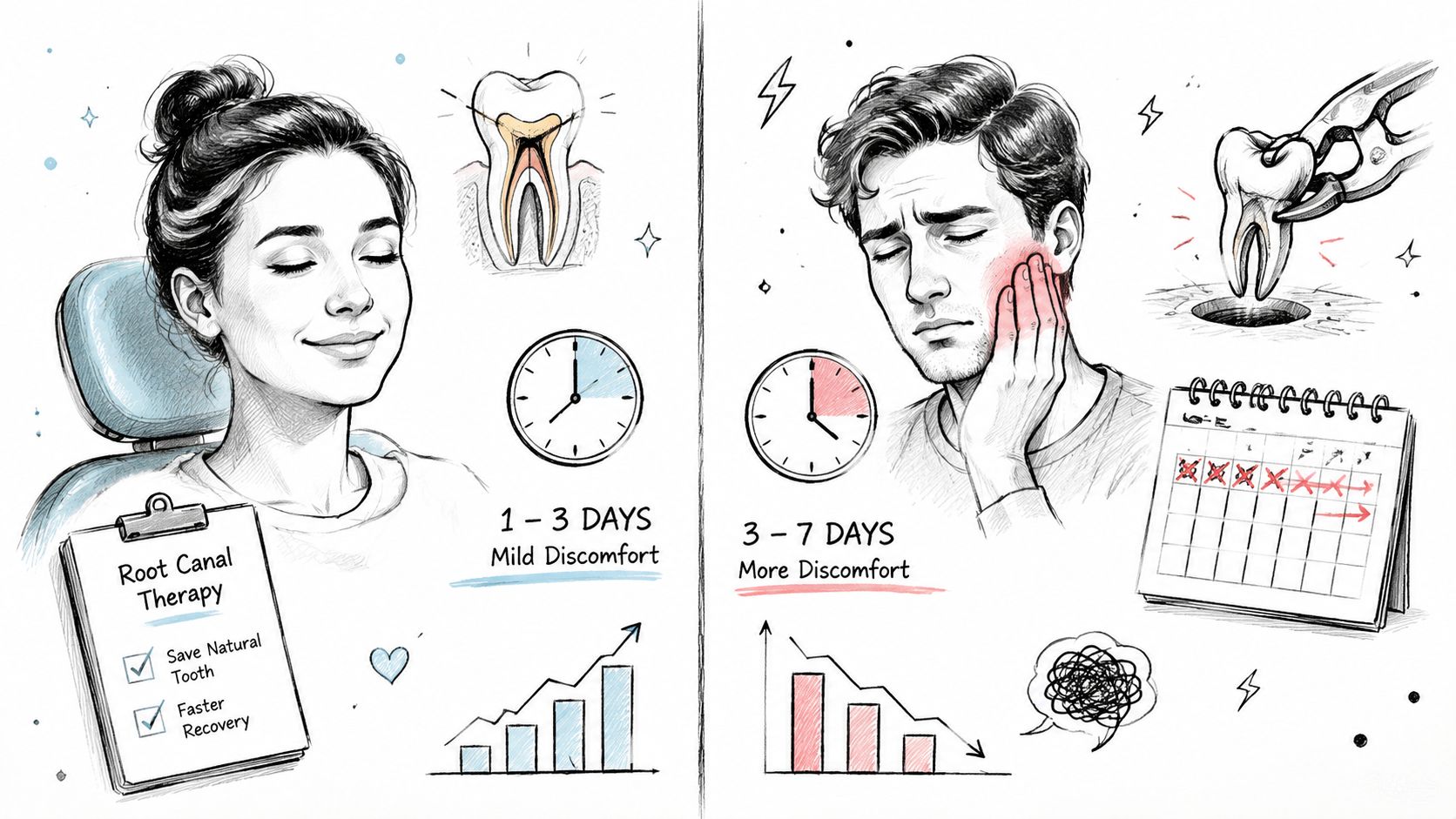
Pain is the first concern for many. That's normal. What matters is separating the discomfort of the procedure from the long-term function of the tooth afterward.
Root canal therapy is designed to remove the pain source while keeping the tooth. Extraction removes the tooth and usually resolves that tooth-specific pain, but the healing phase can feel different depending on whether the removal was simple or surgical.
What recovery often feels like
A root canal is often followed by tenderness, especially if the tooth was already inflamed before treatment. The recovery is usually driven more by the surrounding tissues than by the canal work itself. Once the tooth is restored, the goal is for it to go back to doing normal work in the bite.
Extraction recovery depends on how involved the removal was. A simple extraction is usually easier than a surgical one, while a surgical extraction can come with more swelling and a more noticeable healing period. The socket itself also needs time to close and settle, which is a different kind of recovery than keeping a natural tooth.
If a tooth can keep working after proper restoration, that usually means less maintenance later than managing a missing space.
That's why function matters as much as comfort. A root-canaled tooth that's restored well can keep your bite more natural, while extraction creates a gap that changes the way the mouth works until it's replaced. If you want a practical healing roadmap, this root canal recovery guide walks through the usual healing process in everyday terms.
Long-term function is where the choices separate
Chewing, bite stability, and keeping neighboring teeth in place all depend on whether the tooth stays or goes. A saved tooth can preserve the natural arrangement you already have. A removed tooth can be replaced, but the replacement is not the same as having the original tooth still rooted in bone.
That difference is why a short-term fix can turn into a longer maintenance plan. The recovery after extraction may be straightforward, but the long-term management is often more involved than people expect.
Side-by-Side Comparison of Key Decision Factors
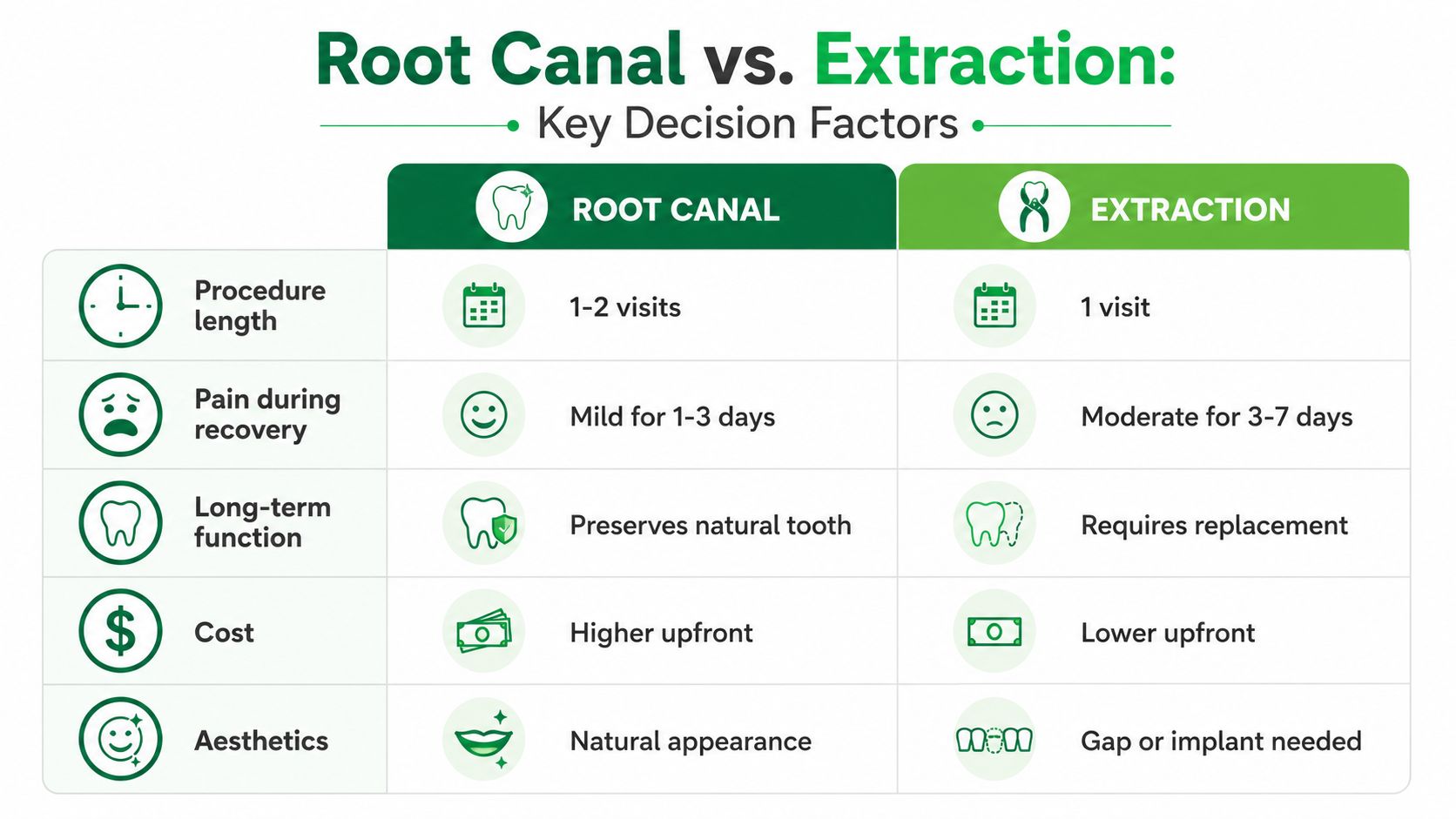
A quick comparison makes the tradeoff easier to see. The point is not that one path always wins. It is that each option solves a different problem, and the best choice depends on what you want to preserve.
| Factor | Root Canal Treatment | Extraction |
|---|---|---|
| Procedure length | Usually requires treatment plus final restoration | Usually one removal visit |
| Recovery | Tends to involve less structural disruption to the mouth | Healing depends on whether it was simple or surgical |
| Long-term function | Preserves the natural tooth | Requires replacement if you want full function |
| Upfront cost | Higher direct cost in the study, $689.1 on average (study) | Lower direct cost in the study, $280.1 on average (study) |
| Cost after replacement | Often already built into the restoration plan | Rose to $1,245.5 on average when replacement was included (study) |
| Tooth retention | 90.7% remained in place over 5 years in the registry study | The tooth is removed |
| Restoration dependence | Final restoration quality strongly affects outcome | Replacement quality becomes the main issue |
How to read the table
The biggest mistake is to compare only the procedure fee. That can make extraction look cheaper on paper, even though it may start a longer chain of care. A better comparison asks whether you are paying to keep a working tooth or paying to begin a replacement plan.
Restoration quality deserves special attention here. A root canal is only as strong as the tooth after it is rebuilt, which is why the crown or other final restoration matters so much. If that restoration is weak, delayed, or poorly fitted, the tooth may not last as well as it should. In that sense, the decision is not just about saving or removing the tooth, it is also about how well the tooth can be supported afterward.
The same idea applies after extraction, but in a different way. Once a tooth is removed, the main question becomes how well the space will be managed over time, because replacement quality determines how closely function can be maintained. That is why the cheapest option upfront can become the more expensive one later.
When Root Canal Is the Right Choice and When Extraction Makes Sense
A tooth is worth saving when it still has enough sound structure to support a strong restoration and the surrounding tissues can support it. That's the common situation where root canal therapy does its job well. The tooth is treated from the inside, then protected so it can keep functioning in the bite.
Scenarios where saving the tooth usually fits
A dentist may lean toward root canal therapy when the damage is inside the tooth, not through the root. If the decay hasn't destroyed the tooth past the point of restoration, the case can still be very reasonable. The same is true when the main issue is infection in the pulp, but the outer tooth and root remain stable enough to hold a crown.
You'll also hear more about saving the tooth when the bite matters a lot. Back teeth do serious work, and losing one can affect chewing in ways patients notice later. That's one reason a restorable tooth is often treated rather than removed.
Scenarios where extraction is the better call
Some teeth aren't good candidates for saving. A vertical root fracture, severe gum disease with poor support, or decay that reaches too far below the gumline can make extraction the more responsible choice. In those cases, trying to rescue the tooth may only delay the inevitable and add cost.
Patient preference matters too. Some people don't want multiple visits, or they prefer a treatment that resolves the immediate problem in one step. That doesn't make the choice wrong. It means the decision has been made with the full tradeoff in mind.
Good dentistry is not about forcing every tooth to stay. It's about choosing the option that gives the best outcome for that tooth and that mouth.
That's where a calm exam, X-rays, and a discussion of replacement options come in. If a tooth is beyond saving, extraction can be the more honest path. If it's still salvageable, root canal therapy usually gives you more to work with later.
Making Your Decision with Confidence
The right choice starts with one question, can the tooth be restored in a way that will last? If the answer is yes, saving it often preserves more of your natural bite and keeps the rest of the mouth simpler. If the answer is no, extraction may avoid repeated repair attempts and move you toward a more predictable plan.
Before you agree to either path, ask a few direct questions. Is the tooth restorable? How healthy is the surrounding bone and gum support? If I extract it, what replacement would you recommend? What will this choice mean for chewing and maintenance over time?
A second opinion is reasonable when the tooth is borderline. That's especially true if you're hearing mixed messages about whether the tooth can be saved. You're not being difficult by asking for clarity. You're making a decision that affects how you eat, smile, and maintain your mouth for years.
If you're comparing options in Houston, All Stars Dental provides root canal therapy, crowns, implant restorations, bridges, and denture options under one roof, so you can discuss saving a tooth and replacing one in the same visit when needed. That kind of practical comparison makes the decision easier because you can look at the full path, not just the first procedure.
If you're dealing with a painful or damaged tooth, schedule an evaluation with All Stars Dental so you can compare root canal and extraction with a dentist who explains the next steps clearly. Their team can review whether the tooth is restorable, outline replacement options if it isn't, and help you choose the path that makes the most sense for your mouth and budget.
- How Long for Implant to Heal Before Crown: A Houston Guide
- Mini Implants vs Regular Implants: Which Is Right for You
- Laser Root Canal: Pain Relief & Success Rate Facts
- Affordable Full Mouth Reconstruction in Houston: Your 2026 Guide to Restoring Your Smile
- The Best Dental Implants of 2026: A Patient’s Guide to Quality and Longevity
- Same-Day Dentures vs. Traditional Dentures in Houston: Which Is Right for You?
- Dental Implant vs. Bridge: A Comprehensive 2026 Guide to Restoring Your Smile