
How Long for Implant to Heal Before Crown: A Houston Guide
Most dental implants need about 3 to 6 months to osseointegrate before a final crown is placed. The lower jaw is often ready closer to 3 months, while an upper-jaw implant commonly needs closer to 4 to 6 months because the bone is usually less dense and heals more slowly.
If you're in Houston waiting for the tooth that will finally complete your smile, the calendar can feel confusing. The gum may look healed, discomfort may have faded, and the implant may feel like it's doing nothing. Inside the jaw, however, bone is gradually bonding to the implant surface. That quiet process creates the foundation your crown needs.
The answer to “how long for implant to heal before crown” isn't one universal appointment date. Your dentist considers the implant's stability, the jaw location, bone quality, your health, the bite, and the restorative steps that come after integration. A careful timeline may feel slow, but it's designed to protect the result rather than rush a crown onto an implant that isn't ready.
Table of Contents
- What to Expect From the Implant Healing Timeline
- Understanding Osseointegration and Why the Crown Waits
- Key Factors That Shorten or Extend Your Healing Time
- Immediate, Early, and Delayed Loading Protocols Compared
- The Often-Missed Middle Stage Between a Stable Implant and the Final Crown
- Temporary Tooth Options During the Healing Period
- Common Misconceptions About Implant Healing Timelines
- Your Healing Checklist and Next Steps in Houston
What to Expect From the Implant Healing Timeline
A patient at a Houston clinic might arrive expecting a simple sequence: implant placement, a short wait, then a crown. Instead, the process often feels more like a quiet construction project. The visible part of the work ends quickly, while the important foundation develops beneath the gum.
For conventional treatment, the most common wait before a final crown is 3 to 6 months, while the implant bonds with the surrounding bone during osseointegration. An NIH/NCBI review places the healing estimate at about 2 to 3 months in the mandible and 3 to 6 months in the maxilla, or upper jaw. You can review the clinical discussion in this NIH summary of implant healing and loading.
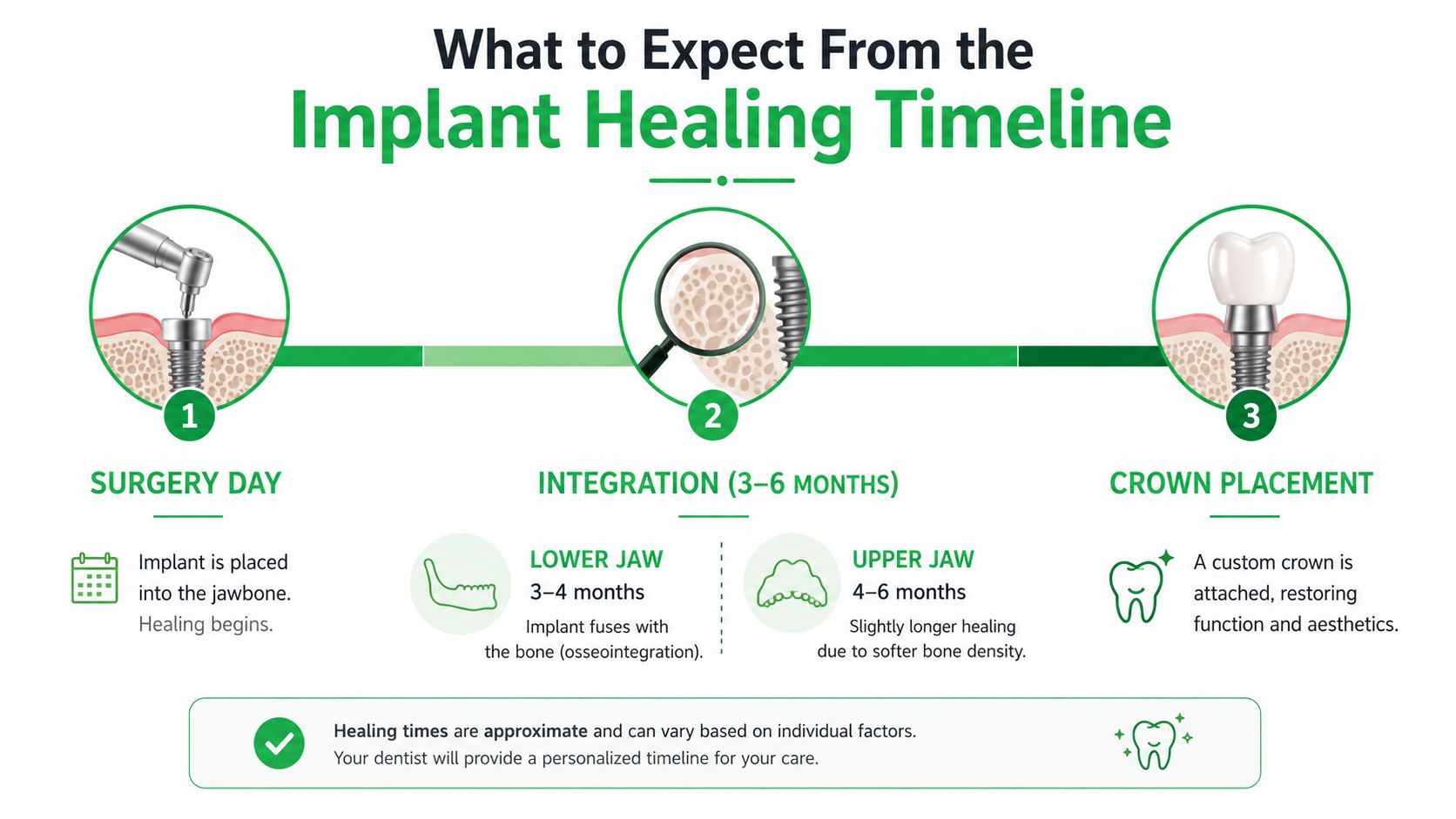
The lower jaw and upper jaw don't follow identical calendars
Lower-jaw bone is often denser, giving an implant a firm environment for integration. Upper-jaw bone can be softer and less predictable, so the dentist may choose a longer observation period before attaching a restoration. That difference isn't a delay for its own sake. It reflects how much stability the implant needs before it begins handling chewing forces.
During the healing window, your dentist may provide a temporary tooth or another prosthesis. The NHS explains that the gum can usually heal in 1 to 2 weeks, while the bone takes longer and implants are often left to integrate for 2 to 6 months before use, as described in its patient guide to dental implants.
The final crown also has its own preparation stage. For a closer look at the restorative steps, see this guide to what to expect from dental implant restoration. The key point is simple: healed gums don't necessarily mean a fully integrated implant, and a stable implant still needs a carefully planned crown.
Understanding Osseointegration and Why the Crown Waits
Osseointegration is the process in which living jawbone bonds with the implant surface. The implant acts like an artificial tooth root, but it doesn't become secure merely because it was placed successfully on surgery day. Bone must remodel around it and create a stable connection capable of tolerating function.
A useful analogy is a young tree in soil. At first, the tree may stand upright, but loose soil and movement can prevent strong roots from developing. The implant is similar. The surrounding bone needs time to establish a dependable biological connection before the crown places repeated pressure on it.
Why movement matters
Every bite creates force. If the implant moves too much while bone is trying to attach, the body may form softer fibrous tissue at the interface instead of building the firm bone connection the restoration requires. That is why dentists assess primary stability, bite forces, and the quality of the surrounding bone before deciding whether a crown can be attached early.
Classic guidance described avoiding load for about 3 to 4 months in the mandible and 6 to 8 months in the maxilla. A more recent review notes that an implant may need to remain undisturbed for 3 to 8 months to protect osseointegration. Those ranges help explain why a dentist may recommend observation rather than choosing a date from a standard calendar.
Practical rule: A crown should be placed when the implant is biologically and mechanically ready, not simply when the patient is tired of waiting.
This doesn't mean every patient must wait for the longest possible interval. Some carefully selected cases can use an early or immediate restoration, but the restoration may need to remain outside heavy functional contacts. Your clinician balances the desire for a tooth quickly against the risk of disturbing the developing bone connection.
Key Factors That Shorten or Extend Your Healing Time
Two people can receive implants on the same day and still receive crowns on different schedules. The deciding factors include the bone at the implant site, whether grafting was necessary, the location in the mouth, and how well the patient can protect the area during healing.
Bone and procedure-related factors
Bone quality matters because the implant needs adequate support from the beginning. A firm lower-jaw site may provide strong primary stability, while a softer upper-jaw site may require more cautious loading. The ITI consensus explains that conventional loading is generally delayed for 3 to 6 months, while early loading means placing a restoration between 1 week and 2 months. Its guidance also connects the longer maxillary timeline with slower, less predictable healing in lower-density bone. See the ITI consensus on implant loading protocols.
A graft can add another layer of planning because the dentist may first need to create or strengthen the foundation. Extraction-related changes, a sinus-area procedure, or a complex graft can make the overall sequence longer than a straightforward implant in already-adequate bone.
For a plain-language discussion of why this foundation matters, read about proper bone support for dental implant success.
Health and habits
Your body's ability to repair tissue also affects the schedule. Poorly controlled diabetes, smoking, inadequate oral hygiene, and certain medications can make healing less predictable. Tell the dental team about every prescription, supplement, and medical condition, including medications used for bone health. Your dentist may coordinate with your physician rather than making assumptions.
Some influences are within your control:
- Protect the site: Avoid chewing directly on the implant unless your dentist specifically says it's safe.
- Keep the area clean: Follow the prescribed brushing and rinsing instructions without scrubbing the surgical site.
- Avoid smoking: Smoking can interfere with the healing environment and may lead your clinician to use a more cautious plan.
- Manage medical conditions: Keep diabetes and other relevant conditions under appropriate medical care.
- Attend follow-ups: Appointments let the team evaluate healing instead of guessing from how the gum looks.
Healing isn't a passive countdown. You can't control every biological variable, but you can reduce avoidable pressure, inflammation, and disruption.
Immediate, Early, and Delayed Loading Protocols Compared
“Loading” means placing a restoration into service on the implant. The word can sound technical, but it answers a practical question: When will this implant begin supporting a tooth and its biting forces?
Recent consensus definitions describe immediate loading as placing a restoration within 48 hours, early loading as more than 48 hours and less than 12 weeks, and delayed loading as 3 months or more. Primary stability and bite management help determine whether the restoration should be provisional or definitive. The ITI consensus material on loading protocols explains why these categories depend on more than elapsed time.
| Protocol | Typical timing | Conditions required | Patient example |
|---|---|---|---|
| Immediate | Within 48 hours | Strong initial stability, carefully controlled bite, and suitable case selection | A patient receives a provisional tooth designed to minimize functional pressure |
| Early | More than 48 hours and less than 12 weeks | Adequate stability, favorable bone, and a restoration that limits harmful movement | A stable implant is restored before the conventional healing period ends |
| Conventional | Commonly during the established healing window | The implant remains protected while bone integration develops | A patient waits for integration before beginning the restorative phase |
| Delayed | 3 months or more | Additional healing time because the site or patient carries greater risk | An upper-jaw implant or grafted site is observed conservatively |
A short timeline isn't automatically better. Immediate and early loading can be predictable in selected cases, but the clinician must control occlusion, restoration design, and implant movement. A provisional crown may be used to support appearance while avoiding the forces associated with normal chewing.
The material of the eventual restoration is a separate discussion from healing time. If you're comparing options, you can review titanium and zirconia dental implant materials with your dentist. The loading protocol depends first on biology and mechanics, not on choosing a particular crown material.
The Often-Missed Middle Stage Between a Stable Implant and the Final Crown
A patient may hear, “The implant is stable,” and reasonably expect the final crown next. Stability clears one important checkpoint, but it doesn't finish the restorative work.
First, the dentist may place a healing cap or abutment. The abutment is the connector between the implant and crown, and its shape affects how the gum frames the replacement tooth. The surrounding soft tissue may need time to settle around that contour, especially when the implant sits near the front of the mouth.
Why the gum shape matters
In an anterior case, a provisional restoration can help guide the gum toward a natural-looking emergence profile. The goal isn't merely to fill the gap. The crown must appear to rise from the gum in a way that matches neighboring teeth, and the tissue may need careful shaping before the final design is approved.
Soft-tissue healing often settles in about 1 to 2 weeks, while osseointegration commonly takes 3 to 6 months. After integration, the team may still need to complete an impression or digital scan, select or customize the abutment, communicate shade and contour details to the laboratory, evaluate the crown, and seat it. The clinical discussion in this recent NIH/PMC publication on implant restoration protocols describes provisional restorations as a way to preserve tissue contour when primary stability is high.
A typical patient journey may look like this:
- Healing cap or abutment placement: The dentist exposes or accesses the implant and chooses the connector.
- Tissue shaping: The gum settles around the selected contour, with a provisional used when appropriate.
- Digital scan or impression: The office records the implant position, neighboring teeth, bite, shade, and tissue profile.
- Laboratory fabrication: A dental technician creates the custom crown.
- Try-in and final seating: The dentist checks fit, contacts, appearance, and bite before securing the restoration.
That middle stage can feel like waiting, but it gives the dentist a chance to correct small fit or cosmetic issues before the crown becomes final.
Temporary Tooth Options During the Healing Period
You don't necessarily have to live with a visible gap while the implant integrates. The temporary option depends on where the tooth is missing, how much pressure the site can tolerate, your appearance concerns, and whether the temporary appliance can stay completely clear of the implant.
A healing cap may remain visible at the gum line. It protects access to the implant and helps the gum heal around the area, but it isn't a chewing tooth. Some patients prefer a removable option for appearance, while others need a temporary replacement that fits around work, speaking, or social commitments.
Common choices
- Removable partial or flipper: This replaces the visible tooth and can be removed for cleaning. It must be adjusted carefully so it doesn't press on the implant site.
- Essix-style clear retainer: A transparent tray can carry a replacement tooth while keeping the area looking even. The dentist needs to ensure the tray doesn't transmit harmful pressure.
- Bonded temporary tooth: A temporary tooth can sometimes be attached to adjacent teeth. It may work well in selected situations, but the design must protect the implant and surrounding tissues.
- Provisional implant crown: When primary stability and bite conditions are favorable, a clinician may place a provisional restoration to shape tissue or improve appearance. It may be kept out of normal chewing contacts.
- Same-day denture: For patients who need a broader removable replacement, a same-day denture may be appropriate when the clinical plan supports it. All Stars Dental lists same-day dentures among its services for eligible cases.
The NHS advises that a temporary prosthesis used during integration must be designed to avoid loading the implant. That distinction is important: a temporary tooth can restore appearance without functioning like a fully loaded permanent crown.
Ask how often you should remove the appliance, how to clean it, whether you can sleep in it, and what to do if it feels tight. If a temporary tooth rubs the gum or makes contact when you bite, call the office rather than adjusting it yourself.
Common Misconceptions About Implant Healing Timelines
“Every implant is ready at three months”
Three months is a useful reference point for some lower-jaw cases, not a universal deadline. Upper-jaw bone, grafted sites, lower stability, and bite concerns may justify more observation. Your dentist should explain what finding supports the recommended timing.
“An immediate crown is always possible”
Immediate loading exists, but it depends on careful case selection. A restoration placed quickly may be provisional, protected from heavy contact, and supported by strong initial stability. If those conditions aren't present, waiting is the safer choice.
“If it feels stable, it has healed”
Your tongue can detect movement, but it can't measure the biological connection between implant and bone. A site may feel comfortable while integration is still developing. Clinical examination and the dentist's treatment plan matter more than a patient's ability to feel the implant.
“A shorter wait is always a better result”
A shorter schedule can be convenient, but convenience doesn't replace stability. Consensus guidance allows certain mandibular full-arch or overdenture cases to heal for at least 6 weeks before loading when rough-surface implants are supported by a rigid bar or similar stabilization. The same guidance doesn't recommend immediate or early loading with early implant placement as a routine approach because the evidence base is weaker. You can review the consensus statement on implant placement and loading.
“Pain automatically means something is wrong”
Some soreness after surgery can be part of normal recovery, but worsening pain, increasing swelling, drainage, fever, or a loose temporary appliance deserves a prompt call to your dentist. Don't diagnose the problem from an online timeline. Tell the clinical team what changed and follow its instructions.
Your Healing Checklist and Next Steps in Houston
Use the healing period to protect the work already completed:
- Protect the implant: Don't chew on the site unless your dentist has cleared it.
- Clean gently: Follow the recommended brushing and rinsing routine.
- Keep appointments: Let the team assess integration, gum shape, and bite.
- Report changes: Call about worsening pain, swelling, drainage, or mobility.
- Discuss grinding: Ask whether a night guard or other bite protection is appropriate.
- Follow medical guidance: Share medication changes and health concerns promptly.
The right crown date comes from your implant's stability and the condition of the surrounding tissue, not from pressure to match someone else's timeline. A Houston consultation can clarify whether you're waiting for bone integration, soft-tissue shaping, laboratory fabrication, or a combination of these steps.
If you're considering implants or waiting for a crown, visit All Stars Dental at 1301 Waugh Drive in Houston to discuss your healing timeline, temporary tooth options, and restorative plan. The team offers implant care, implant restorations, and clear treatment explanations so you can make decisions without feeling rushed.
- Mini Implants vs Regular Implants: Which Is Right for You
- Root Canal vs Extraction: Houston Patient Guide
- Affordable Full Mouth Reconstruction in Houston: Your 2026 Guide to Restoring Your Smile
- The Best Dental Implants of 2026: A Patient’s Guide to Quality and Longevity
- What’s a Crown in Dentistry? Your Complete 2026 Guide to Restorative Care
- Dental Implant vs. Bridge: A Comprehensive 2026 Guide to Restoring Your Smile
- Dental Implant Restorations in Houston: Completing Your Smile with Dr. Tran