
Tooth Pain Radiating to Ear: Causes & Relief 2026
You're trying to figure out why a toothache seems to slide into your ear, and that can feel unsettling fast. One minute the problem seems local, the next you're not sure whether you have a dental issue, an ear infection, or both. The good news is that tooth pain radiating to the ear is a known pattern, and there are clear clues that can help you narrow down the likely source before you even step into a clinic.
Table of Contents
- That Unmistakable Pain From Your Tooth to Your Ear
- The Nerve Connection Why Your Tooth and Ear Share a Pain Signal
- Common Dental Culprits Behind Referred Ear Pain
- When It Is Not Your Tooth TMJ Sinus Issues and More
- Decoding Your Symptoms and Knowing When to Call Us
- Your Next Steps Toward Pain Relief in Houston
That Unmistakable Pain From Your Tooth to Your Ear
The first time this happens, it often catches people off guard. A tooth starts aching, then the pain seems to creep up the jaw and settle near the ear, and suddenly the whole side of the face feels involved. That pattern is frustrating because it doesn't behave like a simple toothache or a simple earache.
What you're feeling is often referred pain, which means the brain is getting strong signals from one place but interpreting them as coming from another. A review of ENT cases found that dental disorders may account for up to 50% of referred otalgia, and another clinical review notes that secondary otalgia represents nearly 50% of all otalgia cases (PubMed review). That's why a painful ear doesn't always mean the ear is the problem.
The clue that helps most is the trigger pattern. Pain that changes with chewing, biting, hot or cold foods, or pressure on a tooth tends to point toward the mouth rather than the ear. If that sounds like your situation, the symptom deserves a dental exam, not just a wait-and-see approach.
The Nerve Connection Why Your Tooth and Ear Share a Pain Signal
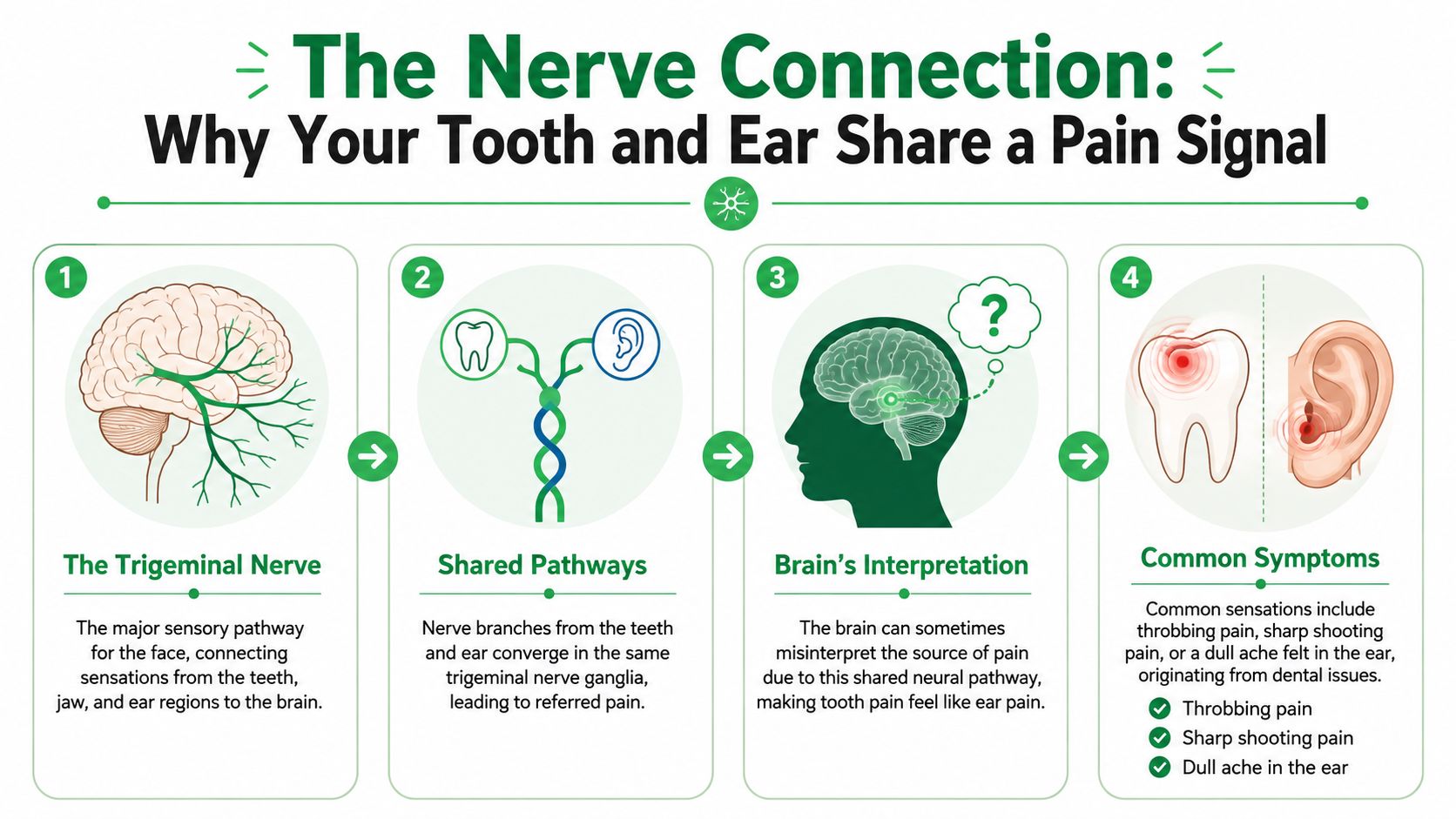
Shared wiring can blur the source
Your teeth, jaw, and parts of the ear send sensation through shared routes in the trigeminal system, which is why the brain can mix up where pain started. To illustrate, imagine several apartment phones connected to the same switchboard. If one line gets overloaded, the message can arrive at the wrong extension.
That's why an inflamed molar, deep decay, or a jaw joint problem can feel like ear pain even when the ear itself is normal. The symptom isn't imaginary, and it isn't random. It's the brain working with overlapping sensory input and making its best guess.
Practical rule: if the pain behaves like a tooth problem, treat it like a tooth problem until a professional rules otherwise.
For a plain-language explanation of the pain-processing side of this, the article on how the brain processes pain is a useful companion read. The core point is simple, the brain doesn't always localize pain perfectly when signals converge.
Why this matters before you book an appointment
A calm dental exam can often separate ear-origin pain from dental-origin pain faster than guessing can. The examiner can look for tenderness, percussion sensitivity, gum swelling, and bite-related pain, then decide whether the source is a tooth, jaw joint, or something else nearby. That's much more useful than trying to label the problem from the ear alone.
The key takeaway is that shared nerve wiring explains the confusion, but the trigger pattern still tells the story. When the pain tracks with tooth use, that's a strong clue the tooth or supporting structures need attention.
Common Dental Culprits Behind Referred Ear Pain
A deep cavity is often where the trouble begins. Early on, the tooth may only react to sweets or cold drinks, but once the inner tissue becomes inflamed, the pain can spread and become harder to pin down. Some people feel a steady throb, while others notice a sharp flare that seems to travel toward the ear.
A dental abscess usually feels more urgent. Swelling, pressure, and constant pain are common clues, and the discomfort may spread because infection can intensify the nerve signals coming from the tooth. If chewing hurts and the area feels warm, tender, or puffy, that pattern needs prompt attention.
Teeth that trigger pain when you chew
Impacted wisdom teeth and cracked teeth often make themselves known through use. Biting may bring on the pain first, then the ache spreads into the jawline or ear region. The tooth may also feel “off” when you close down on it, which points to a structural problem rather than simple surface sensitivity.
Dental disorders can account for a large share of referred ear pain in ENT settings, as noted in a PubMed review. That is one reason a careful dental exam matters when earache is paired with a suspicious tooth. If the discomfort starts from the tooth, treatment may involve fillings, root canal treatment, crowns, or extraction, depending on the underlying issue.
If you want a clearer picture of what root canal treatment is meant to address, this internal guide on everything you need to know about root canals in Houston is a helpful next read.
Look for the pattern: tooth-related pain often reacts to temperature, pressure, and chewing before it turns into a constant ache.
A helpful clinical clue is that pain from dental disease usually follows the tooth's job. Hot, cold, biting, and tapping can each reveal something different about the tooth's condition. A symptom that seems to “move” to the ear may still begin with one damaged tooth.
When It Is Not Your Tooth TMJ Sinus Issues and More
A sore ear can come from the jaw joint just as easily as from a tooth. TMJ dysfunction sits high on the list because the joint lies close to the ear and shares neighboring muscles and nerves. In one study of patients with orofacial pain, ear symptoms appeared in 72% of TMD patients, and ear fullness was especially common; another study found 46% of people seeking medical care for ear pain had TMJ dysfunction (PMC study).
Clues that point toward TMJ
TMJ pain usually changes when the jaw moves, not when the tooth is tapped or exposed to cold. Clenching, grinding, yawning, chewing gum, or opening wide can all make the pain worse. A clicking or popping jaw, muscle soreness near the temples, or stiffness when you wake up are all clues that the joint or chewing muscles are involved.
For patients who want a broader view of jaw-related facial pain, this resource on Evidence-informed orofacial care gives a useful overview of how the area can be managed. In dental care, the same logic applies, if the pain follows jaw motion, the jaw deserves close attention.
Sinus pressure can blur the picture
Sinus issues can create pressure in the upper teeth and around the face, which is why people sometimes blame a tooth when the sinuses are driving the symptoms. This tends to feel more like pressure or fullness than a sharp bite-triggered toothache. If the discomfort spreads across the cheek and comes with congestion or head pressure, the pattern leans away from a single tooth.
A rare but important possibility is nerve pain, which can feel sudden, electric, or unusually intense. That kind of pain doesn't behave like typical decay or joint soreness, so it needs a professional diagnosis rather than a guess.
If you've been told you may have jaw-related pain, this internal page on TMD pain treatment in Houston what you need to know can help you understand what treatment conversations usually look like.
Decoding Your Symptoms and Knowing When to Call Us
The fastest way to sort this out is to match the trigger to the symptom. Biting and temperature changes tend to point toward the tooth, while jaw motion and clenching point more toward TMJ or muscle strain. That simple split can save a lot of uncertainty.
| Symptom Checker: Tooth Pain vs. TMJ vs. Sinus Pain | Potential Cause | Primary Pain Type | Key Triggers | Other Common Symptoms |
|---|---|---|---|---|
| Symptom Checker: Tooth Pain vs. TMJ vs. Sinus Pain | Dental abscess or deep decay | Throbbing, sharp, or lingering ache | Chewing, biting, hot or cold drinks, tapping the tooth | Swelling, gum tenderness, sensitivity |
| Symptom Checker: Tooth Pain vs. TMJ vs. Sinus Pain | TMJ or chewing muscle strain | Dull ache, pressure near the ear or jaw | Opening wide, clenching, grinding, chewing | Clicking jaw, morning stiffness, temple soreness |
| Symptom Checker: Tooth Pain vs. TMJ vs. Sinus Pain | Sinus pressure | Fullness or pressure in the face | Head movement, congestion, bending forward | Facial pressure, upper tooth discomfort, stuffiness |
The most actionable clue is still the trigger pattern. Pain that worsens with biting, thermal change, or percussion points toward odontogenic disease, while pain amplified by jaw opening, closing, clenching, or bruxism suggests TMJ or masticatory muscle involvement (LI Family Dental). If you can't make the pain settle by changing how you use the tooth or jaw, don't keep guessing.
If swelling is spreading, fever shows up, or swallowing becomes difficult, stop waiting and get urgent care.
Severe facial swelling, fever, trouble breathing, or trouble opening the mouth normally are not symptoms to watch at home. Those signs can mean an infection needs prompt evaluation.
All Stars Dental can evaluate tooth pain, jaw pain, and related oral problems in one visit, which is helpful when the source isn't obvious. For relief options and what a visit can look like, this guide on toothache relief in Houston is a practical place to start.
Your Next Steps Toward Pain Relief in Houston

Pain that travels from the tooth to the ear is a signal, not a mystery to ignore. The safest next move is a professional exam that checks the tooth, gums, bite, and jaw together, because the actual source isn't always the place that hurts the most. That's especially true when the pain changes with chewing or jaw movement.
If you're in Houston and the symptoms are sticking around, don't wait for them to sort themselves out. A dentist can tell the difference between a tooth problem, TMJ strain, and other causes, then guide you toward the right treatment instead of trial and error. For patients who want a calm first step, All Stars Dental is one place to schedule that evaluation.
If your tooth pain is reaching your ear, book a visit with All Stars Dental in Houston so the source can be checked properly and treated before it gets worse. They provide dental evaluation, restorative care, and TMD assessment in one setting, which makes it easier to get answers when the pain is confusing.