
Teeth Whitening Cost: A Complete 2026 Pricing Guide
Professional in-office whitening usually runs $300 to $1,500 per session, dentist-made take-home trays $150 to $600, and over-the-counter kits $20 to $100+. If you're comparing options before a wedding, a new job, or a photo-heavy season, the question isn't just what whitening costs, it's what kind of result you're buying for that money.
A Houston adult staring at a mirror before a big event is usually weighing the same thing. Pay more for speed, spend less for convenience, or choose the middle path for better control and a more durable result.
Table of Contents
- What Teeth Whitening Costs in 2026
- In-Office Whitening and the Price of Speed
- Take-Home Trays From a Dentist
- Over-the-Counter Whitening on a Budget
- Hidden Factors That Change Your Final Price
- How Long Results Last and What Touch-Ups Cost
- Common Misconceptions That Drive Up Cost
- Choosing the Right Option for Your Smile and Budget
What Teeth Whitening Costs in 2026
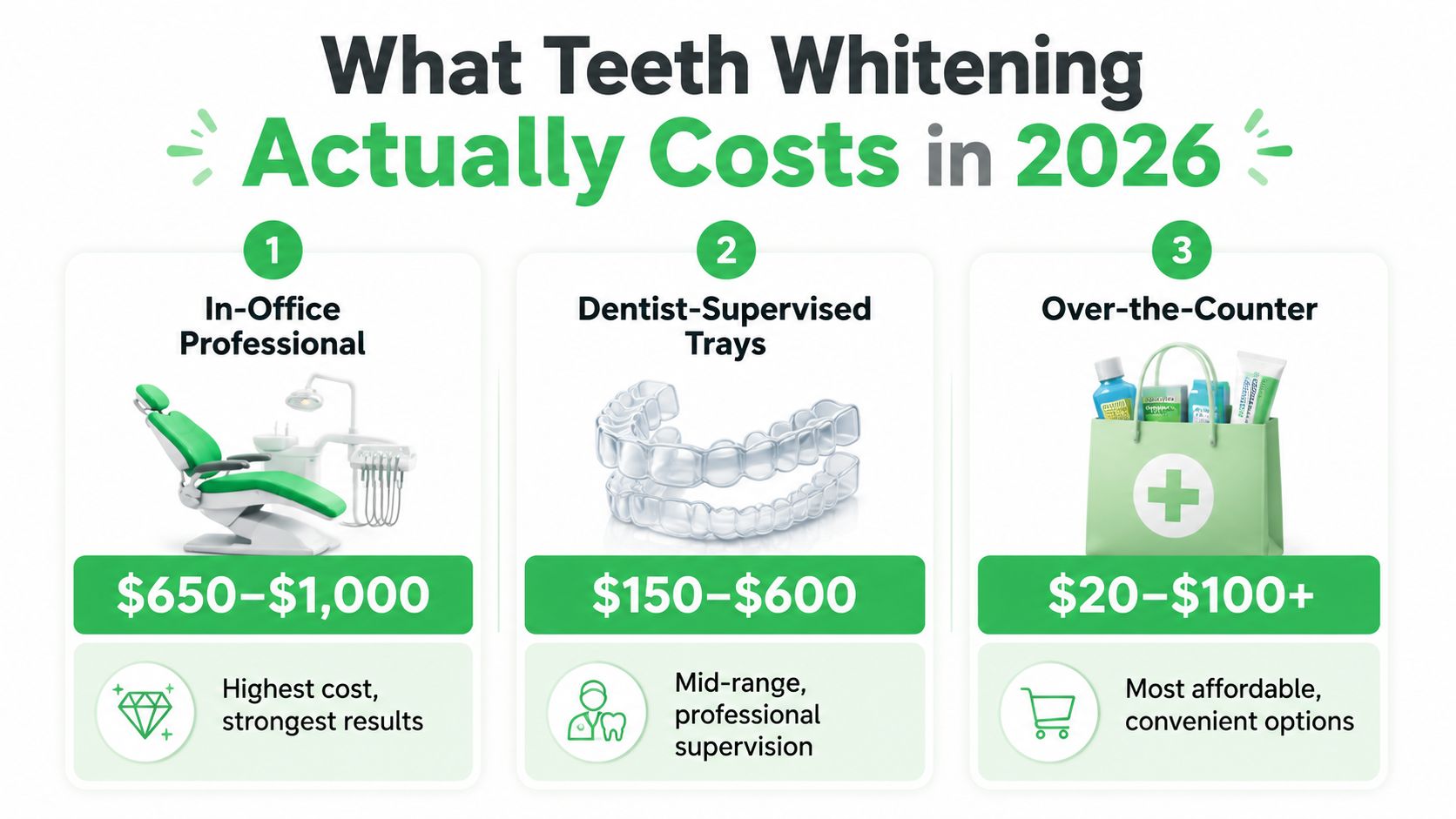
The three price tiers you'll see
Teeth whitening cost is a spectrum, not a single number. If you want the fastest change, you pay for in-office professional whitening, where clinician control, stronger gels, and chairside time push the price to the top of the market. GoodRx reports an average cost under a dentist's supervision of $508 in 2022, up from $393 in 2019, and says whitening can range from $10 for some over-the-counter products to $1,000 or more for professional treatment GoodRx.
A Houston patient who walks in before a wedding usually gets three very different options. One is fast and expensive. One is slower and more controlled. One is cheap enough to pick up at a pharmacy tonight, but it usually gives the smallest change in shade.
Practical rule: Pay for the amount of supervision your stain pattern needs. Don't buy the most expensive option just because it sounds stronger.
Why the numbers spread out so much
Supervised whitening costs more because you are paying for customization, isolation of the gums, clinical setup, and the dentist's time. CareCredit reports that laser dental whitening averages $792, with a range of $611 to $1,368, while dentist-provided take-home kits usually run $375 to $500 CareCredit. That gap is not random. It reflects the level of control built into the treatment and how much oversight your case needs.
The chemistry changes too. In-office systems use 25 to 40% hydrogen peroxide and aim for a fast visible shift, while custom trays usually rely on lower-strength peroxide formulas worn over time Dental Area. Real Dental Costs puts professional in-office whitening around $300 to $1,000 per session, take-home trays around $150 to $600, and OTC strips around $20 to $70 Real Dental Costs.
If you want the cleanest way to choose, use shade change as the metric. Ask how much brightening you need, how soon you need it, and how long you want it to hold. That gives a far better answer than shopping by sticker price, and it is the same logic I use when I guide patients toward the right teeth whitening treatment for their goals.
In-Office Whitening and the Price of Speed
What you're paying for at the chairside level
In-office whitening is the fastest way to change a smile, and it's the most expensive for a reason. You're paying for a trained clinician, soft tissue protection, controlled gel placement, and the ability to get a meaningful result in a single visit. Typical pricing for professional in-office whitening sits around $300 to $1,500 per session CareCredit and Real Dental Costs.
This option is built for urgency. If someone has a deadline in days, not weeks, chairside whitening is the cleanest solution because the office handles the chemistry and the protection around it. That convenience is expensive, but it's not fluff. It's clinical overhead.
You're not buying “white teeth in an hour” as a slogan. You're buying a controlled treatment that limits gel contact where it shouldn't go.
The common active ingredient is 25 to 40% hydrogen peroxide in in-office systems Dental Area. That concentration is why the results can look dramatic quickly, but it also explains why supervision matters. The dentist can isolate the gums, manage sensitivity, and adjust treatment if the teeth respond unevenly.
When speed is worth the premium
A lot of patients assume the light or laser is the whole product. It isn't. In many cases, the value is the clinician's ability to place the gel correctly and protect the tissues around it. Evidence-based summaries also note that light activation doesn't always produce proportionally better whitening than well-fitted tray systems Dental Area.
That's the key tradeoff. If you care most about speed, in-office whitening makes sense. If you care most about value per shade change, custom trays often win. A patient preparing for a wedding, TV appearance, interview, or reunion usually benefits from chairside whitening because the timeline is tight and the result has to be visible fast.
For a deeper look at how the treatment is performed in practice, see this Houston whitening treatment overview.
Take-Home Trays From a Dentist
The middle tier that usually gives the best balance
Dentist-supervised take-home trays are the smartest compromise for many people. They're usually priced around $150 to $600, and CareCredit says many dentist-provided kits land between $375 and $500 CareCredit. That's a lot less than in-office whitening, but you still get professional oversight and a custom fit.
The process is straightforward. The dentist takes impressions, the lab or office makes trays that fit your teeth, and you wear a professional gel at home on a daily schedule. Industry summaries place the typical carbamide peroxide strength for these trays around 10 to 22% Dental Area, which is why the results build more gradually than chairside whitening.
A custom tray matters more than some realize. It keeps saliva away from the gel, helps the medication stay where it belongs, and reduces the uneven whitening that happens with generic strips. That's where the value comes from. You're not just buying gel, you're buying precision.
Why this option is often the best value
The strongest argument for custom trays is reuse. Once you have the trays, future touch-ups are much cheaper because you're usually only paying for refill gel, not a whole new appliance. That lowers the long-term cost in a way store-bought products can't match.
If you've had whitening before and want to keep your smile bright without repeating a full in-office appointment, trays are usually the better financial choice. They also fit busy schedules because you can whiten at home without sitting in a chair.
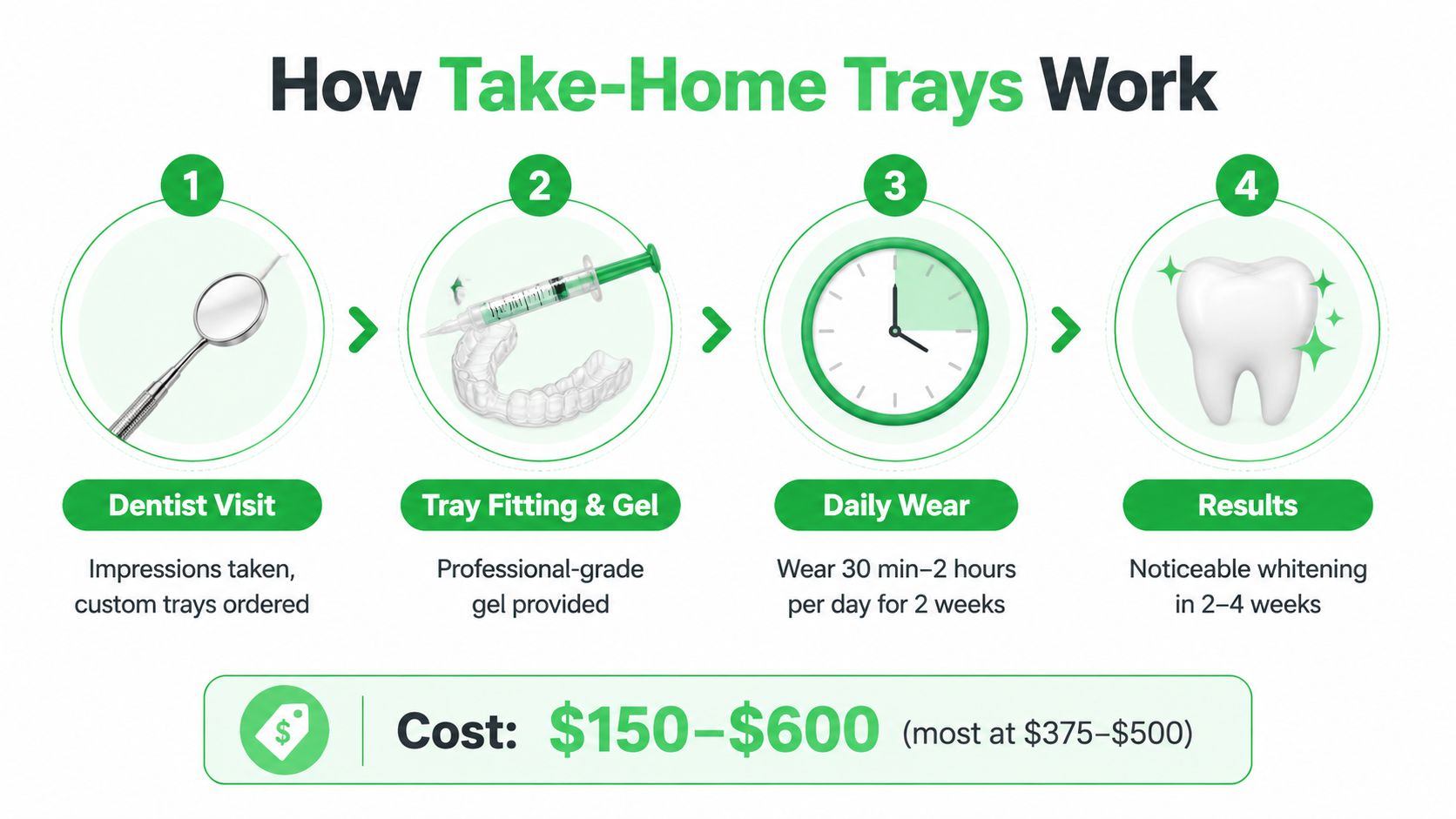
My opinion: If you don't need instant results, custom trays are usually the best blend of price, predictability, and repeat value.
Over-the-Counter Whitening on a Budget
What the drugstore shelf actually gives you
Over-the-counter whitening is the cheapest entry point, usually around $20 to $100+ depending on strips, pens, gels, and LED kits GoodRx. The problem is that the lower price usually comes with weaker ingredients, less precise fit, and more uneven results.
Most OTC systems are fine for mild surface stains and maintenance after professional whitening. They're a poor choice if the discoloration is deep, uneven, or clearly tied to years of staining. Generic strips can help some smiles. They do not behave like a custom dental tray, and they're not supposed to.
If you're looking at retail products, keep the focus on function, not hype. A maintenance product like the Healtsy whitening toothpaste product may fit into a stain-control routine, but toothpaste is not the same thing as a whitening treatment. It can support a cleaner-looking smile, not replace a real whitening plan.
What to skip and what to keep in mind
Charcoal powders and trendy LED kits are heavily marketed, but they're usually more about branding than predictable whitening. If a product promises dramatic change without clear supervision, custom fit, or a sensible ingredient profile, it's probably not where your money should go.
OTC makes sense in three situations. First, you want a low-cost trial before committing to professional care. Second, you only need minor brightening. Third, you're maintaining results after a dentist-supervised treatment.
For smokers, the question gets more complicated because stain type matters. This resource on whitening for smokers is worth reading if tobacco use has darkened your teeth. OTC products can help with some surface staining, but they rarely solve a heavy staining pattern on their own.
Hidden Factors That Change Your Final Price
Stain type is the biggest hidden cost driver
The brochure price rarely tells you what you will spend. Intrinsic discoloration, meaning staining inside the tooth rather than on the surface, usually calls for a different treatment path. Internal bleaching is a separate procedure from routine external whitening, and Humana's dental resource places it at about $297.80 per arch Humana.
That matters because two patients can ask for the same brighter smile and still need very different work. Surface stains from coffee or tea often respond well to trays or strips. Deep discoloration, especially when it is built into the tooth itself, can make cheap whitening a poor buy. Pay for the right method first, or you end up spending twice.
| Method | Typical Cost | Active Ingredient | Treatment Time | Best For |
|---|---|---|---|---|
| In-office whitening | $300 to $1,500 | 25 to 40% hydrogen peroxide | About one visit | Fast results, special events |
| Dentist take-home trays | $150 to $600 | 10 to 22% carbamide peroxide | Daily use over about 1 to 2 weeks | Custom fit, value, repeat touch-ups |
| Over-the-counter strips | $20 to $100+ | Varies by product | Several days to weeks | Mild stains, budget maintenance |
| Internal bleaching | About $297.80 per arch | Dentist-directed bleaching agent | Case dependent | Internal discoloration |
Restorations, habits, and geography change the bill
Crowns and veneers do not whiten the way natural enamel does, so visible restorations can change the final look and force a different plan. Cleaning, cavity repair, or other prep work can also raise the total. Age, genetics, coffee, tea, and tobacco use all affect how much whitening you need and how long the result holds.
One patient may need a simple touch-up, while another needs a broader plan to match natural teeth with restorations. That is why the cheapest quote is often the most misleading one. The question is whether the method matches the stain pattern and the amount of correction you need.
Prices also shift by clinic overhead and the technology a practice uses. Houston pricing often sits near national benchmarks, but clinics still build quotes differently. Ask exactly what is included. Evaluation, trays, gel, follow-up, and touch-up guidance should all be clear before you pay.
For smokers, the stain pattern matters even more, and this resource on whitening for smokers is worth reading if tobacco use has darkened your teeth. OTC products can handle some surface staining, but they usually fall short when the discoloration is heavy or long-standing.
Direct advice: Do not ask, “How much is whitening?” Ask, “What type of staining do I have, what method fits it, and what will the total plan cost?”
How Long Results Last and What Touch-Ups Cost
Longevity changes the math
Sticker price is the wrong way to compare whitening. A treatment that costs more upfront can be cheaper per year if it lasts longer. That's why you should think in value per shade change, not just the number on the receipt.
In-office results usually last longer than drugstore options, and custom trays sit in the middle with a strong maintenance advantage because the trays can be reused. OTC results tend to fade faster because the systems are less customized and less powerful. The practical takeaway is simple. The cheapest first purchase is not always the cheapest ongoing strategy.
Here's the same logic in plain terms. If a whitening plan holds its result longer, you spread that cost over more months of use. If it fades quickly, you pay again sooner.
Touch-ups are where custom trays shine
Take-home trays have a real long-term edge because the trays themselves don't disappear after one cycle. You can keep them and buy refill gel as needed. That means your maintenance cost is usually tied to the gel, not a brand-new appliance.
For everyday maintenance, small habits matter more than people expect. Use a straw for coffee when you can, cut back on staining foods, and get regular cleanings at a trusted general dentistry practice. Those moves won't replace whitening, but they do protect the result you already paid for.
Best habit: Protect the result you bought. Whitening is cheaper to maintain than to repeat from scratch.
Common Misconceptions That Drive Up Cost
Cheap doesn't always mean smart
The biggest mistake patients make is assuming all whitening products work the same. They don't. Some products are convenient but weak, some are strong but poorly fitted, and some are marketed aggressively without delivering meaningful shade change.
Another common myth is that whitening ruins enamel. Professionally supervised whitening, used correctly, is a standard cosmetic procedure and is not the same thing as random at-home overuse. The problem is usually misuse, not the category itself. That's why supervision matters.
Insurance is another source of confusion. Most dental plans do not cover whitening because it's considered cosmetic. That doesn't make it frivolous. It just means you should expect to pay out of pocket and ask for a clear quote before treatment starts.
What to ask before you pay
A good dentist should answer direct questions without dodging them. Ask how much shade change is realistic for your teeth, whether you need prep work first, and what maintenance will look like after the initial treatment. If you want financing, ask about it before you sit in the chair, not after.
The goal isn't to find the cheapest product that claims to whiten. The goal is to choose the method that changes your smile in a way you can keep.
Choosing the Right Option for Your Smile and Budget
Match the method to the job
If you've got a big event and want the biggest visible change fast, choose in-office whitening. If you want a balance of results, convenience, and long-term value, go with custom take-home trays. If your staining is mild and your budget is tight, start with OTC whitening plus a professional cleaning.
For readers who also care about the broader smile effect, this guide for anti-aging and white teeth is a useful reminder that brightness affects the whole face, not just one tooth color goal. The point is still the same, though, choose the method that fits the stain, not the marketing.
A general and cosmetic dentist should evaluate enamel health, restorations, and realistic goals before you spend a dollar on whitening. That consultation saves money because it keeps you from buying the wrong category of treatment. All Stars Dental in central Houston offers both in-office and take-home whitening, with fees quoted up front and financing available, which is exactly how the process should be handled. You can also review the practice's benefits of teeth whitening page to understand how treatment fits into a cosmetic plan.
My blunt recommendation
If you want the strongest value, custom trays are the best default for most adults. If you want the fastest result, pay for the chairside visit. If you just want a small improvement without committing much money, try OTC only as a starter, not as your final plan.
If you're in Houston and want a straight answer about whether whitening is worth it for your teeth, schedule a consultation with All Stars Dental. Bring your timeline, your budget, and your questions, and get a treatment plan that matches your smile instead of a one-size-fits-all guess.
If you're ready to compare in-office whitening, custom trays, and maintenance options for your own teeth, visit All Stars Dental and ask for a whitening consultation. The team can quote your options before any work begins, explain what kind of result you can expect, and help you choose the most sensible path for your budget and timeline.