
Dental Implant vs. Bridge: A Comprehensive 2026 Guide to Restoring Your Smile
What if the most affordable way to fix your smile today actually ends up costing you more in the long run? It’s completely natural to feel a bit hesitant when you’re weighing the choice between a dental implant vs bridge. You might find yourself avoiding certain foods or covering your mouth when you laugh, all while feeling confused by the different paths to restoration. We understand that this isn’t just a clinical decision; it’s about your daily comfort and your sense of self.
You deserve to feel informed and relaxed as you plan your care. In this 2026 guide, you’ll discover the key differences between these two options so you can choose the most durable, natural-looking solution for your unique needs. We’ll walk through the latest advancements in digital dentistry, like 3D imaging, and compare the long-term health benefits of each approach. Since dental implants now boast a ten-year success rate of up to 97%, we’ll help you decide if that longevity matches your personal goals for a permanent, healthy smile.
Key Takeaways
- Learn how tooth replacement is about more than aesthetics, specifically how choosing the right restoration helps preserve your jawbone and prevents surrounding teeth from shifting.
- Understand the structural differences of a dental implant vs bridge, including how each interacts with your natural teeth and which option offers a more self-supporting solution.
- Discover why a long-term perspective on value is essential, as certain restorations are designed to offer a lifetime of use while others may require periodic replacement.
- Gain clarity on how the treatment process affects your neighboring healthy teeth and what to expect during the healing journey.
- Explore how a personalized, unhurried consultation with a restorative expert ensures your treatment plan aligns with your unique lifestyle and comfort goals.
Understanding the Impact of Missing Teeth on Your Health and Confidence
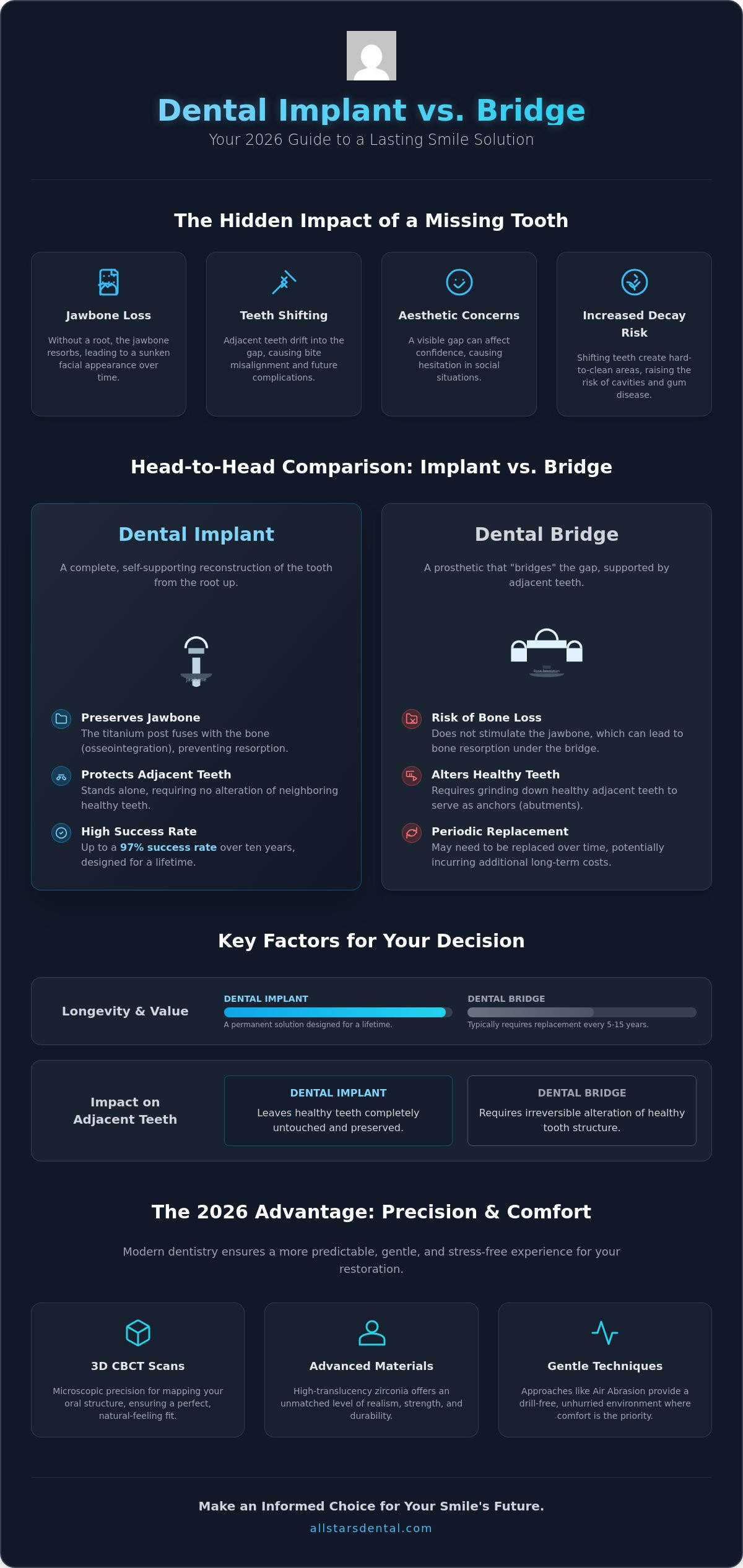
When you lose a tooth, the change is often felt immediately in your self-esteem, but the shift beneath the surface is just as significant. Your mouth is a finely tuned ecosystem where every tooth plays a role in maintaining the position of its neighbors. When a gap is left unaddressed, the surrounding teeth lose their structural support and begin to tilt or “drift” into the empty space. This movement, often called the domino effect, can lead to a misaligned bite, making it difficult to chew comfortably and potentially causing long-term jaw discomfort. Deciding on a dental implant vs bridge is about more than just filling a space; it’s about stopping this chain reaction before it compromises your entire smile.
Beyond the visible teeth, your jawbone requires the constant stimulation of a tooth root to remain dense and healthy. Without that pressure, the bone begins to dissolve in a process known as resorption. Over time, this loss of bone volume can cause your facial features to sag, leading to an appearance of premature aging that many patients find distressing. We understand that this isn’t just a clinical issue. It’s about the hesitation you feel before a social gathering or the way you might cover your mouth when you laugh. Addressing these concerns early helps you regain your confidence and protects the structural integrity of your face.
The Physical Consequences of Untreated Gaps
When teeth shift, they create new, tight spaces that are incredibly difficult to clean with standard brushing and flossing. These pockets become breeding grounds for bacteria, significantly increasing your risk for tooth decay and gum disease in teeth that were previously healthy. You might also notice subtle changes in your speech or a newfound hesitation to order your favorite crunchy foods at a restaurant. Bone resorption is the natural process where the body reabsorbs jawbone tissue that is no longer being stimulated by a tooth root, which eventually alters the underlying support for your lips and cheeks.
Why 2026 is the Best Time for Restoration
If you’ve been putting off treatment due to anxiety, you’ll be heartened to know that restorative care has become a much more gentle, patient-centered experience. In 2026, we utilize advanced diagnostic tools like 3D CBCT scans to map your oral structure with microscopic precision, ensuring that whether you choose an implant or a What is a dental bridge?, the result feels like a natural part of you. Modern materials like high-translucency zirconia offer a level of realism and strength that simply wasn’t available a decade ago. At All Stars Dental, Dr. Tran uses these innovations alongside techniques like Air Abrasion to provide a drill-free, unhurried environment where your comfort is the priority. Choosing between a dental implant vs bridge in today’s clinical environment means you can move toward a healthier smile with more predictability and less stress than ever before.
Dental Implant vs. Bridge: A Detailed Look at Your Restoration Options
Choosing between a dental implant vs bridge is essentially a choice between a structural replacement and a functional span. Think of an implant as a complete reconstruction of your tooth from the root up. It stands alone, much like a natural tooth. A dental bridge, conversely, is a graceful prosthetic that bridges the gap by leaning on the strength of your neighboring teeth. Both options are designed to restore your smile’s beauty, yet they function quite differently within your mouth. While one replaces the missing root, the other uses a supportive framework to hold a beautiful new crown in place.
The Anatomy of a Dental Implant
An implant is a sophisticated three-part system. It begins with a titanium post that serves as your new root. This post is gently placed into the jawbone, where it undergoes osseointegration. This is a natural, steady process where the bone fuses to the metal to create a permanent, rock-solid foundation. Next, an abutment acts as a connector, finally topped by a custom-crafted porcelain crown. Because the implant mimics the entire structure of a tooth, many patients find it feels indistinguishable from their natural ones. When you’re considering the long-term investment, reviewing the single tooth implant cost in Houston can help you understand the value this durability provides over several decades.
How a Dental Bridge Works
A bridge relies on a different architectural principle. It uses abutment teeth, which are the healthy teeth on either side of the gap, as pillars to support a floating prosthetic tooth called a pontic. This expert comparison of implants and bridges highlights that while bridges are a time-tested solution, they do require the gentle reshaping of those anchor teeth to ensure a secure fit. This process allows the bridge to sit flush and feel natural. There are several variations to fit your specific anatomy:
- Traditional Bridges: These are the most common type, utilizing crowns on both sides of the gap.
- Cantilever Bridges: These are used when there’s only one anchor tooth available next to the space.
- Maryland Bridges: This is a more conservative approach using a framework bonded to the back of adjacent teeth.
Bridges remain a popular choice for those seeking faster results, as the entire process is often finished in just two weeks. If you’re looking for a swift transformation, a bridge offers an efficient path to a complete smile. Implants require more patience, typically taking three to six months to allow for proper healing and bone integration. However, that time spent waiting often results in a “set it and forget it” feeling that many find worth the journey. If you’re feeling unsure which timeline fits your lifestyle, Dr. Tran is here to offer a calm, unhurried perspective on your dental bridge or implant restoration options.
The Gentle Expert’s Comparison: Longevity, Aesthetics, and Oral Health
When you’re making a choice as significant as a dental implant vs bridge, it’s helpful to look beyond the initial procedure and imagine your life five, ten, or even forty years from now. A dental implant is often considered a lifetime solution because the titanium post becomes a permanent part of your anatomy. In contrast, while a bridge is a beautiful and functional restoration, it typically needs to be replaced every 10 to 15 years. This durability gap is a primary reason why many patients feel more relaxed choosing an implant, knowing they won’t have to revisit the same problem a decade down the line. Statistics from 2026 show that traditional bridges have a 10-year survival rate of about 89% to 90%, while implants maintain a success rate between 95% and 97% over the same period.
Aesthetics also play a major role in your daily happiness and social confidence. Because an implant is rooted in the jawbone, the crown appears to emerge naturally from the gum line, just like a real tooth. This creates a seamless transition that’s nearly impossible to detect, even during close conversations. A bridge, while expertly crafted to match your natural shade, sits on top of the gums. This structural difference also affects your daily routine. A bridge requires specific maintenance, like using a floss threader to clean underneath the prosthetic tooth to prevent plaque buildup. An implant, however, can be brushed and flossed exactly like your natural teeth, allowing you to feel enlightened and unburdened by complex hygiene protocols.
Preserving Your Natural Tooth Structure
Many people are surprised to learn that implants are actually the more conservative choice for your overall mouth. To place a bridge, a dentist must gently reshape the two healthy teeth on either side of the gap so they can serve as anchors. This involves removing a portion of healthy enamel that can’t be replaced. Implants don’t require any support from neighboring teeth, leaving your natural smile untouched. At All Stars Dental, dental implant restorations in Houston are designed to fit perfectly into your existing bite without placing any extra stress on your other teeth. This unhurried, precise approach ensures the long-term health of your entire oral ecosystem.
Bone Health and Facial Integrity
The most profound difference in the dental implant vs bridge debate lies beneath the surface. Your jawbone operates on a “use it or lose it” principle; it needs the stimulation of chewing through a tooth root to maintain its density and strength. Implants provide this vital stimulation, effectively signaling the bone to stay healthy. Without this, the bone begins to shrink through a process called resorption, which can eventually lead to a “sunken” facial appearance and premature wrinkles. While a bridge effectively fills the gap and restores your bite, it doesn’t address the underlying bone health. This Cleveland Clinic’s guide to implants vs. bridges explains how maintaining that bone structure is vital for your long-term facial integrity and overall well-being.
Choosing the Right Path: A Decision Guide for Houston Patients
Deciding on a dental implant vs bridge is a personal journey that depends on your unique health history and your long-term goals for your smile. While previous sections explored the structural differences, this guide focuses on the practical factors that help you decide which path fits your lifestyle. It’s a big choice. You’re not just choosing a procedure; you’re choosing how you’ll eat, speak, and smile for the next several decades. We believe that every patient deserves a clear, unhurried explanation of how these factors apply to their specific situation so they can move forward with confidence.
Is Your Jaw Ready for an Implant?
The health of your jawbone is the vital foundation of a successful implant. If you’ve been missing a tooth for several years, the bone in that area may have naturally thinned because it hasn’t been stimulated by a root. During an initial evaluation for a dental implant procedure in Houston, Dr. Tran uses advanced 3D imaging to determine if you have sufficient bone density to support the titanium post. If the bone is too thin, a gentle bone grafting procedure can often restore the area to make it ready for an implant. We also take the time to discuss systemic health factors, such as managed diabetes, which can influence how your body integrates with the new restoration.
Calculating the Real Cost of Your Smile
While a bridge typically has a lower upfront cost, it’s helpful to consider the “cost per year” over your lifetime. Because a bridge relies on anchor teeth, those teeth are under more stress and can be more susceptible to decay or structural failure over time. If a bridge needs to be replaced every 10 to 15 years, the total investment over three or four decades can eventually exceed that of a single implant. Implants are designed to be a one-time investment in your health. When you factor in the peace of mind that comes from a permanent, self-supporting tooth, the long-term value becomes much clearer. To help you weigh these factors, consider these three points:
- The Timeline: A bridge is often completed in just two weeks, while an implant requires several months to allow the bone to heal.
- Number of Missing Teeth: If you’re missing several teeth in a row, an implant-supported bridge might offer the best balance of stability and value.
- Adjacent Tooth Health: If the teeth next to the gap already need crowns, a bridge can solve two problems at once. If they’re healthy, an implant preserves them.
When weighing a dental implant vs bridge, remember that the “best” choice is the one that makes you feel the most secure and comfortable. It’s also worth noting that a misaligned bite resulting from tooth loss can sometimes contribute to jaw tension and chronic headaches; if you’re experiencing these symptoms alongside tooth loss, consulting a TMJ specialist Houston patients trust can help you address both concerns as part of a comprehensive care plan. If you’re ready to see which option aligns with your health goals, we invite you to schedule a restorative consultation at All Stars Dental where we can explore these paths together in a relaxed environment.
Restoring Your Smile at All Stars Dental: Where Expertise Meets Empathy
Choosing between a dental implant vs bridge is a significant milestone on your path to better health, and we believe the environment where you receive that care matters just as much as the procedure itself. At All Stars Dental, we’ve intentionally moved away from the cold, clinical atmosphere that often makes patients feel like just another number in a system. Dr. Tran brings over 15 years of experience to every consultation, acting as a patient educator who listens first and advises second. You won’t find any high-pressure sales tactics here; instead, you’ll find a steady, calming influence dedicated to helping you feel empowered by your restorative choices.
We believe that true dental expertise is defined by a high degree of emotional intelligence. We recognize that many of our Houston neighbors come to us with a history of dental anxiety or fears about invasive surgery. Our approach is designed to dismantle those anxieties through total transparency and a warm, person-centered style. Every treatment plan we create is a “one-of-a-kind” map tailored to your specific oral anatomy and lifestyle goals. We take the time to explain the technical details of your care in everyday terms, ensuring you never feel overwhelmed by the process of reclaiming your smile.
The All Stars Dental Difference in Houston
We know that the sound of a dental drill is a primary source of stress for many people. To help you feel more at ease, we utilize advanced technology like Air Abrasion for comfortable, drill-free preparation. This modern technique allows us to treat your teeth with microscopic precision while maintaining a quiet, relaxed environment. Our commitment to your success doesn’t end when the procedure is over. We focus heavily on long-term follow-up and personalized hygiene mentorship, ensuring your new restoration remains healthy and beautiful for decades to come. This unhurried, thorough approach is why our patients often describe their experience as one of calm and security.
Begin Your Journey to a Complete Smile
This personalized journey begins with a comprehensive oral exam where we look at the holistic health of your mouth. Before we make any final decisions about a dental implant vs bridge, Dr. Tran will evaluate your bone density, the health of your surrounding teeth, and your overall well-being. We want you to feel enlightened and confident before any work begins. To prepare for your first visit, it’s helpful to think about your long-term priorities, such as how much time you can dedicate to the healing process or your preferences for daily maintenance. For patients who are also exploring full-arch tooth replacement options, our guide to same-day dentures vs traditional dentures in Houston offers a helpful look at how timing and lifestyle shape the best restorative path.
If you’re still exploring which path is right for you, we invite you to read our detailed look at dental bridges in Houston as a viable, time-tested alternative to implants. Our team is here to guide you through every step of this transformation with kindness and skill. We aren’t just restoring teeth; we’re helping you regain the freedom to eat, speak, and laugh without hesitation. When you’re ready to take that next step, you’ll find a trusted partner waiting to help you achieve a permanent, natural-looking smile in an environment where you truly feel seen and cared for.
Take the Next Step Toward Your Renewed Smile
Choosing between a dental implant vs bridge is a significant decision that affects your comfort, your confidence, and your long-term oral health. The right path for you depends on your unique bone structure, your desired timeline, and whether you’re looking for a lifetime solution or a swifter transformation. Whether you prioritize the bone-preserving benefits of an implant or the efficient results of a bridge, your journey should always be guided by a partner who values your peace of mind as much as your clinical outcome.
With over 15 years of experience in restorative dentistry and full mouth reconstruction in Houston, Dr. Tran is dedicated to providing a painless and unhurried experience. We utilize gentle techniques like Air Abrasion to ensure your comfort from the very first visit. You deserve a smile that feels as natural as it looks, and we’re here to help you navigate these options with empathy and expertise. We invite you to Schedule Your Gentle Consultation with Dr. Tran Today and discover how a personalized treatment plan can restore your smile and your quality of life. We look forward to welcoming you into our care and helping you smile with confidence again.
Common Questions About Your Smile Restoration
Which is more painful: getting a dental implant or a bridge?
Both procedures are designed to be comfortable and stress-free experiences. Most patients are pleasantly surprised to find that a dental implant procedure often involves less post-operative discomfort than a standard tooth extraction. For a bridge, the preparation of anchor teeth is a gentle process similar to receiving a dental crown. We use modern numbing techniques and unhurried care to ensure you feel relaxed and secure throughout your visit.
How long does a dental bridge last compared to an implant?
A traditional dental bridge is a durable solution that typically serves you well for 10 to 15 years with proper care. However, when comparing a dental implant vs bridge, the implant offers significantly more longevity. Dental implants are engineered to be a lifetime restoration, boasting a 10-year success rate of up to 97% in 2026. While a bridge may eventually require replacement, an implant is a permanent addition to your oral anatomy. Understanding what separates a standard restoration from the best dental implants in terms of material quality and component precision can help you make a more informed decision about this long-term investment.
Can I get a dental implant if I have been missing a tooth for years?
Yes, you can absolutely restore your smile with an implant even after several years of tooth loss. The main consideration is the density of your jawbone, which naturally thins when a root is missing. If our 3D imaging shows that your bone has receded, we can often perform a gentle bone graft to rebuild the foundation. This restorative step ensures your new tooth has the steady support it needs to stay healthy for decades.
Does insurance typically cover dental implants or bridges in 2026?
In 2026, most PPO dental insurance plans classify both options as major restorative procedures. These plans typically cover between 40% and 50% of the cost once you’ve met your deductible. It’s important to keep in mind that most annual insurance maximums range from $1,500 to $2,500. Our team is happy to help you navigate your specific benefits so you feel enlightened and informed about your investment before treatment begins.
How many appointments are required for a dental bridge?
A dental bridge usually requires two unhurried appointments to complete your transformation. During the first visit, we gently prepare the neighboring anchor teeth and take precise digital impressions of your mouth. About two weeks later, you’ll return for your second appointment, where Dr. Tran will carefully bond your custom-crafted bridge into place. This efficient timeline allows you to enjoy a complete, functional smile in a relatively short period of time.
What happens if I choose not to replace a missing tooth at all?
Leaving a gap in your smile can lead to a “domino effect” where your remaining teeth begin to tilt and drift out of place. This movement often results in bite misalignment and makes it much harder to keep your teeth clean, increasing the risk of future decay. Additionally, the jawbone in the empty space will continue to dissolve through resorption. Over time, this bone loss can cause your facial features to sag and appear prematurely aged.
Can a dental bridge be replaced with an implant later on?
It is very common for patients to transition from a bridge to an implant as their needs or goals change. If you currently have a bridge but want the permanent, self-supporting benefits of an implant, we can certainly help. We will simply evaluate the health of the bone underneath your current prosthetic. If the bone has thinned since your original bridge was placed, a minor graft can prepare the site for a successful, long-term dental implant vs bridge upgrade.
Are there any age limits for getting dental implants in Houston?
There is no upper age limit for receiving restorative care; your overall health and bone density are far more important than the date on your birth certificate. Many of our older patients in Houston find that implants significantly improve their quality of life and ability to enjoy their favorite foods. We generally only recommend waiting for younger patients until their jawbone has finished growing, which typically occurs in the late teens or early twenties. Patients who are weighing broader tooth replacement solutions may also find it helpful to explore our comparison of same-day dentures vs traditional dentures in Houston to understand all the restorative paths available at any stage of life.
- Affordable Full Mouth Reconstruction in Houston: Your 2026 Guide to Restoring Your Smile
- The Best Dental Implants of 2026: A Patient’s Guide to Quality and Longevity
- Root Canal Recovery: A Step-by-Step Guide to Gentle Healing in Houston
- What’s a Crown in Dentistry? Your Complete 2026 Guide to Restorative Care
- Smile Makeover Houston: The 2026 Guide to Your Custom Cosmetic Transformation
- Same-Day Dentures vs. Traditional Dentures in Houston: Which Is Right for You?
- Air Abrasion Houston: The Guide to Drill-Free Dental Care and Cavity Treatment