
What Are Veneers: A Clear Guide to a Lasting Smile
You catch your reflection in a phone photo and notice one front tooth looks darker than the others, or there's a tiny chip you never cared about until it showed up under flash. That's usually when the question starts: what are veneers, and are they a reasonable way to fix a smile without overdoing it?
Veneers are one of the most recognizable cosmetic dental treatments because they change the part of the tooth people see. They're also easy to misunderstand, since they sit somewhere between a cosmetic cover and a dental restoration. The right answer depends on what you want to change, what you're trying not to change, and how much tooth structure you're willing to trade for the result.
Table of Contents
- Understanding What Veneers Actually Are
- Porcelain vs Composite Veneers
- How the Veneer Procedure Works Step by Step
- Veneers vs Other Cosmetic Options
- Pros and Cons of Choosing Veneers
- Who Makes a Good Veneer Candidate
- How Long Veneers Last and How to Care for Them
- Questions to Ask at Your Veneer Consultation
Understanding What Veneers Actually Are
A patient often notices the problem in the most ordinary way. A selfie comes back, and one tooth looks shorter, darker, or slightly chipped at the edge. The rest of the smile may look fine, but that one detail becomes impossible to ignore.
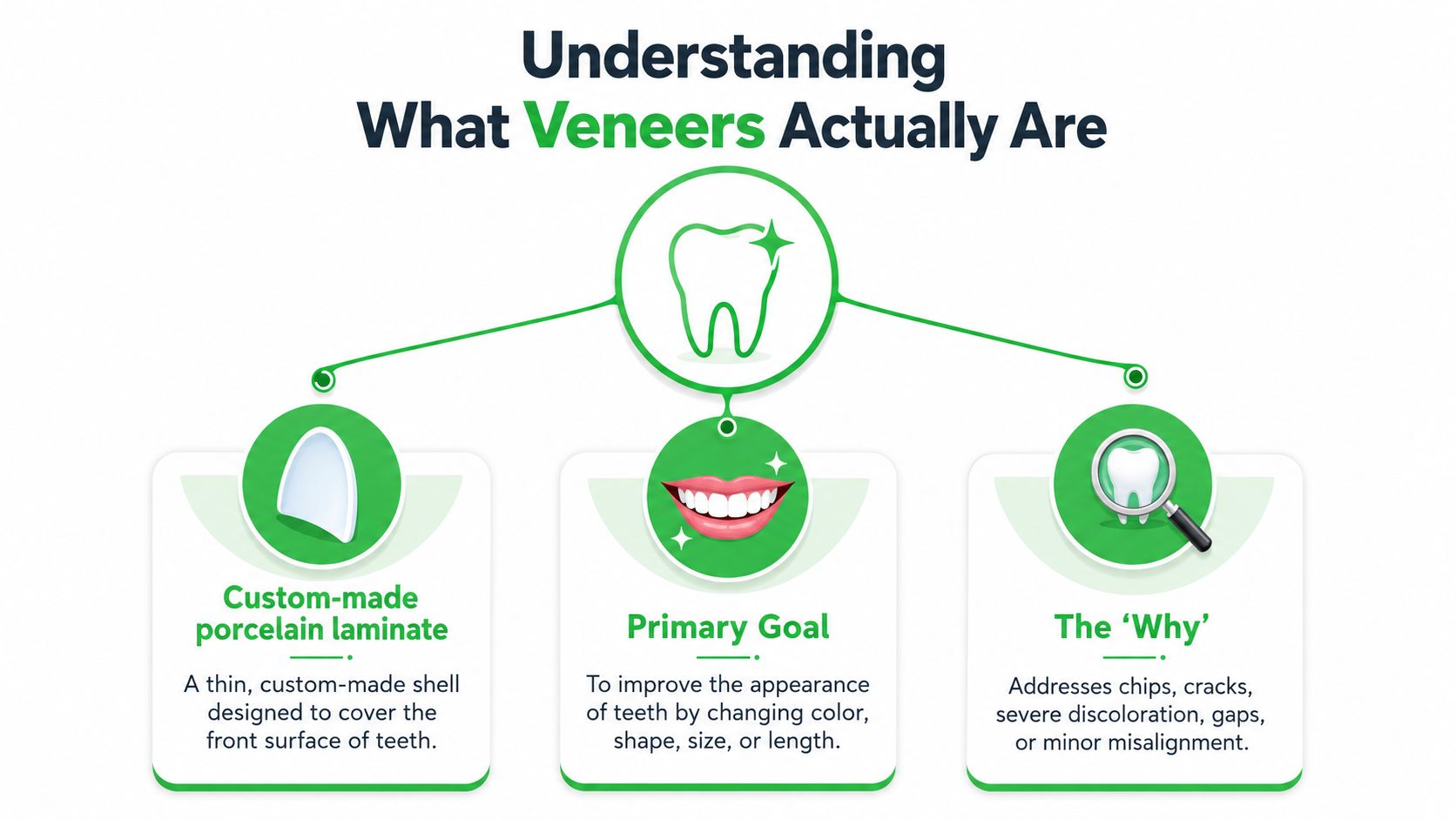
A veneer is a thin, custom-made shell that bonds to the front surface of a tooth. A contact lens for a tooth, or a carefully shaped façade that changes what shows in the mirror without replacing the whole tooth, is a helpful analogy. For a training-oriented visual explanation, Learniverse dental training can be useful because it helps people visualize the relationship between the veneer and the tooth beneath it.
What they actually change
Veneers are designed to adjust the color, shape, length, and sometimes the visual alignment of front teeth. They're often used for chips, worn edges, stubborn discoloration, small gaps, or teeth that look uneven in a smile line. They're not a replacement for a filling when decay is present, and they're not the same thing as a crown or an implant.
That distinction matters because veneers are a cosmetic, elective treatment. They work on the visible front surface, so they're best when the tooth is structurally sound and the goal is appearance. If the underlying problem is major damage, missing tooth structure, or a bite issue that needs a different fix, veneers may not be the right tool.
Practical rule: if the complaint is mostly about how the tooth looks from the front, veneers may fit. If the complaint is about how the tooth functions, a different treatment often makes more sense.
Patients usually do best when they can point to a specific visual problem and say exactly what bothers them. That makes the conversation more honest, and it keeps the treatment plan from drifting into unnecessary work.
Porcelain vs Composite Veneers
The material choice changes how the veneer looks, how it wears, and how many appointments it takes. The two common categories are porcelain veneers and composite veneers, and they aren't interchangeable just because both cover the front of the tooth.
Porcelain is a ceramic shell made in a lab. It's favored when the goal is a highly natural surface that behaves more like enamel in light and shade. Composite is built directly on the tooth from a resin material, which gives the dentist more flexibility chairside and often makes the process faster.
How the materials differ in daily life
The practical difference is easy to feel if you think in terms of finish and upkeep. Porcelain tends to keep its polish and stain resistance better over time, while composite is easier to repair but usually shows wear sooner. Porcelain also typically requires more planning, a lab stage, and often a temporary phase before final placement.
The preparation can be conservative for both, but the clinical sources in the brief describe porcelain and lithium-disilicate veneers as about 0.3 to 0.7 mm thick, with preparation depths of roughly 0.3 to 0.7 mm to preserve enamel while creating room for the ceramic shell. That's why the discussion isn't just about appearance, it's about how much tooth the dentist needs to shape and how predictably the final veneer can bond.
| Feature | Porcelain Veneers | Composite Veneers |
|---|---|---|
| Appearance | Highly natural, strong light transmission | Can look very good, but finish depends more on polishing |
| Strength | Better long-term ceramic performance | More prone to wear and chipping |
| Visits | Usually requires more than one visit | Often completed in a single visit |
| Tooth reduction | Often conservative, but needs planning | Often minimal to moderate |
| Stain resistance | Better stain resistance | More likely to pick up stain |
| Repairability | Repairs can be more involved | Easier to add or repair chairside |
Good question to ask: if you're comparing materials, ask what the plan is for color matching, future repairs, and how the dentist expects the material to age in your bite.
A one-size-fits-all recommendation is a warning sign. The better question is which material fits your priorities, longest service, fastest turnaround, least alteration, or a balance of all four.
How the Veneer Procedure Works Step by Step
The procedure feels less mysterious when you break it into a real sequence. Most patients are anxious about the unknown, not the drilling itself. Once they know what happens in each visit, the whole process feels much more manageable.
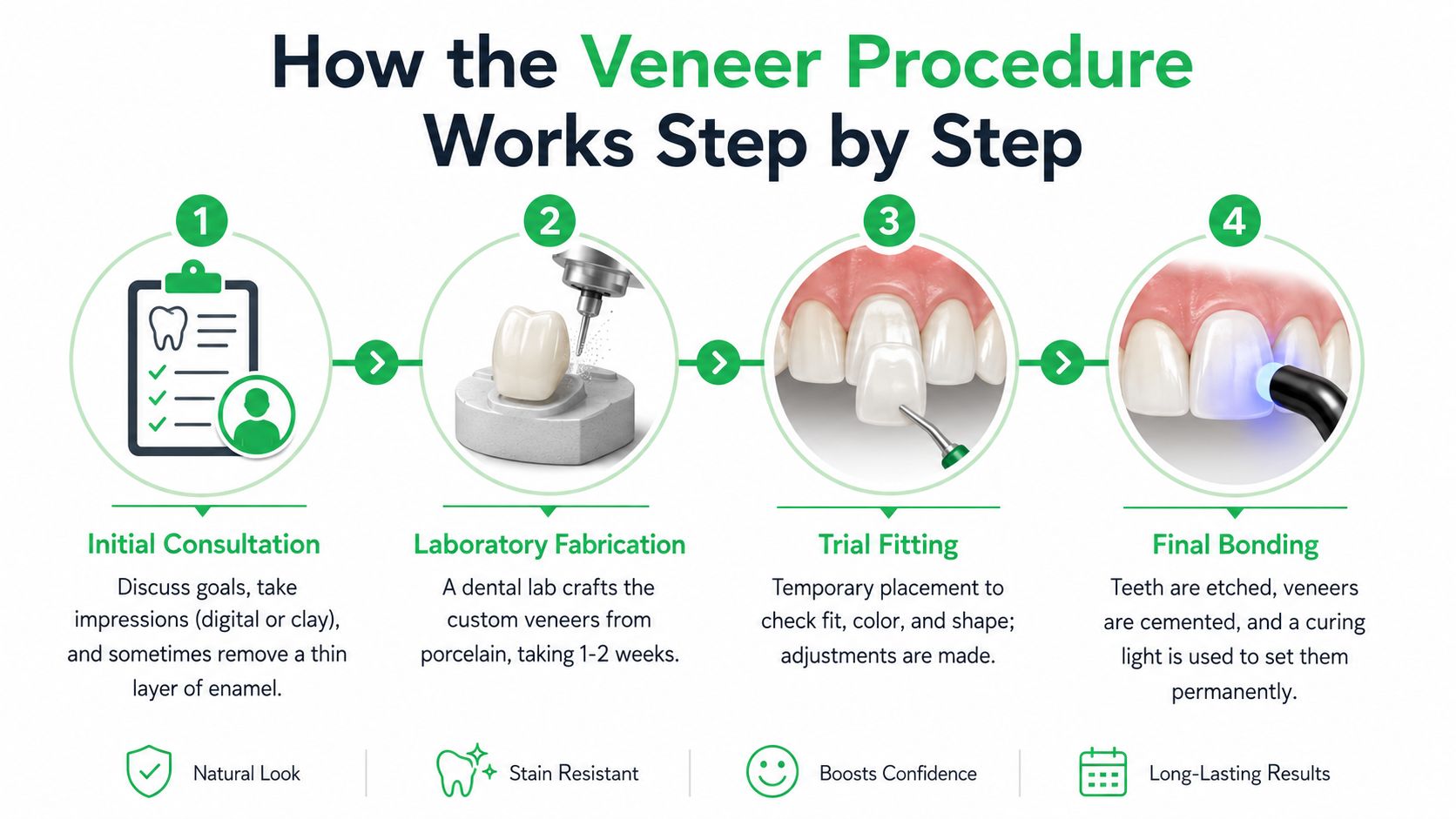
The first appointment is usually the planning visit. The dentist talks through your goals, checks your bite and tooth health, and records impressions or scans so the shape can be designed accurately. The work is about fit as much as appearance, because a veneer that looks right but doesn't meet the bite properly won't last well.
From planning to bonding
For porcelain cases, the tooth is usually prepared by removing a thin layer of enamel so the veneer can sit flush instead of making the tooth look bulky. Then the lab fabricates the custom veneer, matching shape and shade to the information the dentist sends. An internal workflow overview is described in this step-by-step resource from All Stars Dental's veneer process guide.
At the bonding visit, the tooth is isolated, treated with adhesive steps, and the veneer is cemented into place. The dentist checks the bite carefully, because a tiny high spot can make a veneer feel off even if it looks perfect. In normal recovery, teeth may feel a little strange at first, and mild sensitivity can happen, but sharp pain or bite pain deserves a call to the office.
The YouTube overview below is helpful if you want to see the sequence in motion.
What patients usually notice after placement
The first thing many people notice is the bite. It can feel unfamiliar for a day or two even when everything is adjusted correctly. Then the eyes adjust to the new shape, and the smile starts to feel like it belongs to the face rather than sitting on it.
If the veneer feels rough, high, or increasingly sensitive, that's not something to ignore. Small adjustments are easier early, before the tooth or gum tissues adapt in the wrong way.
Veneers vs Other Cosmetic Options
A lot of people who start with veneers are really asking a narrower question: which treatment fixes my concern without doing more than necessary? That is the right place to begin. Veneers can solve a lot of smile concerns, but they are not the right tool for every problem.
If the issue is mainly surface staining, whitening is usually the simpler first step. Whitening changes the color of natural enamel, while veneers replace the visible front surface. So if the teeth are healthy and the main complaint is yellowing, dullness, or uneven shade, whitening often makes more sense before any restorative treatment.
Matching the problem to the tool
A small chip or minor edge change often points to bonding. Composite bonding usually removes less tooth structure and is easier to repair later than a veneer, which makes it a practical choice for small defects. If the tooth is heavily restored, cracked, or structurally weak, a crown may fit better because it covers the entire tooth instead of just the front. For patients who want a closer look at that decision, how veneers compare to crowns in Houston helps explain why the larger restoration is sometimes the safer call.
Orthodontics also belongs in the discussion. If the problem is tooth position, crowded teeth, or a bite that does not line up well, moving the teeth may solve more than hiding the front surfaces. Veneers can make front teeth look straighter, but they do not straighten teeth or correct a bite problem.
| Option | Best for | What it changes | Why patients choose it |
|---|---|---|---|
| Veneers | Chips, shape, length, permanent discoloration | Front surface appearance | Durable cosmetic redesign |
| Whitening | Surface stains and yellowing | Natural tooth color | Least invasive color change |
| Bonding | Small chips, gaps, minor reshaping | Localized front surface detail | Fast, conservative fix |
| Crowns | Damaged or heavily restored teeth | Full tooth coverage | More structural support |
| Orthodontics | Crooked teeth, spacing, bite issues | Tooth position | Functional correction |
A simple example helps. One dark front tooth may need whitening for the neighboring teeth, then a veneer or bonding on the tooth that does not brighten well. Crowded teeth may need aligners first, then a small amount of cosmetic finishing. A chipped edge may only need bonding.
All Stars Dental lists porcelain veneers and cosmetic bonding among its services, which fits the way these choices are often made in real treatment planning. The useful question is not which option sounds most impressive, it is which one solves the problem with the least unnecessary work.
Pros and Cons of Choosing Veneers
Veneers have a polished reputation, and some of it is deserved. They can create a highly coordinated smile when several front teeth need the same kind of improvement, and porcelain gives a stable, custom shade that tends to look consistent in different light. They also preserve more tooth than a crown does in many cases, which is a meaningful advantage when the tooth underneath is healthy.
But the trade-offs are real. Once enamel is reduced, that tooth is committed to some form of restoration going forward. Veneers aren't a temporary cosmetic accessory you can remove later without consequences, and that should be part of the decision from the beginning.
What veneers can't do
A veneer can change how a tooth looks, but it can't perform every correction people hope for. It won't straighten teeth in the orthodontic sense, and it can't solve a bite problem by itself. It also may not fully hide very dark underlying discoloration in every case, especially when the dentist is trying to keep the result natural rather than opaque.
Habits matter too. Nighttime grinding, chewing ice, using teeth to open packages, or skipping a protective night guard can shorten veneer life. Gum recession can also change how the margins look over time, even when the veneer itself is intact.
Veneers are best when the tooth is healthy enough to support a cosmetic shell and the patient accepts that maintenance still matters.
The strongest candidates understand that a veneer is a restoration with a service life, not a forever cosmetic fix. That mindset leads to better satisfaction because the patient is choosing the treatment for the right reasons. People who want an instant answer to a deeper issue often end up disappointed, even if the dentistry is technically excellent.
Who Makes a Good Veneer Candidate
A good candidate usually has healthy enamel, stable gums, and a bite that doesn't place excessive force on the front teeth. They also know what they want to change. Vague dissatisfaction is hard to treat, but a specific complaint, like a chipped corner, uneven shape, or a tooth that's been discolored for years, gives the dentist something workable.
Oral health comes first. Active gum disease, untreated decay, or weak teeth should be handled before cosmetic work starts, because veneers bond best to a stable foundation. Severe misalignment can also be a problem if the teeth need movement rather than masking.
Quick self-check
- Healthy enamel: Veneers need a reliable bonding surface, so teeth with enough sound enamel are better starting points.
- Stable bite: If the front teeth take heavy force, the veneer plan needs protection and careful design.
- Good home care: Brushing and flossing habits matter because the margin where veneer meets tooth still needs to stay clean.
- Realistic goals: The best cosmetic result often looks like a better version of your own smile, not a completely different mouth.
Emotional readiness matters too. If someone wants veneers to fix confidence, work stress, or relationship problems, the result rarely feels satisfying for long. Teeth can improve a smile, but they can't solve everything a person is carrying.
When patients are unsure, dentists usually do better by pausing than by rushing into prep. A careful consult, photos, and a bite evaluation can prevent a lot of regret later.
How Long Veneers Last and How to Care for Them
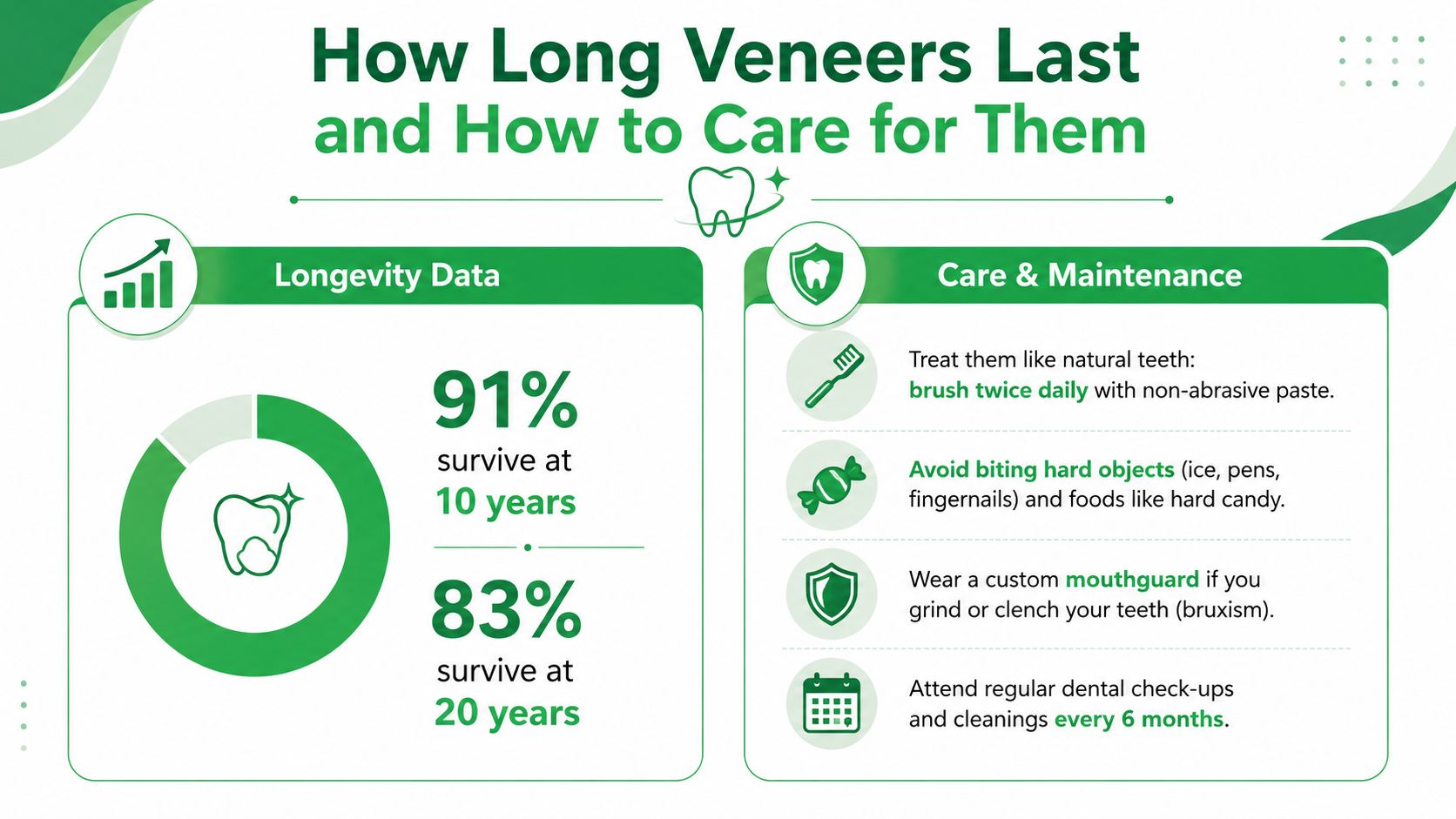
Well-made porcelain veneers can last a long time. The long-term data in the brief show 96% cumulative survival at 5 to 6 years, 93% at 10 to 11 years, 91% at 12 to 13 years, and 73% at 15 to 16 years in one prospective study of 304 porcelain veneers. Another clinical study found estimated survival of 94.4% after 5 years, 93.5% after 10 years, and 82.93% after 20 years from pubmed.ncbi.nlm.nih.gov/17695870.
What daily care actually looks like
The basics don't change because the tooth has a veneer on it. Brush twice a day with a non-abrasive toothpaste, floss carefully, and keep routine check-ups so the dentist can monitor the margins and gums. If you grind at night, a custom mouthguard is worth discussing, because bruxism increases the chance of chips and stress at the edges.
The practical guide from All Stars Dental's veneer longevity page fits the same common-sense approach, which is why it's helpful to read before deciding.
| Longevity data | Care and maintenance |
|---|---|
| Porcelain veneers showed strong survival into the second decade in the studies above. | Brush twice daily with a non-abrasive paste. |
| Long-term function depends on placement, bite, and maintenance. | Don't bite ice, pens, fingernails, or hard candy. |
| Replacement can become necessary if a veneer chips, debonds, or no longer matches nearby teeth. | Wear a custom mouthguard if you grind or clench. |
| The tooth underneath still needs regular monitoring. | Keep regular cleanings and exams. |
Replacement isn't a failure in the dramatic sense people fear. A veneer can chip, debond, or stop matching the rest of the smile as gums and nearby teeth change over time. The important thing is to treat veneers as a long-term restoration with upkeep, not a one-and-done purchase.
Questions to Ask at Your Veneer Consultation
Bring specific questions, not just “Am I a candidate?” Ask what material is being recommended and why, because the answer should connect to your bite, your goals, and how much tooth needs to be altered. Ask how much enamel will be removed, and whether the plan is conservative enough for the result you want.
Also ask whether a wax-up or digital mock-up is available. That preview helps you judge shape before anything permanent happens. You should also ask what happens if a veneer chips or fails, and how the dentist plans to protect your bite if you clench or grind.
A good consultation should leave you clearer, not more confused. You deserve a plan that explains the timeline, the number of visits, and the maintenance commitment in plain language.
If you're trying to decide whether veneers fit your smile, All Stars Dental offers porcelain veneers, cosmetic bonding, whitening, crowns, and other restorative options under one roof. If you're in Houston and want a grounded consultation about what would improve your teeth, visit All Stars Dental to start the conversation.
- How Much Do Veneers Cost? 2026 Pricing Guide
- Porcelain Veneers Houston: Your 2026 Guide to a Natural, Confident Smile
- Veneers vs. Crowns in Houston: Your Ideal Smile in 2026
- Affordable Full Mouth Reconstruction in Houston: Your 2026 Guide to Restoring Your Smile
- The Best Dental Implants of 2026: A Patient’s Guide to Quality and Longevity
- What’s a Crown in Dentistry? Your Complete 2026 Guide to Restorative Care
- Smile Makeover Houston: The 2026 Guide to Your Custom Cosmetic Transformation