
Mini Implants vs Regular Implants: Which Is Right for You
You're in the chair, the implant consultation is done, and the next question lands fast. Your dentist says you're a candidate, but now you're trying to choose between mini implants vs regular implants, and the internet has turned that into a size-and-price debate that misses a key issue. The better question is simpler and more useful, what do you need the implant to do today, and what might you need it to do years from now?
| Feature | Mini Implants | Regular Implants |
|---|---|---|
| Diameter | Under 3 mm | Greater than 3 mm |
| Design | Usually one-piece | Usually two-piece implant-plus-abutment |
| Main strength | Denture stabilization, narrow spaces, selected non-load-bearing uses | Crowns, bridges, full-arch restorations, broader prosthetic workflows |
| Restorative flexibility | More limited | More modular and adaptable |
| Surgical feel | Often less invasive | More extensive planning and placement options |
| Best framing | Specific-use tool | Broader definitive solution |
Table of Contents
- Why This Decision Matters More Than Size Alone
- How Mini Implants and Regular Implants Differ in Design
- What the Clinical Evidence Shows About Success Rates
- Surgical Experience and Patient Comfort Compared
- Matching the Right Implant Type to Your Specific Situation
- The Hidden Trade-Off Most Comparisons Overlook
- Understanding Costs and Questions to Ask Your Dentist
Why This Decision Matters More Than Size Alone
A lot of patients walk in thinking they are choosing between a “small implant” and a “normal implant.” That framing sounds harmless, but it can lead to the wrong decision if it ignores the job the implant has to do. A 70-year-old who wants to stop lower dentures from moving has a different need than someone replacing a front tooth with a crown, and those are not interchangeable problems.
The key question is function, not just diameter
Mini implants are reduced-diameter implants under 3 mm, and they are typically one-piece devices. Regular implants are usually greater than 3 mm and commonly use a two-piece design, which gives more restorative flexibility. That difference changes how the restoration is planned, what can be attached later, and how much room the dentist has to adapt if the case becomes more complex (NCBI Bookshelf).
The clinical record matters here. A 2014 systematic review treated mini-implants as a real clinical category rather than a novelty, reporting survival rates of 90.9% to 100% for mini-implants in the edentulous arch and 93.8% to 100% for narrow-diameter implants overall (PubMed). That does not make them universal replacements for regular implants. It does show that they have a place in evidence-based treatment planning.
Practical rule: choose the implant based on the prosthetic goal first, then look at diameter and surgery second.
That mindset prevents a common mistake. Patients sometimes select the smaller option because it sounds easier, then discover later that the restoration they want needs more flexibility than a one-piece implant can offer. A clearer starting point is to ask whether this is a stabilization case, a definitive tooth replacement case, or a full-arch reconstruction case. If that part is clear, the rest of the decision gets much easier.
A useful patient guide from Houston families is this implant overview for local patients, and it pairs well with the bigger decision framework here. The point is not that one size is always better. The point is that the wrong tool can look convenient at first and become limiting later.
How Mini Implants and Regular Implants Differ in Design
A mini implant and a regular implant may both replace missing teeth, but they are not built the same way. That design difference affects how I place them, what I can restore with them, and how much flexibility I have later if the treatment plan changes.
One-piece versus two-piece changes everything downstream
A one-piece mini implant combines the implant body and abutment into a single unit. That can make placement simpler and reduce the number of parts, but it also narrows the restorative choices. A two-piece regular implant separates the implant from the abutment, which gives the dentist more control over angle, component selection, and the type of restoration that can be built on top of it.
That difference matters in practical terms. If I am using an implant to stabilize a denture, a one-piece design can work very well. If the goal is a crown on a front tooth, a bridge, or a full-arch restoration that may need more prosthetic adjustment, the two-piece system gives me more room to work. Regular implants are the more adaptable platform because I can tailor the restoration to a wider range of clinical demands.
Mini Implants vs Regular Implants at a Glance
| Feature | Mini Implants | Regular Implants |
|---|---|---|
| Diameter | Under 3 mm | Greater than 3 mm |
| Typical build | One-piece | Two-piece |
| Restorative flexibility | More limited | Broader |
| Prosthetic use | Best for select narrow-space or retention cases | Better for crowns, bridges, and full-arch work |
| Surgical footprint | Often simpler | Often more involved |
| Core idea | Specific-use solution | More universal restorative platform |
The appeal of “less invasive” is real, but it only helps if the implant also fits the long-term restorative plan. A mini implant can be an excellent choice in the right case, especially when space is tight or retention is the main goal. It does not function as a universal substitute for a conventional implant, because the one-piece design limits later options in ways patients do not always expect.
That is why the one-piece versus two-piece distinction is not a technical detail. It is the design feature that explains most of the practical trade-offs, including how much flexibility you have if the restoration needs to change later.
What the Clinical Evidence Shows About Success Rates
Patients usually want a straight answer here, and the honest answer is more nuanced than a simple winner and loser. Mini implants can perform very well in selected applications, especially overdenture retention, but the evidence does not support treating them as identical to regular implants across every use case.
The numbers depend on the application
A 2014 systematic review reported 90.9% to 100% survival for mini-implants in the edentulous arch and 93.8% to 100% for narrow-diameter implants overall. It also found no statistically significant difference in survival for narrow-diameter implants (3.3 to 3.5 mm) versus conventional implants, with an odds ratio of 1.16 and 95% CI 0.7 to 1.69 (PubMed). That is encouraging, but it applies best to carefully selected cases rather than every implant situation.
A randomized mandibular overdenture study reported implant survival of 89% with 4 mini-implants, 82% with 2 mini-implants, and 99% with 2 standard implants, while oral-health-related quality of life and satisfaction were still at least comparable across groups (PubMed). In a real treatment discussion, that matters. A patient may still feel well served by mini implants if the main goal is denture retention and the anatomy is tight, even when survival is not identical to standard implants in every trial.
The same comparative body of evidence also reported a recent study with 95.8% success for mini-implants versus 94.0% for regular implants, plus lower anchoring loss and higher stability scores for the mini-implant group (PubMed). A 2022 review also reported fewer maintenance problems with mini-implants, including abutment adjustments, replacement of retentive elements, occlusal adjustment, and overdenture fracture (PubMed). Those findings are useful, but they do not erase the design limits that shape future restorative choices.
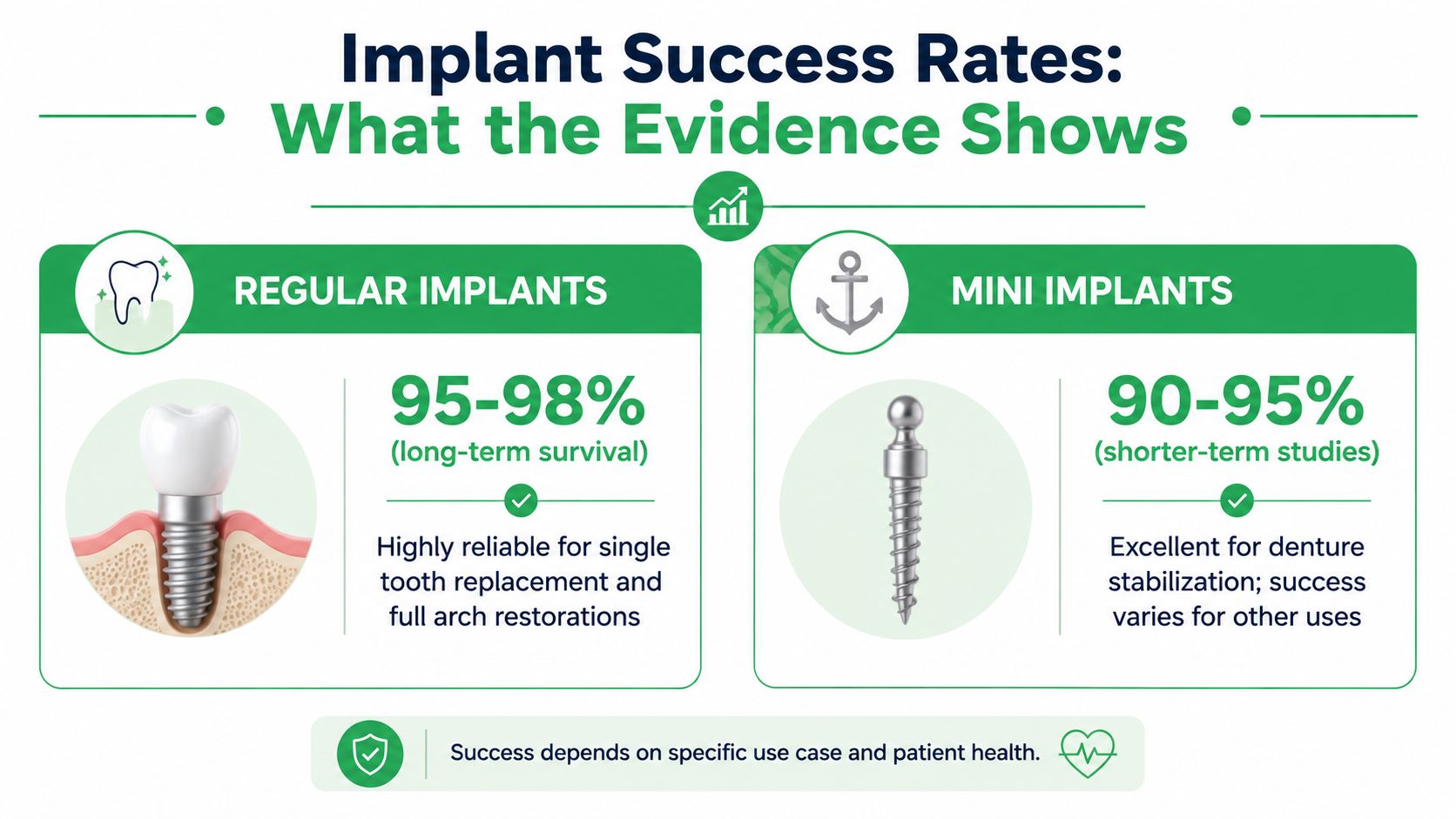
The clean takeaway is not that one option wins every study. It is that mini implants have strong evidence in selected roles, especially denture stabilization, while regular implants remain the safer default for broader definitive use. That distinction matters because mini implants are best understood as a specific-use tool, not a cheaper universal substitute.
Surgical Experience and Patient Comfort Compared
A patient usually notices the procedural difference right away. Mini implants are often placed with a lighter surgical footprint, while regular implants usually call for more planning around bone volume, restorative space, and the long-term prosthetic design that will sit on top of them.
Comfort is not the same as versatility
Orthodontic anchorage research found that mini-implants produced significantly less patient pain and less anchoring loss than standard implants, while maintaining comparable space-closure performance and comparable success rates. The same study also reported greater implant stability for mini-implants in that application (PMC). That is a narrow clinical setting, but it still points to a practical lesson. Mini implants can be a very good fit when the main goal is anchorage or stabilization rather than broad restorative flexibility.
Clinical reality: easier placement does not automatically mean better long-term replacement options.
Regular implants can require more involved surgery because they are designed for a wider range of restorations. In some cases, that means bone grafting or more detailed site preparation may be part of the plan. Mini implants may sometimes fit narrower ridges without that extra step. The trade-off is straightforward. You may gain simplicity at the front end, but you give up some prosthetic options later.
What patients usually feel
Patients often describe mini implant placement as simpler because the system is smaller and the treatment can be more efficient. The comfort difference is real for many cases, especially when the goal is quick stabilization. Comfort still should not be the only criterion. A case that feels easier on day one can become frustrating if the implant cannot support the restoration you need later.
A guideline review on implant therapy also emphasizes that treatment choice should match the prosthetic goal and the available anatomy, since the surgical approach and the final restoration are tied together from the start (PMC). That is the practical point patients usually need to hear. Mini implants are attractive when reduced invasiveness and faster functional support matter most. Regular implants are the better fit when the priority is a restoration that can handle wider demands over time. If the case is temporary or transitional, that comfort difference may matter a lot. If the case is definitive, the bigger question is whether the system can do the full job without limiting the options you may need later.
Matching the Right Implant Type to Your Specific Situation
The right choice becomes clearer once the question changes from which implant is “better” to which implant fits the problem in front of you. The answer depends on the clinical goal, the available anatomy, and how much flexibility the final restoration needs.
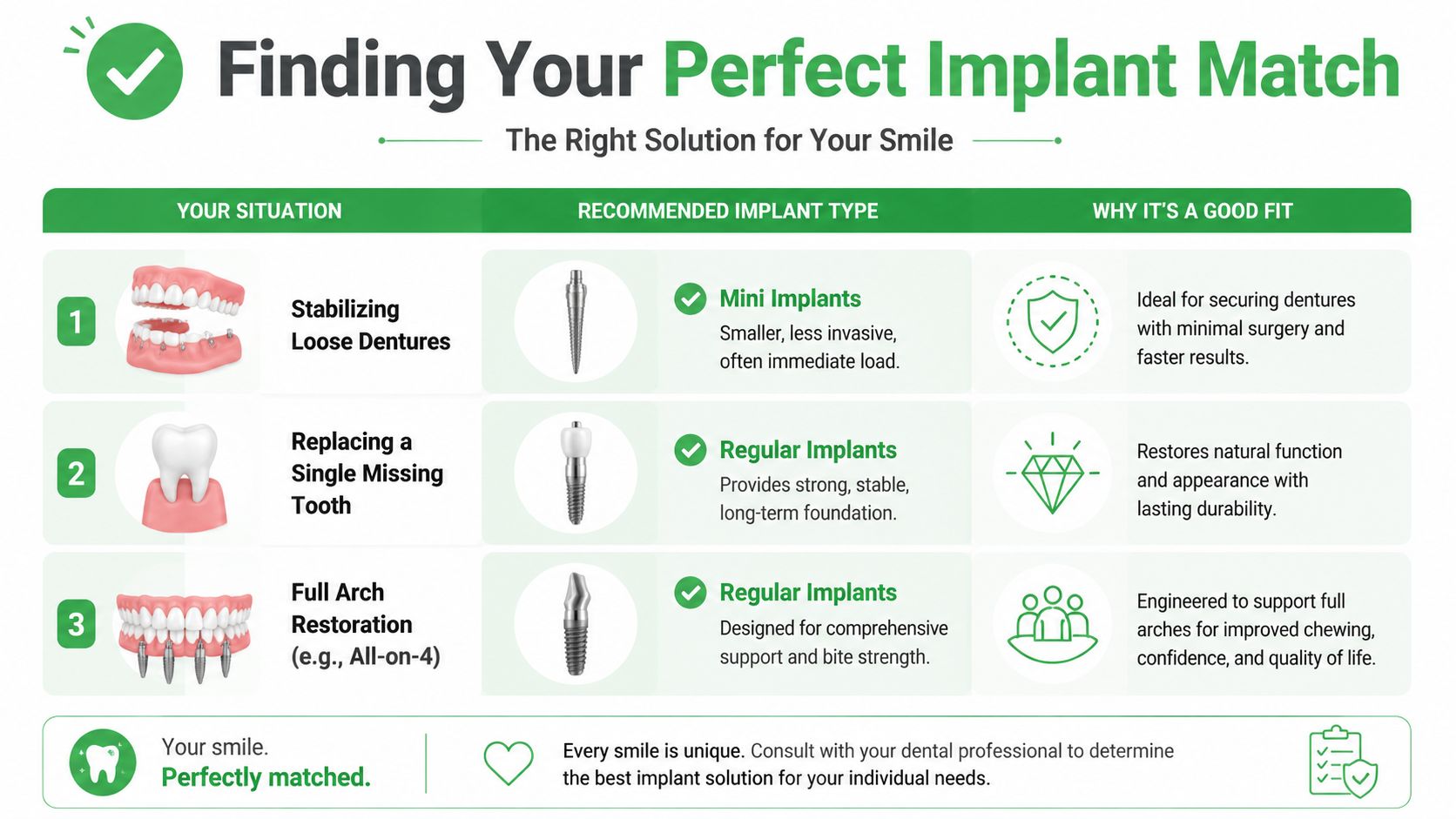
Denture stabilization
Mini implants have their clearest role here. They are often a strong fit for loose lower dentures because they can improve retention with a less invasive approach, and the clinical literature has supported that use case. For many patients, that means a denture that feels steadier without moving immediately into a more complex restorative plan.
Single-tooth replacement and broader load-bearing cases
Regular implants usually make more sense when one tooth needs a crown or when the restoration will face greater bite demands. The difference is not only strength, it is also prosthetic flexibility. A two-piece system gives more room to adjust the restoration shape, angle, and emergence profile, which matters when the final result has to be refined more precisely.
Narrow ridges and transitional solutions
Mini implants can be a practical option when bone width is limited and the goal is to avoid grafting or create a transitional solution. They may also suit a patient who wants a faster return to function and accepts a more limited setup. Bone support still has to be respected, and the planning has to match the load the implant will carry. For a fuller discussion of that point, this guide on bone support and implant success is a useful companion read.
The question is whether the implant solves the immediate functional problem without boxing in the restorative plan later.
The question is not “Can a mini implant work?” It is “Can it work for the specific load, prosthesis, and timeline this mouth actually needs?”
Patients who need a full-arch restoration should usually favor the system with the most prosthetic flexibility, while patients trying to stabilize dentures or manage a narrower ridge may need a very different conversation. That is the heart of good treatment planning.
The Hidden Trade-Off Most Comparisons Overlook
A patient sitting across from me often hears mini implants described as the cheaper version of regular implants. That framing misses the actual decision. Mini implants are usually a different tool for a different job, and their one-piece design sets a definite limit on how much the restoration can be adjusted later.
The issue is what happens if your needs change
A two-piece regular implant gives more freedom when the restoration needs to be modified. The crown, abutment, and final prosthesis can often be adjusted in ways that are not available with a one-piece mini implant. If the bite changes, if the prosthesis has to be rebuilt, or if the treatment plan grows beyond the original goal, a regular implant system usually gives the dentist more room to work.
That matters because implant treatment is not just about the first visit or the first restoration. Patients live with these choices through chewing, cleaning, maintenance, and the occasional repair. A plan that feels less expensive at the start can become harder to live with if the prosthesis needs to be replaced or expanded and the implant platform does not support that change well.
Temporary value versus definitive value
Mini implants can be a strong choice for a transitional phase, especially when the goal is to avoid grafting or get back to function sooner. That use case is real, and in the right mouth it can be the right answer. Transitional care and definitive care, however, are different goals. If the end point is a durable single-tooth replacement or a broader load-bearing restoration, regular implants still have the stronger support base in the literature and in day-to-day practice.
Bottom line: mini implants can save steps now, but they can also limit choices later.
That is why I tell patients to look past the first restoration and ask what happens if the crown breaks, the denture design changes, or the bite needs to be rebalanced. A one-piece mini implant may handle the immediate job well, yet leave fewer options if the plan changes. A two-piece regular implant often gives more room to revise the prosthesis without starting over. The better choice is the one that fits the anatomy in front of you and still leaves enough flexibility for the treatment changes that may come later.
Understanding Costs and Questions to Ask Your Dentist
Cost matters, but it only helps when you know what drives the number. Mini implants often have a lower upfront burden because the surgery is simpler and there are fewer components. Regular implants usually cost more at the start because they involve more materials, more steps, and often a broader restorative workflow.
Think in terms of total treatment value
A lower initial number does not automatically mean the better value. If a mini implant needs more frequent maintenance, offers less flexibility, or cannot support a future change in the restoration, the total value can shift quickly. Regular implants may ask for a larger first investment, but they often buy more prosthetic freedom and more room to revise the final restoration later.
For a cost-focused local reference, this Houston implant pricing guide is useful background, especially if you are comparing a single-tooth case. The same principle applies to both systems. Ask what is included, what may change, and what happens if the plan has to be revised later.
The design matters here too. A one-piece mini implant can be a practical solution for a narrow, simple situation, but it gives you fewer restorative options if the bite changes, the crown fails, or the plan needs to expand. A two-piece regular implant usually gives more flexibility for future prosthetic work, which is why it often makes more sense when the case may need long-term adjustments.
Questions to bring to your consultation
- What is the full treatment plan? Ask whether the goal is stabilization, a single crown, or a more complete restoration.
- How does my bone shape affect the choice? Thin ridges can change the discussion a lot.
- What are the maintenance expectations? A simple answer now can save frustration later.
- If this implant needs replacement, what happens next? Ask how the design affects repair, replacement, and future restorative options.
All Stars Dental explains fees before treatment begins, which is the kind of transparency patients should expect anywhere. That is the right standard, because implant care should not feel like a guessing game.
A good consultation should leave you with a clear answer on whether mini implants fit a specific-use job or whether a regular implant gives you better long-term flexibility. That is the fundamental question behind the price.
- How Long for Implant to Heal Before Crown: A Houston Guide
- Root Canal vs Extraction: Houston Patient Guide
- Affordable Full Mouth Reconstruction in Houston: Your 2026 Guide to Restoring Your Smile
- The Best Dental Implants of 2026: A Patient’s Guide to Quality and Longevity
- Dental Implant vs. Bridge: A Comprehensive 2026 Guide to Restoring Your Smile
- Dental Implant Restorations in Houston: Completing Your Smile with Dr. Tran
- Dental Implant Specialist Houston: A Comprehensive 2026 Guide to the Procedure